Monstera Care (Monstera deliciosa)

Also known as: Monstera, Mexican Breadfruit, Windowleaf Philodendron, Fruit salad plant, Delicious Monster, Ceriman, tarovine

About Monstera

Monstera deliciosa is a tropical evergreen plant that grows perfectly indoors and outdoors. You’ll also find it under other names, like Swiss cheese plant or fruit salad plant, as this species can provide a harvest, but only if conditions are as close to natural as possible. Originally from the tropical regions, it has become widely cultivated in the USA, Europe, Australia, and Latin America thanks to its high adaptability.

This perennial houseplant can climb to a somewhat impressive 70 inches, but in indoor conditions, owners usually expect a range of 30-50 or even 6-8 inches. Mature Monstera produces flowers, and these blooms may develop into an edible fruit with a banana- or pineapple flavor. However, flowering and fruiting are uncommon, as conditions rarely match the plant’s natural habitat.

That’s interesting: In some regions, the fruit is eaten fresh, added to salads, or blended into smoothies and desserts because of its sweet flavor.


Main Plant Requirements

Care Difficulty

Easy Care

Light Preference

Bright Indirect Light

Water Requirements

Moderate Water

Temperature Preference

Tropical / Frost Sensitive

Hardiness Zone

10–12

Soil Texture

Loamy, Peaty, Organic-rich

Soil pH

Acidic (5.5–6.5), Slightly acidic (6.5–7.0)

Soil Drainage

Moist but well-drained

Fertilization

Moderate (every 2–4 weeks)

Get Personalized Care Plan

Scan your plant to receive care tips personalized for your specific plant

Personalized Care in the App

Available on iOS and Android

How to Care for the Monstera

This Mexican breadfruit doesn’t like direct sunlight and prefers gentle conditions with partial shade.

  • Ideally, provide 3-6 hours of bright but indirect light every day. Just put the pot next to an east- or south-facing window
  • Remember that aggressive sunlight after 01:00 PM can scorch the leaves of Monstera and cause pale or crispy patches, so it is better to use curtains

Rotate your Monstera deliciosa regularly: since it naturally leans toward the light, turning the pot helps maintain an even shape and prevents it from becoming

In nature, Monstera thrives in humid environments and can not store water like cacti, so provide consistent moisture to support its foliage and overall well-being.

  •  Water when the top 2-5 cm (0.79–1.97 inches) of soil feels dry, every 7-10 days under active growth conditions
  • Reduce watering in autumn and winter to once every 2 weeks or whenever the soil is dry 2.5 cm (1 inch)

Note that tap water contains chlorine and fluoride, so allow water to sit out for 24 hours or use filtered water

Although it is a tropical plant, don’t underestimate it: Monstera deliciosa can tolerate temperatures down to 50°F (10°C) and up to 90°F (32°C), but will stop growing at these extremes.

  • Optimal temperatures for this plant are 65-85°F (18-29°C) for steady growth, as this range matches the plant’s natural tropical environment
  • It grows best in temperatures above 68°F (20°C), while winter conditions should remain above 45°F (5°C)
  • Remember that sudden temperature shifts and dry air cause stress to the leaves and the plant in general

Note: If temperatures drop below 34°F (1°C), the leaves may appear paler.

Tropics are full of humidity, so Monstera likes it and grows perfectly in such conditions.

  • The optimal humidity indicator is 60-70%, but the plant can also tolerate dry conditions like 40-50%
  • Avoid placing your Swiss cheese plant next to air conditioning, fans, or vents, as they will dry the air and damage the leaves
  • Increase humidity with misting or using a humidifier in the spring and summer

Choose loose, nutrient-rich soil that retains moisture while allowing excess water to drain.

  • Avoid heavy, compacted soil mixes for your Monstera plant, as they restrict airflow around the roots and can lead to rot
  • Slightly acidic to neutral conditions support nutrient uptake and steady development
  • Use a potting soil mix with added bark, perlite, or coco coir

Note: windowleaf philodendron likes slightly acidic to neutral soil, with an ideal pH range between 5.5 and 7.5.

For big plants, big pots are needed. If your Monstera is young, choose light plastic containers to keep the soil moist, but replace them with ceramic or terracotta pots over time.

  • Choose a sturdy container about 1-2 (2,5-5 cm) inches wider than the current plant root ball, with big drainage holes
  • Avoid containers without drainage, as stagnant water can quickly lead to root damage and decay

Choose a pot for Monstera at least 10-12 inches (25-30 cm) deep to support vertical growth with stakes

Monstera deliciosa is sensitive to excess mineral buildup in the soil, so overly strong fertilizers can cause damage, but it responds well to consistent feeding when actively growing.

  • Apply a balanced liquid fertilizer (10-10-10 or 20-20-20) every 2-4 weeks during spring and summer
  • Use fertilizer at half strength to avoid salt buildup and root damage
  • Reduce feeding to once every 6-8 weeks or stop completely during fall and winter

Note: Choose plant fertilizers that include micronutrients; liquid formulas are easier to distribute evenly in the soil.

Ceriman pruning is needed to manage size and keep a controlled shape, and, usually, this process is made during the active period of growth.

  • Carefully remove yellow, damaged, or overcrowded leaves
  • Cut stems just above a node
  • Use clean, sharp tools to prevent infection

A practical way to size a pot for Monstera deliciosa is to match it to the spread of its largest leaf: for example, if the widest leaf is about 8 inches, select a container of 7-9 inches.

  • Repot the plant every 1-2 years or when roots emerge from holes
  • In the early spring, gently loosen compacted roots and try to avoid damaging healthy roots
  • Water lightly after repotting, and set a stake for the stem to climb on

There are two main ways to propagate your houseplant: through stem cuttings that include at least one node, or Monstera propagation with air layering:

Stem Cuttings Propagation

  • In spring or early summer, place the cutting in water or a light, moist substrate, with temperatures around 70-80°F (21-27°C)
  • Make sure the node is positioned below the water line or nestled into the soil, as this is the area where new roots will form
  • Refresh the water every 3-5 days, using filtered or rainwater instead of tap water. After 2-3 weeks, a cluster of roots will begin to form. After this, transfer it into fresh soil and keep it slightly moist

Air Layering Propagation 

  • Select a healthy stem section with several nodes, or a leaf attached to a short aerial root
  • Make a shallow cut just below the node, then surround that area with a layer of moist sphagnum moss and wrap it with plastic to keep humidity

Keep the moss consistently damp while Monstera’s roots develop, and once a strong root system forms, cut below the rooted section and transfer it into fresh soil.

As winter arrives, shorter days give less sunlight, and cooler temperatures slow down a Monstera’s growth. To prevent the plant's stress and damage, follow the simple guide:

  • Keep temperatures above 50-75°F (16-24°C), as these plants can't live below 50ºF (10°C)
  • Maintain humidity above 40-50%, using a humidifier
  • Allow the top inch (ca. 2,5 cm) of soil to dry before watering the plant

Monstera deliciosa is not just one plant: there exist 59 species in its genus. As a rule, they have similar traits, but those with exaggerated fenestrations, with holes and splits, are more expensive, as they’re more demanding in care. Below, you’ll find the Monstera loved by gardeners the most:

  • Monstera Albo: An expensive white-colored type that looks really exotic;
  • Monstera Obliqua: Rare plant with huge holes and splits;
  • Monstera Acacoyaguensis: Its leaves are perforate when they become mature;
  • Monstera Dubia: Also known as “shingle,” as it has a grey-green color and can be confused with a stone from afar;
  • Monstera Adansonii: This light-green type comes from America, but is called the Swiss plant, and has beautiful, big holes;
  • Monstera Peru and Thai Constellation: Both types are related to Monstera deliciosa, with large oval leaves.

Monstera plants are relatively easy to care for despite their exotic look: they thrive in indirect light and moderate watering. They can also climb supports or spread outward, so people often use them in creative designs for homes and offices.

Care Tips

Group Plants Together

Group Plants Together

Plants naturally release moisture into the air, so placing several together raises local humidity levels. You can group several Monstera plants or combine them with other tropical species that have similar preferences. At the same time, do not place them too close together. Limited airflow may create conditions that encourage pests and fungal issues.

Use a Pebble-Tray

Use a Pebble-Tray

Fill a shallow tray with small stones, then add water so it sits just below the top layer. Place the pot on the stones without letting the base touch the water. Check the tray regularly and refill it when needed. If you use decorative pebbles for Monstera’s pot, it’s a good way to make your design more interesting and creative.

Mist Monstera With Water

Mist Monstera With Water

Use a fine, even spray so the droplets settle on the leaves without pooling. Apply a light mist, but don't soak the foliage. Morning is the best time for this, since cooler air allows moisture to linger. Don't mist Monstera deliciosa in the evening, as prolonged moisture on the foliage can encourage fungal issues. Finally, adjust the frequency based on the dryness in your space to prevent excessive moisture buildup.

Humidifier is Your Assistant

Humidifier is Your Assistant

Aim to keep levels within a balanced range of about 40-60%, but don't let the air become overly damp. Position the humidifier close enough to your Monstera, but not directly beside it. Maintain the device by cleaning it regularly and refilling it with distilled water to prevent mineral buildup.

Common Pests and Diseases

Browning Leaves

Browning Leaves

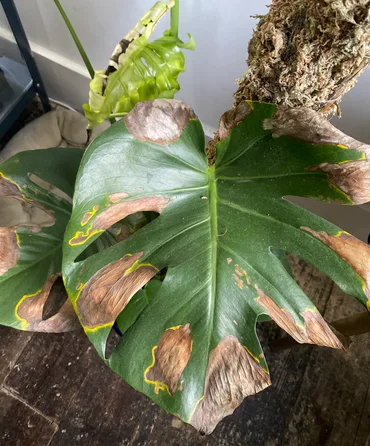
Dark brown spots edged with yellow can signal bacterial leaf spot, especially when the markings appear uniform and may produce a slightly sticky residue. This issue with the Monstera plant often spreads in humid, crowded conditions, so avoid low temperatures and keep foliage dry to prevent it.

Solution

Remove affected foliage, and allow the soil to dry before the next watering. Adjusting moisture levels will restore balance in the future, so keep it under control.

Black-Colored Spots on Leaves

Black-Colored Spots on Leaves

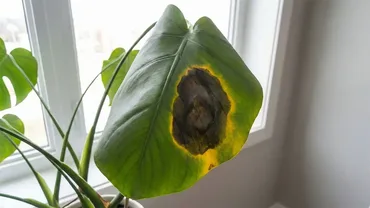
Dry, powdery spots on Monstera often point to a fungal infection, while dark areas that appear wet or slightly sticky are more likely caused by bacteria.

Solution

Trim off any affected leaves and disinfect your tools afterward. Poor airflow and excessive humidity can worsen the situation, so improve ventilation. Last, apply neem oil to the remaining foliage.

Yellowing Leaves

Yellowing Leaves

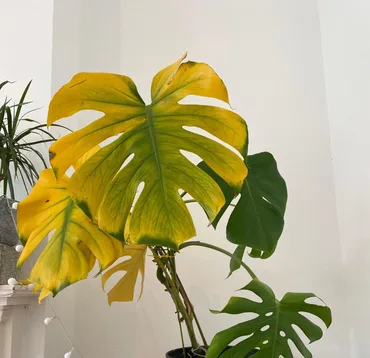
Yellowing leaves may indicate several underlying issues; for example, overwatering, poor drainage, or nutrient deficiencies. Sudden temperature changes or drafts can also cause yellowing. When they appear consistently, they can point to stress or disease rather than natural aging.

Solution

Make sure excess water drains freely, and consider providing balanced nutrients. If Monstera yellowing continues, inspect the roots for signs of decay.

Interesting Facts

Name Confusing

Monstera deliciosa is often mistakenly referred to as split-leaf philodendron or Philodendron pertusum. These names are outdated since 2018 and no longer officially recognized. They are now treated as synonyms, with Monstera deliciosa being the correct and accepted botanical name.

Aerial Roots in Everyday Life

In parts of Peru, the plant’s aerial roots have been traditionally used as natural cordage, while in Mexico they have been woven into baskets. In Martinique, Monstera’s roots are also incorporated into folk remedies for snakebites, and in Mexico, they have been used in traditional practices to ease arthritis-related symptoms.

Dangerous Beauty

Every part of the Monstera plant contains calcium oxalate crystals, which can trigger immediate irritation if chewed or ingested. Contact with these crystals may cause a burning sensation along with swelling of the lips, mouth, tongue, and throat. Sometimes, it leads to excessive salivation and difficulty breathing, swallowing, or speaking. The fruit is edible when fully ripe, but it can still occasionally provoke a temporary itchy rash or hives.

FAQs about Monstera

Leaves curl due to stress, most often from underwatering, low humidity, or excessive direct sunlight. Cold drafts and root problems can also be a reason. When moisture levels drop or conditions become too harsh, the plant curls its leaves to reduce water loss and protect itself.

Grow Healthy Plants with Botan Care

Keep your plants happy and healthy with plant identification, disease detection, and easy care guidance.

Botan plant care app — identify plants on mobile

Explore More Plants