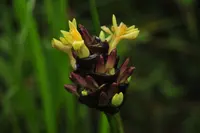
Queen's tears Care (Billbergia nutans)

Also known as: Angel's Tears

About Queen's tears

Queen's tears (Billbergia nutans) is a compact epiphytic bromeliad, often grown as a houseplant for its arching rosettes and graceful, fountain-like habit. It usually forms narrow, strap-shaped leaves with small serrations along the edges, creating a vase that can hold water at the center. In its native habitats of Brazil, Uruguay, and Argentina, it grows on trees or rocky outcrops in bright, filtered light and humid air. The plant is considered relatively easy to grow and adapts well to indoor conditions if given good drainage and protection from cold. To care for Queen's tears, provide bright indirect light, a fast-draining mix, and moderate, consistent moisture without waterlogging the roots.

Main Plant Requirements

Care Difficulty

Easy Care

Light Preference

Bright Indirect Light

Water Requirements

Moderate Water

Temperature Preference

Tropical / Frost Sensitive

Hardiness Zone

9–11

Soil Texture

Sandy, Loamy, Organic-rich

Soil pH

Acidic (5.5–6.5), Slightly acidic (6.5–7.0)

Soil Drainage

Well-drained

Fertilization

Light (every 4–6 weeks)

Get Personalized Care Plan

Scan your plant to receive care tips personalized for your specific plant

Personalized Care in the App

Available on iOS and Android

How to Care for the Queen's tears

Billbergia nutans needs bright, indirect light to flower and maintain compact growth.

  • Provide 4–6 hours of bright, filtered light daily, such as dappled shade under taller plants or sheer-curtained windows for Queen's tears.
  • Allow gentle morning sun but protect from harsh midday and afternoon sun, which can scorch leaves and cause bleaching or brown patches.
  • In summer, shift plants to slightly shadier spots if foliage pales; in winter, move to brighter positions to compensate for short, low-intensity days.

This bromeliad prefers moderately moist conditions with brief drying at the surface between waterings.

  • Water when the top 2–3 cm of soil feels dry, then soak thoroughly and let excess drain away to prevent root and base rot.
  • In active growth and warm weather, check moisture more often; in cooler months, reduce watering frequency as evaporation and uptake slow.
  • Keep the central cup lightly filled with fresh water but flush weekly to avoid stagnation, and watch for limp, curling leaves as a sign of underwatering.

This species grows best in warm, frost-free conditions that mimic its subtropical origin.

  • Aim for 65–80°F (18–27°C) for steady growth, with slightly cooler nights improving color and flower initiation.
  • Protect Billbergia nutans from temperatures below 40°F (4°C); brief dips may be tolerated, but frost can damage foliage and kill the growing point.
  • During hot spells above 90°F (32°C), increase shade and airflow, and avoid placing plants near heat-reflective surfaces that can overheat leaves.

This bromeliad prefers moderately humid air but adapts to typical indoor conditions.

  • Aim for 40–60% humidity to support steady growth and flowering of Queen's tears.
  • It tolerates short periods of drier air, but very dry rooms may slow growth and crisp leaf tips.
  • Low humidity stress shows as browning leaf edges and tight leaf rosettes; increase humidity with a nearby tray of water and pebbles or a room humidifier.

This species needs a very airy, fast-draining mix that mimics epiphytic conditions.

  • Use a loose, organic-rich mix such as 50% fine orchid bark, 25% perlite, and 25% peat or coco coir to keep roots aerated.
  • Ensure rapid drainage; water should run through in seconds, leaving the mix lightly moist but never soggy.
  • Slightly acidic to neutral pH around 5.5–7 suits Billbergia nutans and helps nutrient uptake without salt buildup.
  • Avoid heavy, compacted garden soil; if a mix feels dense or stays wet for days, lighten it with extra bark and perlite.

This bromeliad is well suited to container growing due to its compact, clumping habit.

  • Choose a shallow, wide pot so the narrow root system anchors offsets without sitting in deep wet substrate.
  • Select a heavier pot material like ceramic or clay to stabilize the tall foliage spikes and prevent tipping.
  • Fill the pot so the leaf bases sit slightly above the rim, minimizing water pooling around the rosette during overhead watering.

Billbergia nutans benefits from modest feeding to support flowering and healthy foliage.

  • Use a balanced water-soluble fertilizer (around 10-10-10 or 20-20-20) diluted to 1/4–1/2 strength for caring for Queen's tears.
  • Feed every 4–6 weeks during the warm growing season when the plant is actively producing leaves and pups.
  • Flush the pot with plain water occasionally to reduce salt buildup from fertilizer residues.
  • Stop or greatly reduce feeding in late fall and winter when growth slows.

Pruning Billbergia nutans focuses on removing spent growth rather than reshaping the plant.

  • Cut off finished flower spikes at the base once blooms fade to redirect energy to pups.
  • Remove dead, yellowing, or damaged leaves at any time using clean, sharp scissors or pruners.
  • Thin out very crowded rosettes after flowering to improve air flow and light penetration.
  • Avoid heavy cutting into healthy rosettes, as this can reduce future flowering and weaken the clump.

This bromeliad prefers to be somewhat root-bound and needs repotting only occasionally.

  • Repot when roots circle the container surface, growth stalls, or the clump becomes top-heavy and unstable.
  • Plan repotting for spring or early summer, about every 3–4 years, when active growth helps recovery.
  • Use a small pot only 2–3 cm wider with a coarse, fast-draining mix to keep roots aerated.
  • Handle the root ball gently, keep the central rosettes above the soil line, and water lightly for a few days to limit stress.

Propagation of this species is commonly done by separating pups rather than from seed.

  • Divide offsets (pups) once they reach about 1/3–1/2 the size of the mother rosette, usually in spring or early summer.
  • Gently detach pups with a clean knife if needed, keeping a small portion of root tissue attached.
  • Plant pups in a coarse, free-draining mix, keeping the central cup above the soil surface.
  • Provide bright, indirect light, 65–80°F temperatures, and slightly moist soil until new growth confirms establishment.

This plant is frost-sensitive and needs protection in regions with cold winters.

  • In zones colder than 9–10, grow Billbergia nutans in containers and move indoors before temperatures drop below 40°F.
  • Indoors, place in bright, indirect light with temperatures ideally above 55–60°F.
  • Reduce watering in winter, keeping the mix slightly dry while avoiding complete desiccation.
  • In mild climates, add a light mulch around outdoor clumps to buffer brief cool snaps without covering the rosettes.

Care Tips

Use Heavy Cachepot

Place the nursery pot inside a heavier ceramic cachepot or weighted outer pot to counterbalance the narrow base and arching leaves, reducing the risk of the plant tipping over as the rosettes elongate and bloom.

Offset Management

After flowering, cut back old, drained rosettes at the base and leave only 2–4 of the strongest offsets so the plant allocates energy to robust new growth instead of supporting a crowded clump.

Basket Display Setup

For a hanging basket, plant several offsets around the rim rather than in the center and allow them to lean outward, which shows off the arching flower spikes and makes routine tasks like caring for Queen's tears easier.

Flush The Tank

Every 2–4 weeks, pour room-temperature water through the central cups until it overflows and drains out of the pot to wash away dust, algae, and mineral buildup that can irritate the leaf bases.

Quarantine New Plants

Keep new bromeliads in a separate area for 2–3 weeks and inspect leaf bases and the central tank with a flashlight to catch scale, mealybugs, or mosquitos before placing them near established plants.

Common Pests and Diseases

Scale insects

This pest feeds on the leaves and leaf bases, often hiding in the tight rosette and along the flower stalks, causing yellowing and a sticky residue. Symptoms include slowed growth and sooty mold developing on the honeydew they excrete.

Solution

Remove visible insects with a cotton swab dipped in 70% isopropyl alcohol and rinse the rosette with lukewarm water, tipping the plant to drain trapped moisture. For heavier infestations, use an insecticidal soap or horticultural oil spray directed into leaf axils, repeating every 7–10 days while improving air movement and avoiding overfertilizing, which can encourage soft, susceptible growth.

Mealybugs

These insects form white, cottony clusters in leaf axils, along the central cup, and on flower stems, sucking sap and weakening the plant. Symptoms include distorted new growth, sticky residue, and eventual decline if not controlled.

Solution

Isolate the plant, then physically remove mealybugs with a cotton swab and 70% isopropyl alcohol, paying special attention to hidden areas in the rosette. Follow up with insecticidal soap or a light horticultural oil spray at 7–10 day intervals and reduce excess nitrogen fertilization, which can favor rapid pest buildup in Queen's tears indoor care conditions.

Bromeliad rust

This disease causes small yellow spots on leaves that enlarge and develop orange or brown pustules, usually starting on older foliage. Symptoms include premature leaf aging and reduced overall vigor, especially under humid, stagnant air.

Solution

Promptly remove and discard affected leaves and increase air circulation around the plant, avoiding overhead misting that keeps foliage wet for long periods. Keep leaves dry when watering the central cup, and if the problem persists, apply a copper-based fungicide labeled for ornamental bromeliads according to package directions.

Leaf spot

This disease produces water-soaked or tan to brown lesions on leaves, often with darker edges, that may merge into larger patches under warm, humid conditions. Symptoms include unsightly foliage and, in severe cases, partial leaf dieback.

Solution

Cut off and discard affected leaves, using clean tools that are disinfected between cuts. Improve ventilation, reduce leaf wetness by watering directly into the cup or potting mix, and if needed use a broad-spectrum fungicide labeled for foliar leaf spots on ornamentals, making sure excess solution does not accumulate in the central cup.

Aphids

These insects cluster on soft new leaves and flower spikes, sucking sap and causing curling, distortion, and sticky honeydew that can lead to sooty mold. This pest is often introduced on flowering stems or nearby outdoor plants when Billbergia nutans is kept outside in mild seasons.

Solution

Rinse the plant thoroughly with a gentle but firm stream of water, directing it along flower stems and undersides of leaves. For persistent populations, treat with insecticidal soap or neem oil spray every 5–7 days until controlled, and avoid placing the plant directly next to heavily infested outdoor ornamentals.

Interesting Facts

Pendant tank epiphyte

In its native range of Brazil, Paraguay, and Argentina, this species often grows as an epiphyte on tree branches, forming narrow rosettes that hang almost vertically rather than sitting flat like many other bromeliads.

Nectar-rich winter bloomer

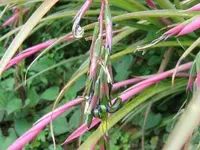
The plant commonly flowers in cooler months, producing tubular greenish flowers edged in blue and backed by bright pink bracts that secrete abundant nectar and attract hummingbirds in its natural habitats.

Self-watering leaf tank

Its tightly overlapping leaves create a central water-holding cup that traps rain and organic debris, providing both moisture and nutrients to the plant and a small microhabitat for insects and microorganisms.

Botan icon

Did you know?

This species has naturalized in parts of mild-climate regions outside its native range, such as coastal areas of California, where it can persist in gardens and on trees without regular irrigation due to its epiphytic adaptations and efficient water storage in its leaf tanks.

FAQs about Queen's tears

Flowering usually occurs on mature rosettes that have produced enough energy. Lack of blooms often relates to insufficient light, infrequent fertilizing, or a pot that is too spacious, which encourages foliage and offsets instead of flowers.

Grow Healthy Plants with Botan Care

Keep your plants happy and healthy with plant identification, disease detection, and easy care guidance.


Botan plant care app — identify plants on mobile

Explore More Plants