Winter rest setup
From late fall, move the plant to a bright room with 45–55°F nights, stop fertilizing, and reduce watering so the canes experience a cool, dry rest that triggers reliable flowering.

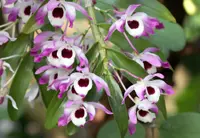
Noble Dendrobium (Dendrobium nobile) is an epiphytic orchid that usually grows on trees or rocks, forming upright, cane-like stems with clustered leaves. It produces showy, often fragrant flowers along the canes, typically in late winter or spring, and is valued as a decorative houseplant. In nature, it occurs in cooler, upland regions of India and Southeast Asia, where it experiences distinct seasonal changes. Its need for bright light, good air movement, and a marked cool, drier rest period makes it moderately challenging for beginners. Understanding these seasonal patterns is key to successful flowering and to know how to care for Noble Dendrobium.

Care Difficulty
Moderate Care

Light Preference
Bright Indirect Light

Water Requirements
Moderate Water

Temperature Preference
Tropical / Frost Sensitive

Hardiness Zone
11–12

Soil Texture
Peaty, Organic-rich

Soil pH
Acidic (5.5–6.5)

Soil Drainage
Well-drained

Fertilization
Moderate (every 2–4 weeks)
Scan your plant to receive care tips personalized for your specific plant
Available on iOS and Android
This orchid needs bright, indirect light with some gentle direct sun to flower well.
Watering should match the orchid’s growth cycle and the dryness of its potting medium.
Temperature swings between day and night are important for Dendrobium nobile flowering and overall health.
This orchid prefers moderate to high humidity for steady growth and flowering.
This epiphytic orchid needs a very airy, fast-draining potting mix rather than regular garden soil.
This species is well suited to container growing when pot and stability are chosen carefully.
This orchid benefits from moderate feeding during active growth but needs a lean rest period to flower well.
Pruning focuses on cleaning and managing old canes rather than reshaping the plant.
Repotting keeps this orchid healthy but is needed only when the root system clearly outgrows its container.
This orchid is most commonly multiplied by division and keikis rather than by seed.
Cool, drier winter conditions are essential for bud formation in this orchid.

Plant Health Check
Not sure what's wrong with your plant? Check your plant's health inside the app.
This species is native to montane forests of the eastern Himalayas and Southeast Asia, where it often grows on trees or rocks in cool, misty conditions at higher elevations.
It is a deciduous or semi-deciduous orchid whose canes often drop many of their leaves before flowering, with blossoms forming along the leafless pseudobulbs in late winter or spring.
The flowers are strongly sweet-scented and show a contrasting dark blotch in the lip, visual and olfactory cues that help guide pollinating insects to the reproductive structures.

This species is one of the classic parents used in breeding many modern hybrid dendrobiums, contributing its cool-tolerance, strong fragrance, and showy, long-lasting flowers to a wide range of ornamental orchids commonly sold today.
Lack of flowering usually comes from skipping a cool, drier winter rest. This species needs several weeks around 50–60°F with reduced watering and no fertilizer, plus bright light, to trigger buds on the older canes.
Keep your plants happy and healthy with plant identification, disease detection, and easy care guidance.