Support Heavy Leaves
Use short, sturdy stakes and soft ties to support drooping petioles on large leaves, placing supports early in the season before wind or the weight of rain causes bends or breaks.

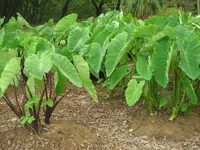
Taro (Colocasia esculenta) is a tropical, clump-forming perennial grown for its large, heart-shaped leaves and starchy underground corms. It is commonly cultivated as a food and ornamental plant. In nature, it occurs in warm, humid regions of Southeast Asia and the Pacific, often along streams, wetlands, and consistently moist soils. The plant prefers rich, evenly damp soil and sheltered, bright conditions without harsh drying winds. Its fast growth and strong need for moisture make it rewarding but slightly demanding, especially in dry indoor air or cooler climates. Understanding how to care for Taro helps keep its foliage healthy and prevents stress-related leaf problems.

Care Difficulty
Moderate Care

Light Preference
Partial Sun

Water Requirements
Aquatic

Temperature Preference
Tropical / Frost Sensitive

Hardiness Zone
8–11

Soil Texture
Loamy, Clay, Organic-rich

Soil pH
Acidic (5.5–6.5), Slightly acidic (6.5–7.0)

Soil Drainage
Waterlogged tolerant

Fertilization
Heavy (weekly, diluted)
Scan your plant to receive care tips personalized for your specific plant
Available on iOS and Android
Colocasia esculenta prefers bright, indirect light and can also handle partial shade in warm climates.
This species thrives in consistently moist to wet conditions and dislikes drying out deeply.
This tropical plant grows best in warm, frost-free conditions with stable seasonal temperatures.
This species prefers consistently high humidity and reacts quickly to dry indoor air.
Colocasia esculenta thrives in moisture-retentive, organic-rich soil that still allows some air around the roots.
This species can grow very well in large containers if the pot and watering are managed carefully.
Colocasia esculenta benefits from consistent but moderate feeding to sustain large leaf growth.
Pruning Colocasia esculenta focuses on hygiene and space management rather than shaping.
Repotting or transplanting supports vigorous Colocasia esculenta growth and tuber expansion.
Multiplying Colocasia esculenta is usually done by division of tubers or clump sections.
Cold-sensitive Colocasia esculenta needs specific winter care in climates with freezing temperatures.

Plant Health Check
Not sure what's wrong with your plant? Check your plant's health inside the app.
Taro is one of the world’s oldest cultivated root crops and has served as a staple carbohydrate source for many Pacific Island, Southeast Asian, and African cultures for thousands of years.
Its leaves, petioles, and corms naturally contain sharp calcium oxalate crystals called raphides, which can cause intense irritation if eaten raw and function as a defense against herbivores.
This species tolerates waterlogged and even shallowly flooded soils, thanks to air-filled tissues (aerenchyma) in its petioles and roots that help transport oxygen in low-oxygen, muddy environments.

Genetic and archaeological evidence indicates that taro was independently domesticated in several regions, including parts of Southeast Asia and New Guinea, making it one of the few crop plants with multiple early centers of domestication.
Brown tips or edges usually result from low humidity, underwatering, salt buildup from fertilizer, or exposure to strong sun or cold drafts. Increase humidity, water evenly, flush excess salts, and protect from temperature extremes to improve foliage quality.
Keep your plants happy and healthy with plant identification, disease detection, and easy care guidance.