Caudex height control
Repot slightly deeper or shallower depending on how much of the caudex you want exposed, but never bury it more than 1–2 cm above its previous soil line to avoid rot while shaping the plant’s appearance.

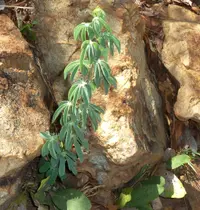
Blue leaf elephant foot (Adenia glauca) is a caudiciform vine grown for its swollen, sculptural base and delicate climbing stems. It is a succulent-type plant that stores water in its caudex, which helps it tolerate dry spells. Native to arid regions of southern Africa, it has bluish to gray-green leaves and a thick, often rounded base that slowly enlarges with age.
The plant stays compact in a pot but can send out long twining shoots if given support. It suits growers who enjoy slow, architectural plants and can manage its seasonal growth and rest periods. Understanding how to care for Blue leaf elephant foot involves providing bright light, fast-draining soil, and careful watering to avoid rot.

Care Difficulty
Moderate Care

Light Preference
Partial Sun

Water Requirements
Low Water

Temperature Preference
Tropical / Frost Sensitive

Hardiness Zone
10–12

Soil Texture
Sandy, Loamy, Rocky

Soil pH
Slightly acidic (6.5–7.0), Neutral (7.0)

Soil Drainage
Well-drained

Fertilization
Minimal (feed rarely)
Scan your plant to receive care tips personalized for your specific plant
Available on iOS and Android
This succulent-caudiciform vine prefers bright, indirect light with some direct sun for compact growth.
This species stores water in its caudex, so it prefers deep but infrequent watering and fast-drying soil.
This plant thrives in warm, dry conditions and is sensitive to cold and frost.
This species from arid regions prefers relatively dry air and does not need elevated humidity.
Adenia glauca needs a very fast-draining, mineral-rich substrate that prevents water from sitting around the caudex or roots.
This caudiciform vine is well suited to container growing when stability and drainage are prioritized.
Adenia glauca benefits from modest, careful feeding during active growth but is sensitive to excess nutrients.
Pruning Adenia glauca focuses on controlling vine length and removing weak growth while protecting the caudex.
Repotting Adenia glauca is infrequent and should prioritize keeping the caudex stable and roots undisturbed.
Propagation of Adenia glauca is possible from both seeds and stem cuttings but requires warm, stable conditions.
Winter care for Adenia glauca centers on frost avoidance and keeping the caudex dry during dormancy.

Plant Health Check
Not sure what's wrong with your plant? Check your plant's health inside the app.
This species forms a swollen, bottle-shaped stem base (caudex) that stores water, allowing it to survive long dry periods in its native arid habitats of southern Africa.
Despite its bulky base, it produces thin, twining vines that climb over nearby shrubs and rocks, helping the leafy parts reach more light while the caudex remains shaded and protected.
It is strongly deciduous in habitat, dropping its leaves during the dry or cool season to reduce water loss, then rapidly pushing new growth when warmth and moisture return.

In its native range in South Africa and neighboring regions, this species can partially bury its caudex in sandy or rocky soil, with only the upper part visible, which helps buffer temperature extremes and reduces water loss from direct sun exposure.
This species often flowers only once mature, which can take several years. Blooming is more reliable after a cool, dry winter rest and strong seasonal light. Excessive watering or constant warmth can suppress flower formation.
Keep your plants happy and healthy with plant identification, disease detection, and easy care guidance.