


Encourage Symmetrical Rosettes
Rotate the container or adjust the planting orientation by 90° every 2–3 months so the rosette receives light from different directions and develops a balanced, even form rather than leaning toward one side.

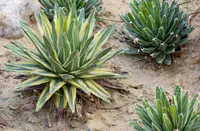
Foxtail agave, Agave attenuata, is a soft-leaved succulent valued for its architectural rosette and smooth, spineless leaves. It forms a symmetrical mound that looks almost sculpted.
In maturity, it sends out tall, gently curving flower spikes that resemble a fox’s tail, which gives the plant its common name. This agave naturally occurs in higher-elevation areas of central Mexico, where conditions are bright and dry.
It is considered one of the easier agaves for gardens and containers because it lacks sharp spines and tolerates heat and drought once established. Understanding how to care for Foxtail Agave starts with providing strong light, fast-draining soil, and infrequent but deep watering.

Care Difficulty
Easy Care

Light Preference
Partial Sun

Water Requirements
Low Water

Temperature Preference
Tropical / Frost Sensitive

Hardiness Zone
9–11

Soil Texture
Sandy, Loamy, Rocky

Soil pH
Slightly acidic (6.5–7.0), Neutral (7.0)

Soil Drainage
Well-drained

Fertilization
Minimal (feed rarely)
Scan your plant to receive care tips personalized for your specific plant
Available on iOS and Android
This species prefers bright, direct sun but adapts to light shade in hot regions.
Agave attenuata prefers infrequent, deep watering with thorough drying in between.
This succulent thrives in warm, frost-free conditions with only moderate temperature swings.
This species tolerates a wide humidity range and usually needs no special humidity management indoors or outdoors.
This species needs sharply draining, mineral-based soil to prevent root and crown rot.
This species is well suited to container growing when the pot supports its shallow, spreading root system and top-heavy rosette.
Agave attenuata needs only modest feeding in containers or poor, sandy soils.
Pruning Agave attenuata focuses on hygiene and maintaining a clean rosette.
Agave attenuata grows slowly and needs infrequent repotting or transplanting.
Agave attenuata is most often propagated from basal offsets rather than seed.
Agave attenuata is frost tender and needs active winter care in most temperate climates.

Plant Health Check
Not sure what's wrong with your plant? Check your plant's health inside the app.
Unlike many agave species, this plant lacks sharp terminal spines and has only very soft leaf tips, which makes it unusually safe to handle compared to its relatives.
When mature, it produces a tall, arching flower spike up to several meters long that curves like a fox’s tail, densely covered with small greenish-yellow flowers.
In the wild it is native to higher-elevation volcanic slopes in central Mexico, where it grows in rocky, well-drained soils and a relatively mild, frost-free climate.

This species is considered functionally monocarpic, meaning each rosette flowers only once and then dies, but it usually forms many offsets at the base that continue the life of the clump after the flowering rosette has withered.
Yellowing usually comes from excess moisture, poor drainage, or cold damage. Check that the pot or bed drains freely, let soil dry between waterings, and protect from prolonged temperatures below 50°F to prevent root stress and rot.
Keep your plants happy and healthy with plant identification, disease detection, and easy care guidance.

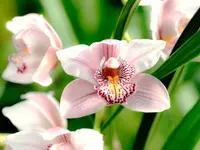
Four-Season Orchid
Cymbidium ensifolium
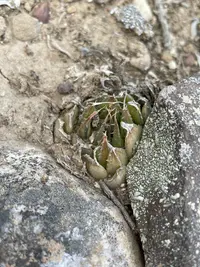
Haworthia arachnoidea var. nigricans
Haworthia arachnoidea var. nigricans
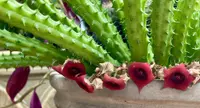
Red Dragon Flower
Huernia schneideriana
winged bean
Psophocarpus tetragonolobus
Rose-apple
Syzygium jambos
Philodendron bipennifolium
Philodendron bipennifolium
 POPULAR
Baby Tears
Pilea depressa
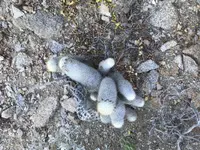
Cochemiea albicans
Cochemiea albicans