Garden croton Care (Codiaeum variegatum)

Also known as: Variegated Croton

About Garden croton

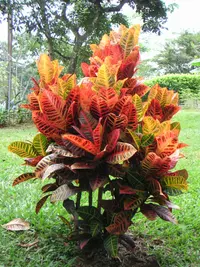
Garden croton (Codiaeum variegatum) is an evergreen shrub grown mainly for its striking, multicolored foliage rather than its flowers. Leaves can be broad, narrow, twisted, or lobed, often patterned in green, yellow, orange, red, and sometimes nearly black.

In nature it occurs in tropical areas of Southeast Asia and the western Pacific, where it grows in warm, humid conditions with bright, filtered light. Indoors it stays compact and bushy but can become leggy if light is too low.

This plant is considered moderately demanding because it dislikes sudden changes in temperature, drafts, or humidity. Understanding how to care for Garden croton starts with providing stable warmth, bright light, and evenly moist but well-drained soil.

Main Plant Requirements

Care Difficulty

Moderate Care

Light Preference

Bright Indirect Light

Water Requirements

Moderate Water

Temperature Preference

Tropical / Frost Sensitive

Hardiness Zone

10–12

Soil Texture

Loamy, Sandy, Organic-rich

Soil pH

Acidic (5.5–6.5), Slightly acidic (6.5–7.0)

Soil Drainage

Moist but well-drained

Fertilization

Light (every 4–6 weeks)

Get Personalized Care Plan

Scan your plant to receive care tips personalized for your specific plant

Personalized Care in the App

Available on iOS and Android

How to Care for the Garden croton

Colorful croton foliage needs bright, stable light levels to keep its variegation strong.

  • Provide 4–6 hours of bright, indirect light daily; gentle morning sun is ideal, while harsh midday sun should be filtered through a sheer curtain or light shade cloth.
  • Outdoors, place Garden croton in dappled light or east-facing exposure; indoors, set near a bright window but out of direct afternoon sun.
  • Insufficient light leads to dull, greener leaves and leggy growth, while too much direct sun causes leaf scorch, crisp edges, and faded colors, especially in summer.

This species prefers evenly moist but not saturated soil to support dense, healthy foliage.

  • Allow the top 2–3 cm of soil to dry before watering, then water thoroughly so excess drains away; do not leave the root zone standing in water.
  • In warm, active growth periods, expect more frequent watering; reduce frequency in cooler seasons while still preventing the root ball from fully drying out.
  • Watch leaves as indicators: drooping and crisp edges suggest underwatering, while yellowing, dropping lower leaves and a sour soil smell point to overwatering in Codiaeum variegatum.

Stable warm temperatures are important for reliable growth and foliage color.

  • Aim for 65–80°F (18–27°C) for best growth; short spikes up to 85–90°F (29–32°C) are tolerated if humidity and soil moisture are adequate.
  • Avoid exposing plants to temperatures below 55°F (13°C); growth slows under this level, and tissue damage occurs as temperatures approach 40°F (4°C).
  • Crotons are very sensitive to frost; protect outdoor specimens from cold snaps, drafts, and sudden 15–20°F (8–11°C) drops, especially when moved between indoor and outdoor conditions.

This species prefers consistently warm, moist air and reacts quickly to dry conditions.

  • Aim for 50–70% humidity; prolonged air below 40% often dulls leaf color and edges.
  • Tolerates short dry spells, but persistent dry air causes crispy margins, leaf drop, and halted growth.
  • Increase humidity with a nearby humidifier, grouping plants, or a pebble tray, keeping foliage dry to limit disease in Garden croton.

Codiaeum variegatum needs a loose, airy mix that holds some moisture but drains rapidly.

  • Use a peat- or coco-based mix with 20–30% perlite and/or fine bark to create a slightly chunky, well-aerated structure.
  • Aim for slightly acidic to neutral pH around 6.0–7.0, which supports nutrient availability and stable foliage color.
  • Ensure fast drainage; water should flow out within seconds, never leaving the mix soupy or compacted.
  • Improve heavy, compact mixes by blending in extra perlite and bark, avoiding dense clay-based garden soil.

This species is well suited to container culture due to its moderate root system and upright, woody form.

  • Choose a wide, weighty pot to counterbalance the top-heavy canopy and reduce tipping in wind or accidental bumps.
  • Select containers with multiple drainage holes so water exits quickly and does not collect around the woody root crown.
  • Use thicker-walled ceramic or terracotta pots outdoors to stabilize temperature swings that can shock roots in shallow plastic pots.

Codiaeum variegatum benefits from steady, moderate feeding during its active growing season.

  • Use a balanced liquid fertilizer (such as 10-10-10 or 20-20-20) at 1/2 strength every 4–6 weeks in spring and summer.
  • Alternatively, apply a slow-release granular fertilizer at the start of spring for long, even feeding.
  • Reduce feeding to once in late fall or stop entirely in winter when growth slows.
  • For Garden croton in containers, water before fertilizing to avoid root burn and salt buildup.

Pruning Codiaeum variegatum helps maintain a compact, well-branched form and remove weak growth.

  • Carry out light structural pruning in late winter or early spring before strong new growth begins.
  • Remove dead, diseased, or storm-damaged stems first, cutting back to healthy tissue with clean, sharp shears.
  • Thin crowded or crossing branches to improve light penetration and air movement in the canopy.
  • Tip-pinching young shoots encourages bushier growth and denser foliage display.

Container-grown croton benefits from periodic repotting to refresh soil and allow room for root growth.

  • Check for roots circling the pot, emerging from drainage holes, or persistent wilting as signs it needs a larger container.
  • Repot every 2–3 years in spring, moving to a pot 2–5 cm wider with drainage holes and fresh, well-drained peat-free mix.
  • Gently loosen circling roots and trim any dead or mushy sections to reduce stress and encourage new root growth.
  • Water thoroughly after repotting, then keep in bright, indirect light and stable warmth for 1–2 weeks to recover.

Codiaeum variegatum is most commonly propagated from semi-hardwood stem cuttings taken in warm seasons.

  • Take 8–12 cm cuttings in late spring or summer, removing lower leaves and allowing latex sap to dry before planting.
  • Insert cuttings into a sterile, well-drained medium such as 1:1 perlite and peat or coco coir.
  • Maintain high humidity (60–70%) and bottom warmth around 70–80°F with bright, indirect light to encourage rooting.
  • Use a rooting hormone on the cut end to improve success, and transplant rooted cuttings once strong new growth appears.

Croton is a tropical shrub with poor frost tolerance and needs careful winter management in temperate climates.

  • Avoid exposure below 50°F; foliage and stems may be damaged near freezing, and roots can die in hard frost.
  • Move container plants indoors or into a heated greenhouse before night temperatures drop consistently below 55°F.
  • Provide bright, indirect light indoors and avoid cold drafts, sudden temperature drops, and hot, dry air from heaters.
  • In mild regions, use a 5–8 cm mulch layer around the root zone to insulate soil and stabilize moisture levels.

Care Tips

Acclimate After Purchase

After bringing a plant home, keep it in its nursery pot for 2–3 weeks away from drafts and frequent moving, so it can adjust gradually and drop fewer leaves.

Rotate For Even Color

Turn the pot 90° every 1–2 weeks so all sides receive similar light, which reduces one-sided leaning and helps maintain even leaf color and variegation when growing Garden croton.

Stabilize Tall Stems

If stems become top-heavy, insert a slim stake close to the main stem and secure it loosely with soft plant ties to prevent snapping and to keep the plant upright in its container.

Quarantine New Plants

Keep any new houseplant at least 2–3 m away from existing crotons for 2–3 weeks and inspect leaves and stems weekly, so possible pests or diseases are noticed before they spread.

Clean Leaves Safely

Every 4–6 weeks, wipe both sides of the leaves gently with a soft, damp cloth and plain water to remove dust, avoiding commercial leaf-shine sprays that can clog pores and attract pests.

Common Pests and Diseases

Spider mites

This pest feeds on leaf sap, causing fine stippling, dulling of variegated colors, and webbing on leaf undersides, especially in dry indoor air. Severe infestations lead to leaf edge browning and premature leaf drop.

Solution

Rinse foliage thoroughly with lukewarm water, focusing on leaf undersides, then allow the plant to dry in bright, indirect light. For persistent problems, use repeated applications of insecticidal soap or horticultural oil at 5–7 day intervals and increase humidity to make conditions less favorable for mites.

Scale insects

These insects attach firmly to stems and leaf midribs, appearing as small brown or tan bumps that excrete sticky honeydew. Symptoms include yellowing leaves, reduced vigor, and occasional sooty mold growth on the honeydew.

Solution

Manually remove individual scales with a cotton swab dipped in isopropyl alcohol, then wash the plant with mild soapy water. For larger infestations, apply horticultural oil or insecticidal soap thoroughly over several treatments, making sure to coat stems and leaf bases where scale often hides.

Mealybugs

This pest appears as white, cottony clusters in leaf axils, on stems, and along leaf veins, feeding on sap and weakening the plant. Symptoms include distorted new growth, sticky leaves, and slow decline in overall vigor.

Solution

Isolate the plant, then wipe visible mealybugs with a cotton swab dipped in isopropyl alcohol and rinse the foliage afterward. Follow up with insecticidal soap or neem oil sprays every 7–10 days, checking hidden areas around leaf bases where mealybugs tend to return.

Bacterial leaf spot

This disease causes water-soaked, translucent spots on leaves that turn brown or black with yellow halos, often starting on lower foliage in warm, wet conditions. Symptoms include progressive spotting, leaf drop, and unsightly foliage on affected croton varieties.

Solution

Remove and discard affected leaves, avoid overhead watering, and keep foliage as dry as possible by watering at the soil level. Improve air circulation around the plant and, in severe cases, discard heavily infected plants to protect nearby specimens, following local guidelines for plant disposal.

Edema

Symptoms include small corky, blister-like bumps on the underside of leaves, often following periods of overwatering or sudden changes from low to high light. This physiological disorder occurs when roots absorb more water than leaves can transpire, common during seasonal light shifts in Garden croton indoor care.

Solution

Allow the soil surface to dry slightly between waterings, reduce watering volume, and provide stable bright, indirect light. Improve air movement around the plant and avoid sudden changes in light or temperature to prevent new edema spots from forming, although existing lesions will not disappear.

Interesting Facts

Leaf color and light

The pigments that create red, orange, and yellow patterns in this species are mainly carotenoids and anthocyanins, which increase under higher light, so leaves tend to become more intensely colored in brighter conditions and greener in shade.

Toxic latex sap

The stems and leaves contain a white, milky latex typical of the spurge family (Euphorbiaceae), which can irritate skin and eyes and makes the plant unpalatable to many herbivores.

Extreme leaf diversity

This single species has produced hundreds of horticultural cultivars with dramatically different leaf shapes, from narrow and twisted to broad and oval, all arising from mutations affecting leaf development and pigment distribution.

Botan icon

Did you know?

In its native range in Southeast Asia, this shrub can reach 3–6 m tall and form dense, woody hedges, which is why it has been widely planted outdoors in tropical climates for living fences and formal borders.

FAQs about Garden croton

Brown, crispy edges usually result from low humidity, underwatering, or exposure to cold drafts. Check that the potting mix never fully dries, keep it away from vents, and increase humidity with a pebble tray or humidifier.

Grow Healthy Plants with Botan Care

Keep your plants happy and healthy with plant identification, disease detection, and easy care guidance.


Botan plant care app — identify plants on mobile

Explore More Plants