Support For Vines
Install a slim trellis or hoop and gently tie young shoots with soft garden tape so the plant can climb and produce more flowering wood instead of sprawling and tangling.

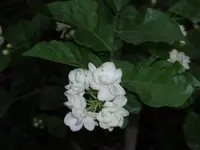
Arabian jasmine, Jasminum sambac, is a woody, evergreen shrub or vine valued for its intensely fragrant white flowers that often open at night. It typically grows with twining or bushy stems and glossy, medium-green leaves, making it suitable for containers, trellises, or small garden spaces.
This species is native to tropical Asia and thrives in warm, frost-free climates, but it can be grown indoors in cooler regions. It is moderately easy to grow if given bright light, consistent moisture without waterlogging, and well-drained soil.
Understanding how to care for Arabian Jasmine mainly involves balancing light, warmth, and humidity, which supports regular flowering and healthy, dense foliage.

Care Difficulty
Moderate Care

Light Preference
Full Sun

Water Requirements
Regular Water

Temperature Preference
Tropical / Frost Sensitive

Hardiness Zone
9–11

Soil Texture
Sandy, Loamy, Organic-rich

Soil pH
Acidic (5.5–6.5), Slightly acidic (6.5–7.0)

Soil Drainage
Moist but well-drained

Fertilization
Moderate (every 2–4 weeks)
Scan your plant to receive care tips personalized for your specific plant
Available on iOS and Android
This plant thrives in bright, warm conditions that mimic a tropical climate.
This species prefers evenly moist but not saturated soil, with brief drying at the surface between waterings.
This tropical shrub performs best in consistently warm, frost‑free conditions.
This species prefers moderately humid air and reacts quickly to very dry conditions.
This plant grows best in loose, well‑drained, organic‑rich soil that still holds some moisture.
This species is very suitable for container growing when root space and drainage are managed carefully.
Jasminum sambac responds well to modest feeding that supports flowering without causing excessive leafy growth.
Pruning Jasminum sambac maintains a compact shape and encourages more flowering shoots.
Container-grown Jasminum sambac benefits from timely repotting to prevent root binding and nutrient depletion.
New Jasminum sambac plants are most commonly raised from stem cuttings, with layering and seed as secondary options.
Jasminum sambac is frost-sensitive and needs protection in climates with cold winters.

Plant Health Check
Not sure what's wrong with your plant? Check your plant's health inside the app.
This species opens most of its small white flowers in the evening and releases its strongest fragrance at night, an adaptation that attracts nocturnal pollinators such as moths in its native range.
It holds official national or symbolic flower status in several countries, including the Philippines, where it is known as sampaguita and is traditionally used in ceremonial garlands.
Although often grown as a compact shrub in pots, it naturally develops long, flexible stems that can be trained as a loose climber on supports, combining both shrub and vine-like growth forms.

In many parts of South and Southeast Asia, this species has been selectively cultivated for centuries into distinct horticultural forms with different petal counts and flower shapes, ranging from simple single blooms to highly double, rose-like flowers that rarely set seed and are propagated almost exclusively by cuttings.
Lack of blooms often comes from insufficient light, heavy pruning at the wrong time, or excess nitrogen fertilizer. Mild root restriction, moderate feeding with balanced fertilizer, and strong light usually restore flowering over the next growth cycle.
Keep your plants happy and healthy with plant identification, disease detection, and easy care guidance.