Rotate For Symmetry
Turn the pot 90° every 1–2 weeks so new leaves develop evenly and the plant does not lean strongly toward one light source.

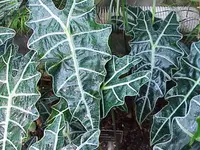
Sander's Alocasia (Alocasia sanderiana) is a tropical aroid grown mainly as an ornamental foliage plant. It is valued for its narrow, shield-shaped leaves with bold white veins and wavy edges. The plant forms an upright clump from underground rhizomes and usually stays compact indoors.
Alocasia sanderiana originates from the tropical Philippines, where it grows in warm, shaded forest environments. It can be challenging for beginners, as it reacts quickly to low humidity, cold drafts, and irregular watering. To care for Sander's Alocasia successfully, provide bright filtered light, consistently lightly moist soil, and good airflow without temperature extremes.

Care Difficulty
Hard Care

Light Preference
Bright Indirect Light

Water Requirements
Keep Soil Moist

Temperature Preference
Tropical / Frost Sensitive

Hardiness Zone
11–12

Soil Texture
Loamy, Peaty, Organic-rich

Soil pH
Acidic (5.5–6.5), Slightly acidic (6.5–7.0)

Soil Drainage
Moist but well-drained

Fertilization
Moderate (every 2–4 weeks)
Scan your plant to receive care tips personalized for your specific plant
Available on iOS and Android
This species prefers bright, indirect light that mimics filtered tropical sun.
Alocasia sanderiana prefers evenly moist but not waterlogged soil.
This plant thrives in consistently warm, stable temperatures without cold drafts.
This species needs consistently high humidity to maintain healthy foliage and growth.
This plant needs airy, organic-rich, fast-draining soil that still retains some moisture.
This species is well suited to container growing when the pot supports its moisture-sensitive roots.
Nutrient support helps Sander's Alocasia maintain strong foliage and steady growth in containers.
Alocasia sanderiana benefits from light, targeted pruning to maintain healthy, tidy foliage.
Container-grown plants appreciate careful repotting to prevent root congestion and maintain vigor.
New plants are most reliably produced by division of mature Alocasia sanderiana clumps or offsets.
This species is highly sensitive to cold and must be kept warm during winter in most climates.

Plant Health Check
Not sure what's wrong with your plant? Check your plant's health inside the app.
This species is believed to be native to the rainforests of northern Mindanao in the Philippines, where it grows in warm, shaded, and very humid lowland habitats rather than in exposed sites.
Its leaves are unusually narrow and strongly sagittate (arrow-shaped), forming a distinct V-like outline with a deeply lobed base that differs from the broader, more shield-like foliage seen in many other Alocasia species.
The thick, pale veins and margins form a raised network over the dark green leaf blade, which helps stiffen the leaf surface and is thought to support the large blade while also influencing how water sheds from it.

Alocasia sanderiana is one of the original parents of the widely grown hybrid Alocasia × amazonica (often sold as Alocasia 'Polly'), so understanding Alocasia sanderiana care instructions helps explain why those hybrids also demand warm temperatures, high humidity, and careful root moisture management.
Yellowing leaves usually result from overwatering, poor drainage, or natural aging of the oldest foliage. Check that the pot drains freely, roots are not waterlogged, and fertilizer is not excessive, which can also stress roots and foliage.
Keep your plants happy and healthy with plant identification, disease detection, and easy care guidance.