Macodes petola Care

About Macodes petola

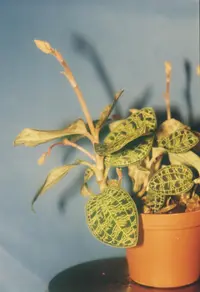
Macodes petola is a small terrestrial orchid grown mainly for its decorative foliage rather than its flowers. It is often called a jewel orchid because of its glowing, vein-like leaf patterns. In its native Southeast Asian habitats, it grows on the forest floor in warm, shaded, and consistently humid conditions. It forms low clumps, with soft, velvety leaves that stay close to the substrate rather than climbing. The plant is considered moderately demanding, as it dislikes sudden changes in temperature, dry air, and waterlogged conditions. Understanding how to care for Macodes petola starts with providing gentle, filtered light, evenly moist but airy substrate, and stable indoor conditions.

Main Plant Requirements

Care Difficulty

Hard Care

Light Preference

Bright Indirect Light

Water Requirements

Keep Soil Moist

Temperature Preference

Tropical / Frost Sensitive

Hardiness Zone

12–13

Soil Texture

Peaty, Organic-rich, Loamy

Soil pH

Strongly acidic (4.5–5.5), Acidic (5.5–6.5)

Soil Drainage

Moist but well-drained

Fertilization

Light (every 4–6 weeks)

Get Personalized Care Plan

Scan your plant to receive care tips personalized for your specific plant

Personalized Care in the App

Available on iOS and Android

How to Care for the Macodes petola

This jewel orchid prefers low to medium light that mimics a shaded forest floor.

  • Provide bright, filtered light for 8–10 hours daily, such as behind a sheer curtain or under LED grow lights rated for low-light orchids.
  • Allow early morning sun only; avoid direct midday or afternoon sun, which can cause leaf scorching, bleaching, and crispy edges on Macodes petola.
  • In winter, move the plant closer to a bright window or extend artificial lighting time if leaves lose contrast or new growth is slow.

This species prefers evenly moist conditions without becoming waterlogged.

  • Water when the top 1–2 cm of the substrate feels just barely dry, using small amounts so moisture penetrates but excess drains away quickly.
  • Use a loose, fast-draining mix (such as fine orchid bark with sphagnum moss) to prevent root rot, yellowing leaves, and a sour smell from chronic overwatering.
  • Reduce watering slightly in winter or lower light, but increase frequency if leaves wrinkle, edges curl, or the pot feels very light, indicating underwatering.

This orchid thrives in consistently warm, humid conditions with minimal temperature swings.

  • Aim for 70–80°F (21–27°C) by day and 65–72°F (18–22°C) at night for steady growth and stable leaf coloration.
  • Avoid temperatures below 60°F (16°C); brief drops to 55°F (13°C) may be tolerated but can slow growth and increase disease risk.
  • Protect from hot drafts and direct heat; above 85°F (29°C), increase airflow and humidity and keep out of direct sun to prevent leaf stress and wilting.

This jewel orchid needs high, stable humidity to keep foliage healthy and turgid.

  • Aim for 70–85% humidity; it may survive around 60% but growth and leaf quality decline below that.
  • Dry air causes dull leaves, browned edges, and leaf-tip dieback, often starting on newest growth.
  • Increase humidity with a closed terrarium, room or ultrasonic humidifier, or a clear cover that still allows air exchange.

Macodes petola prefers a loose, airy, moisture-retentive but fast-draining substrate rather than regular potting soil.

  • Use a mix such as fine orchid bark or small bark chips, sphagnum moss, perlite, and a little leaf mold or coco husk to boost organic matter.
  • Structure should feel springy and fibrous, holding moisture around roots while allowing abundant air pockets so roots never sit compacted.
  • Aim for slightly acidic pH around 5.5–6.5, which supports nutrient uptake and discourages certain root pathogens.
  • Avoid dense peat-only mixes, standard garden soil, or any medium that compacts, stays waterlogged, or forms a heavy sludge after watering.

This species is very suitable for container culture, especially in shallow, enclosed or semi-enclosed setups.

  • Choose a wide, shallow pot or terrarium base so creeping rhizomes can spread horizontally without deep, stagnant pockets of wet mix.
  • Use relatively non-porous containers like plastic or glazed ceramic to slow evaporation, then fine-tune moisture with aeration in the substrate instead of relying on clay pots.
  • Stabilize small decorative containers inside a heavier cachepot or terrarium to protect delicate foliage from being knocked or tipped during handling.

This jewel orchid prefers light feeding that mimics nutrient-poor forest soils.

  • Use a balanced orchid fertilizer (about 20-20-20) at 1/4–1/2 strength, formulated for epiphytes or foliage orchids.
  • Feed every 3–4 weeks in spring and summer when Macodes petola is actively growing.
  • Flush the pot with plain water every 4–6 weeks to prevent salt buildup in the medium.
  • Reduce feeding to once every 6–8 weeks in fall and winter, or pause if growth has slowed significantly.

Pruning needs are minimal and mainly focused on hygiene and light shaping.

  • In late winter or early spring, remove any dead, yellowing, or rotting leaves to limit disease spread.
  • Trim soft, elongated stems back to a healthy node to keep Macodes petola compact and encourage branching.
  • Always use small, sharp, sterilized scissors to avoid crushing delicate tissues and introducing pathogens.
  • Discard pruned material and avoid reusing diseased pieces in propagation or around other houseplants.

Repotting maintains healthy roots in this moisture-loving, fine-rooted orchid.

  • Plan to repot every 1–2 years in spring when new growth starts or if roots circle the pot and growth slows.
  • Use a shallow container with good drainage and a loose mix of fine orchid bark, sphagnum moss, and perlite.
  • Gently tease old medium from the roots, trimming any black, mushy sections with sterilized scissors.
  • After repotting Macodes petola, water lightly, keep humidity high, and shade from strong light for 7–10 days to reduce stress.

Propagation is usually done by careful division of mature clumps.

  • Divide in late spring or early summer when plants show active new growth and recovery is fastest.
  • Remove the plant from its pot and separate rhizomes so each division has at least 2–3 healthy growth points and roots.
  • Plant divisions into a fine, moisture-retentive orchid mix and keep humidity at 70–80% with stable warmth.
  • Provide bright, indirect light and avoid heavy watering until new root tips appear and growth resumes.

This tropical species is not frost tolerant and needs warm, stable indoor conditions in winter.

  • Keep temperatures around 65–75°F and avoid drops below 60°F to prevent leaf and root damage.
  • Move containers well away from cold windows, drafts, and exterior doors, especially at night.
  • Maintain 60–80% humidity using trays or humidifiers, but ensure gentle air movement to prevent fungal issues.
  • Water slightly less in winter while never allowing the substrate to dry out completely.

Care Tips

Use shallow pots

Grow this orchid in a wide, shallow pot or tray so the fine roots spread in a thin layer of medium, which reduces rot risk and makes it easier to maintain even moisture.

Top-dress with moss

Apply a thin, loose layer of long-fiber sphagnum moss on top of the orchid mix to buffer moisture, but avoid packing it tightly so air can still reach the roots.

Side lighting setup

Place a small LED grow light slightly to the side rather than directly overhead to highlight the leaf veining and encourage compact, low growth rather than stretched stems.

Stable microclimate box

Keep the plant in a clear plastic or glass box with several small ventilation holes to create a stable, high-humidity microclimate while still allowing slow air exchange and reducing fungal problems.

Gentle cleaning routine

Wipe leaves every 4–6 weeks with a barely damp, soft cloth or cosmetic brush to remove dust, which improves light absorption and allows easier monitoring for early pest signs when caring for Macodes petola.

Common Pests and Diseases

Spider mites

This pest thrives in warm, dry terrarium or indoor conditions and feeds on the soft leaves, causing fine stippling, dull foliage, and delicate webbing between leaves and stems.

Solution

Increase humidity to 70–80%, gently rinse leaves under lukewarm water, and wipe both leaf surfaces with a soft cloth; then apply a neem oil or insecticidal soap spray every 5–7 days for 3–4 cycles, ensuring all leaf undersides are covered while keeping chemicals off delicate moss and companion plants when possible.

Fungus gnat larvae

These insects lay eggs in constantly moist, organic substrates, and the larvae can damage fine roots and the shallow rhizome, leading to slow decline and yellowing leaves.

Solution

Allow the top 1–2 cm of the substrate to dry slightly between waterings, use yellow sticky traps for adults, and treat the substrate with a biological control such as Bacillus thuringiensis israelensis (BTI) or beneficial nematodes, which target larvae without harming the orchid.

Bacterial leaf spot

This disease causes water-soaked, translucent spots that quickly turn brown or black on the thin leaves, often starting where water sits on the surface.

Solution

Remove and discard affected leaves with a sterile blade, improve airflow, avoid water sitting on foliage, and use a copper-based bactericide at label rates, taking care not to overapply to avoid phytotoxic stress on this sensitive jewel orchid.

Rhizoctonia root and stem rot

This disease develops in constantly wet, stagnant substrates and causes browning of roots, softening at the stem base, and sudden collapse of previously healthy growths.

Solution

Unpot the plant, cut away all affected roots and stem sections, repot into fresh, airy orchid mix with good drainage, and water sparingly until new roots form; in high-value collections, a systemic fungicide labeled for Rhizoctonia on orchids may be used according to label instructions as part of broader Macodes petola care instructions.

Interesting Facts

Lightning vein leaves

The leaves show bright, metallic-looking vein networks on a dark background due to light reflecting from multiple layers of specialized cells, a structural color effect rather than pigment alone.

Forest floor specialist

In the wild this species grows on the shaded, humid forest floor of Southeast Asia, where its low, creeping habit and broad leaves help it capture weak, filtered light under dense canopy.

Flowers vs. foliage

Its small, pale flowers are relatively inconspicuous and lightly scented, and in cultivation the plant is valued almost entirely for its foliage pattern rather than its blooms.

Botan icon

Did you know?

This species is one of several so‑called jewel orchids historically collected and grown primarily by foliage enthusiasts, and in some regions wild populations have been locally reduced by over-collection for the ornamental trade.

FAQs about Macodes petola

Brown leaf edges usually come from low humidity, mineral buildup from hard water, or fertilizer burn. Increase humidity to around 60–80%, use filtered or rainwater, and apply very dilute orchid fertilizer only during active growth.

Grow Healthy Plants with Botan Care

Keep your plants happy and healthy with plant identification, disease detection, and easy care guidance.

Botan plant care app — identify plants on mobile

Explore More Plants