Provide sturdy staking
Install a rigid stake or narrow bamboo tripod early in the season and loosely tie stems with soft ties, as the tall, palm-like canes are prone to snapping in wind or when moved indoors.

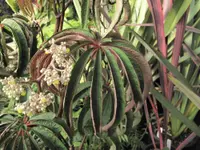
Palm leaf begonia (Begonia luxurians) is a tall, cane-type begonia grown mainly for its tropical, palm-like foliage rather than its flowers. It forms upright, bamboo-like stems topped with divided, arching leaves that give a light, airy look.
This species is native to the Atlantic rainforests of Brazil, where it grows in warm, humid, partially shaded conditions. It is considered moderately easy to grow if protected from cold, strong sun, and prolonged dryness.
Those learning how to care for Palm leaf begonia should know it prefers bright, filtered light, evenly moist but well-drained soil, and stable indoor or greenhouse conditions without extreme temperature swings.

Care Difficulty
Moderate Care

Light Preference
Partial Shade

Water Requirements
Keep Soil Moist

Temperature Preference
Tropical / Frost Sensitive

Hardiness Zone
10–11

Soil Texture
Loamy, Peaty, Organic-rich

Soil pH
Acidic (5.5–6.5), Slightly acidic (6.5–7.0)

Soil Drainage
Moist but well-drained

Fertilization
Light (every 4–6 weeks)
Scan your plant to receive care tips personalized for your specific plant
Available on iOS and Android
This species prefers bright, filtered light that mimics light woodland conditions.
Begonia luxurians prefers evenly moist but not saturated soil around its roots.
This begonia thrives in consistently warm, frost-free conditions.
This species needs relatively high humidity to keep foliage healthy and prevent leaf edge damage.
Begonia luxurians prefers a loose, airy, organic-rich mix that drains quickly yet holds steady moisture.
This species is well suited to container growing, especially where outdoor conditions are seasonal or marginal.
This species responds well to moderate feeding during active growth while remaining sensitive to excess salts.
Pruning helps Begonia luxurians keep a manageable shape and encourages denser foliage.
Container-grown plants benefit from occasional repotting to support the strong root system and tall canes.
This species is most commonly propagated from stem cuttings taken from healthy, non-flowering shoots.
This subtropical begonia is frost sensitive and needs protection in regions with cold winters.

Plant Health Check
Not sure what's wrong with your plant? Check your plant's health inside the app.
This species develops long, narrow, deeply divided leaflets that radiate from a central point, giving the mature plant a strong visual resemblance to a small palm or Schefflera, despite being a true begonia.
Unlike many compact begonias, it can form a woody, bamboo-like shrub several feet tall in frost-free climates, reflecting its adaptation to bright, open sites at the forest edge in its native Brazil.
The plant produces airy clusters of small, creamy-white flowers that often have a light, sweet fragrance, which helps attract pollinating insects in its natural habitat.

Begonia luxurians was introduced to European cultivation in the 19th century and soon became valued in botanical collections as one of the most palm-like begonias, illustrating the remarkable morphological diversity that exists within the genus Begonia.
Brown, crispy edges usually result from low humidity, underwatering, or fertilizer salts building up in the potting mix. Increase ambient humidity, water thoroughly but less often, and flush the soil occasionally to remove excess minerals.
Keep your plants happy and healthy with plant identification, disease detection, and easy care guidance.