Wind-hardening seedlings
From 20–30 cm tall, expose young trees to increasing outdoor wind for 1–2 weeks or use a fan indoors to strengthen stems before planting into their final position.

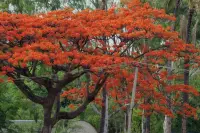
Royal poinciana, Delonix regia, is a fast-growing tropical tree known for its wide umbrella canopy and striking red-orange flowers. In full bloom it forms a dense, colorful crown above smooth grayish bark and fine, fern-like leaves.
This species is native to Madagascar but is now widely planted in warm coastal and subtropical regions as an ornamental shade tree. It prefers full sun, warmth, and well-drained soil, and it dislikes frost or prolonged cold.
In suitable climates it is moderately easy to grow, but its size and strong surface roots require space. In cooler regions, learning how to care for Royal poinciana often involves container growing and winter protection indoors or in greenhouses.

Care Difficulty
Moderate Care

Light Preference
Full Sun

Water Requirements
Moderate Water

Temperature Preference
Tropical / Frost Sensitive

Hardiness Zone
10–12

Soil Texture
Sandy, Loamy

Soil pH
Acidic (5.5–6.5), Slightly acidic (6.5–7.0)

Soil Drainage
Well-drained

Fertilization
Minimal (feed rarely)
Scan your plant to receive care tips personalized for your specific plant
Available on iOS and Android
This tropical tree needs strong, direct light to flower and grow well.
This species prefers evenly moist but not saturated soil, especially while establishing.
This heat-loving tree thrives in warm, frost-free climates.
This species prefers moderately humid air but usually adapts to typical indoor levels if not extremely dry.
This tree needs sharply draining, airy soil that prevents standing water around the roots.
This species can be grown in containers while young, though its fast growth and spreading canopy limit long-term pot culture.
Delonix regia responds well to moderate feeding in warm months but does not need heavy fertilization.
Pruning guides the structure of Delonix regia and helps keep branches strong and safe.
This fast-growing tree is usually moved from containers into the ground once established seedlings form strong roots.
New Delonix regia plants are most commonly raised from seed, which offers reliable results for home growers.
This tropical tree is highly sensitive to frost and needs careful winter management in cooler regions.

Plant Health Check
Not sure what's wrong with your plant? Check your plant's health inside the app.
In many tropical climates, royal poinciana trees synchronize their flowering so that large areas turn almost solid red at once, usually just before or at the start of the rainy season. This mass blooming likely increases visibility to pollinators such as birds and large insects.
The tree produces very long, hard, woody pods that can reach 60 cm and persist on the tree for many months. In its native Madagascar, these pods are thought to have evolved with large herbivores that are now extinct, so in many regions people and livestock now play a major role in spreading its seeds.
Although the tree is widely planted in warm regions worldwide, it is naturally native only to dry forests of western and northern Madagascar. In its natural habitat it is considered threatened due to habitat loss, even while it is common as an ornamental elsewhere.

Genetic and field studies suggest that most royal poinciana trees cultivated around the world come from a very narrow genetic base, likely descended from a small number of original collections, which means that the spectacular variation in flowering displays is produced by relatively limited underlying genetic diversity.
Lack of flowering usually comes from youth, insufficient heat, or nutrient imbalance. Trees often need 3–7 years to bloom. Cool summers, heavy pruning, or high‑nitrogen fertilizer delay buds. Stable warmth and balanced nutrients restore flowering.
Keep your plants happy and healthy with plant identification, disease detection, and easy care guidance.