Safe handling routine
Wear disposable gloves and avoid touching your face when pruning or repotting, then immediately wash tools and hands to prevent skin irritation from the toxic sap.

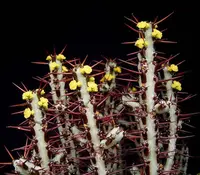
Euphorbia aeruginosa, commonly called verdigris spiny milkweed, is a small succulent shrub with jointed, blue-green stems and sharp spines along the ridges. It stays compact and architectural, making it suited to containers and sunny windowsills.
This species comes from arid regions of South Africa, where it grows in rocky, well-drained habitats. Its stems can flush reddish in strong light, and it produces small, yellow-green flowers close to the spines.
The plant is relatively easy to grow if given bright light, very sharp drainage, and careful watering to avoid rot. Those looking to learn how to care for Verdigris Spiny Milkweed should focus on avoiding overwatering and protecting it from prolonged cold and excess humidity.

Care Difficulty
Moderate Care

Light Preference
Full Sun

Water Requirements
Low Water

Temperature Preference
Tropical / Frost Sensitive

Hardiness Zone
10–11

Soil Texture
Sandy, Rocky, Loamy

Soil pH
Slightly acidic (6.5–7.0), Neutral (7.0)

Soil Drainage
Well-drained

Fertilization
Minimal (feed rarely)
Scan your plant to receive care tips personalized for your specific plant
Available on iOS and Android
This compact succulent prefers bright light with some protection from harsh extremes.
This species stores water in its stems and needs infrequent but thorough watering.
This drought-tolerant succulent prefers warm, stable temperatures without frost exposure.
This species handles typical indoor humidity well and rarely needs special adjustments.
This succulent needs a very fast-draining, mineral-based substrate to protect its roots from rot.
This species is very suitable for container growing due to its compact, shrubby, succulent habit.
This drought-adapted succulent needs modest feeding to support compact, healthy growth.
Pruning Euphorbia aeruginosa focuses on safety and maintaining a compact, well-lit structure.
Container-grown Euphorbia aeruginosa benefits from infrequent, careful repotting to limit stress.
Propagation of Euphorbia aeruginosa is most reliable from stem cuttings taken in warm seasons.
This succulent is frost-sensitive and needs controlled, dry conditions through winter dormancy.

Plant Health Check
Not sure what's wrong with your plant? Check your plant's health inside the app.
This species forms stiff, jointed, blue‑green stems armed with sharp spines that are actually modified sterile peduncles, giving the plant a miniature, branching cactus-like look despite belonging to the spurge family and not to cacti.
The distinctive verdigris to bluish coloration of the stems comes from a waxy cuticle that helps reduce water loss and reflects intense sunlight in its arid native habitat.
Tiny, short‑lived leaves appear near the growing tips during its active season, but they are shed quickly, leaving the plant apparently leafless and relying mainly on its green stems for photosynthesis, an adaptation common to many xerophytic succulents and relevant to Euphorbia aeruginosa care.

In cultivation this species often forms tight, coral-like clumps of many interlocking stems, and older, well-grown specimens can become almost shrublike in a pot while still remaining only a few centimeters tall per stem, making it highly valued among collectors of miniature succulent euphorbias.
This species generally performs best outdoors in bright, dry conditions with good airflow, similar to its native arid habitat. Indoors it stays smaller and needs very strong light and careful watering to avoid rot and weak, stretched growth.
Keep your plants happy and healthy with plant identification, disease detection, and easy care guidance.