


Rotate For Symmetry
Turn the pot 90° every 2–3 weeks so all sides receive similar light, which keeps stems compact and prevents the plant from leaning strongly to one side.

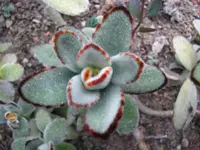
Panda plant, Kalanchoe tomentosa, is a compact succulent shrub known for its thick, fuzzy, grey-green leaves edged with brown spots. The soft hairs reduce water loss and give the leaves a felted look. Native to Madagascar’s dry, rocky habitats, it is adapted to bright light and infrequent rainfall. This makes it a suitable choice for indoor pots and small collections. Growth is slow and upright, with stems that become woody at the base over time. Its drought tolerance and modest size help simplify how to care for Panda Plant, especially for those who tend to underwater. It prefers bright, indirect light, a fast-draining soil mix, and careful, light watering.

Care Difficulty
Easy Care

Light Preference
Bright Indirect Light

Water Requirements
Low Water

Temperature Preference
Tropical / Frost Sensitive

Hardiness Zone
10–11

Soil Texture
Sandy, Loamy, Rocky

Soil pH
Acidic (5.5–6.5), Slightly acidic (6.5–7.0)

Soil Drainage
Well-drained

Fertilization
Light (every 4–6 weeks)
Scan your plant to receive care tips personalized for your specific plant
Available on iOS and Android
Kalanchoe tomentosa prefers bright, indirect light with some gentle direct sun for compact growth.
Water Kalanchoe tomentosa sparingly, allowing the soil to dry well between waterings to avoid root rot.
This succulent prefers warm, stable temperatures and does not tolerate frost.
Humidity is a minor factor for this species as long as air stays relatively dry and moving.
This succulent needs a sharply draining, airy mix that dries quickly after watering.
This species is very suitable for container growing.
This succulent needs light feeding compared with many foliage houseplants, but responds well to modest nutrients in active growth.
Pruning Kalanchoe tomentosa is mainly cosmetic and helps keep plants compact and tidy.
This succulent prefers slightly tight pots and infrequent disturbance, but occasional repotting maintains root health.
New plants are most commonly produced from stem or leaf cuttings, making home propagation straightforward.
This species is not frost hardy and needs indoor conditions in cold climates during winter.

Plant Health Check
Not sure what's wrong with your plant? Check your plant's health inside the app.
The dense silver hairs on the leaves act as insulation that reduces water loss and reflects intense light, an adaptation to the bright, dry conditions of its native Madagascar habitat.
The brown to rust-colored spots and margins on the leaf edges are caused by higher concentrations of protective pigments that help shield the tissues from ultraviolet radiation.
This species uses CAM photosynthesis, opening its stomata primarily at night to take in carbon dioxide, which helps conserve water in its arid environment.

In its native range on the rocky highlands of Madagascar, this species often grows in shallow, mineral-poor crevices where many other broad-leaved plants cannot survive, relying on its thick, water-storing leaves and slow growth to persist in such exposed sites.
Brown tips or edges usually result from underwatering, very low humidity, excess fertilizer salts, or sun scorch from intense direct light through glass. Check the root zone, flush the potting mix, and adjust exposure to gentler light.
Keep your plants happy and healthy with plant identification, disease detection, and easy care guidance.


Purple Sword
Alocasia lauterbachiana
splendens
Haworthia magnifica

Variegated Kalanchoe
Kalanchoe fedtschenkoi 'Marginata'
speckled spur flower
Plectranthus ciliatus
Blackbean
Castanospermum australe
Stenocereus chacalapensis
Stenocereus chacalapensis
Copper Spoons
Kalanchoe orgyalis
Zygopetalum maculatum
Zygopetalum maculatum