Mexican Snowball Care (Echeveria elegans)

About Mexican Snowball

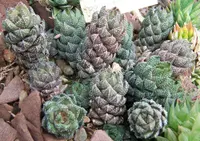
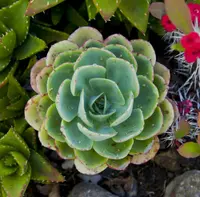
Mexican snowball, Echeveria elegans, is a compact succulent forming tight rosettes of pale blue-green leaves that often blush pink at the edges in bright light. It stays low to the ground and slowly clumps, creating neat mats or clusters.

This species comes from arid regions of Mexico, so it is adapted to strong sun, low rainfall, and very well-drained, gritty soils. Its fleshy leaves store water, which makes it forgiving of occasional neglect and suitable for beginners.

It prefers bright light, low humidity, and infrequent watering, so many growers find it simple to care for Mexican Snowball when given plenty of sun and fast-draining soil.

Main Plant Requirements

Care Difficulty

Easy Care

Light Preference

Full Sun

Water Requirements

Low Water

Temperature Preference

Tropical / Frost Sensitive

Hardiness Zone

9–11

Soil Texture

Sandy, Loamy, Rocky

Soil pH

Slightly acidic (6.5–7.0), Neutral (7.0)

Soil Drainage

Well-drained

Fertilization

Minimal (feed rarely)

Get Personalized Care Plan

Scan your plant to receive care tips personalized for your specific plant

Personalized Care in the App

Available on iOS and Android

How to Care for the Mexican Snowball

Echeveria elegans thrives in bright, direct sun with some protection during the hottest hours.

  • Provide 4–6 hours of direct morning sun plus bright light the rest of the day; Mexican Snowball also does well in all-day bright sun in mild summer climates.
  • Allow light afternoon shade in hot regions to prevent leaf scorch, bleaching, or crispy brown patches from intense sun.
  • If rosettes stretch, lean, or lose blue tone, increase light exposure gradually over 7–10 days to avoid sunburn, especially after cloudy seasons.

This succulent stores water in its leaves and prefers infrequent, deep watering.

  • Water only when the top 3–5 cm of soil are completely dry; leaves should feel firm, not squishy or wrinkled.
  • Use very fast-draining, gritty soil so water runs through in seconds and the root zone does not stay wet for more than 1–2 days.
  • Reduce watering sharply in cool or low-light seasons; soft, translucent, yellowing lower leaves suggest overwatering, while thin, curling leaves indicate it is too dry.

This species prefers warm, dry conditions and dislikes cold, wet weather.

  • Aim for 65–80Β°F (18–27Β°C) for best growth, with good air movement to keep leaves dry and reduce rot risk.
  • Protect from frost; it is damaged below about 30Β°F (-1Β°C) and should be shielded or moved before hard freezes in winter.
  • In heat above 95Β°F (35Β°C), give afternoon shade and avoid overhead watering during the hottest part of the day to limit stress and leaf scorch.

This succulent prefers dry air and is adapted to low-humidity conditions.

This species needs a very fast-draining, mineral-dominant soil mix to prevent root and crown rot.

  • Use a gritty mix such as 50–70% inorganic components (pumice, coarse perlite, or 3–5 mm gravel) blended with 30–50% coarse, low-organic potting substrate.
  • Aim for a slightly acidic to neutral pH around 6.0–7.0, which supports nutrient availability without encouraging pathogen growth.
  • Increase drainage and aeration by avoiding fine peat-heavy mixes that stay wet; instead choose chunky particles that create large air pockets around roots.
  • Avoid compacted, clay-heavy, or water-retentive substrates, as Echeveria elegans is highly susceptible to rot in poorly drained conditions.

This species grows very well in containers when excess moisture is strictly controlled.

  • Choose a shallow, wide pot that matches the rosette spread so roots fill the space without leaving a deep, wet zone beneath them.
  • Select unglazed terracotta where possible, as its porous walls help evaporate moisture and reduce the risk of soggy media after watering.
  • Elevate the container slightly on pot feet or stones so drainage holes stay clear and residual water can escape rather than pooling under the base.

This succulent benefits from light feeding during active growth but does not need heavy fertilization for good performance.

  • Use a balanced liquid cactus or succulent fertilizer (for example 10-10-10) diluted to 25–50% strength.
  • Feed Mexican Snowball once every 4–6 weeks in spring and summer only, after watering the soil lightly.
  • Avoid fertilizing in fall and winter when growth slows, to prevent weak, stretched tissue.
  • Skip compost-rich mixes and slow-release pellets that can hold excess moisture and salts around the roots.

Pruning for Echeveria elegans focuses on cleanliness and preserving a compact rosette shape rather than size control.

  • Best time to prune is during active growth in spring or early summer, when recovery is fastest.
  • Gently remove dead, yellowing, or damaged leaves from the lower rosette to improve air flow and hygiene.
  • Cut spent flower stalks at the base with clean, sharp scissors to redirect energy back into the rosette.
  • Avoid cutting into healthy central growth, which can distort the plant’s symmetry and slow new leaf production.

This species prefers slightly tight pots and only needs repotting when growth or drainage is clearly affected.

  • Plan to repot every 2–3 years in late spring, or when roots circle the pot and growth slows.
  • Choose a shallow container with drainage holes and fresh, gritty cactus or succulent mix for good aeration.
  • Lift the plant gently, loosen circling roots with fingers, and remove old compacted soil without tearing the root ball.
  • After repotting Echeveria elegans, keep it slightly dry and shaded for 3–5 days to limit transplant shock and root rot risk.

This succulent is commonly propagated to create new rosettes and fill containers or rock gardens.

  • Propagate in late spring to early summer when temperatures and light levels support strong rooting.
  • Take healthy leaf cuttings or small offsets, letting cut surfaces callus for 1–3 days before planting.
  • Set callused leaves or offsets on barely moist, gritty mix in bright, indirect light for rooting.
  • Use seeds only for larger batches, keeping them on the soil surface with consistent light and lightly moist conditions.

Cold conditions require specific winter care to maintain plant health and prevent tissue damage.

  • Treat Echeveria elegans as frost sensitive; sustained temperatures below 30Β°F can injure leaves and roots.
  • Move container plants indoors or into an unheated bright room before the first hard frost.
  • Provide as much light as possible indoors and reduce watering, letting the soil dry almost completely between waterings.
  • For plants in mild climates, use a thin gravel mulch around the crown to improve drainage and keep foliage off cold, wet soil.

Care Tips

Offset management

Remove and replant crowded offsets once they reach about 2.5–3.5 cm across to maintain good air flow around the mother rosette and prevent rot in the dense cluster.

Strategic top-dressing

Apply a 0.5–1 cm layer of inorganic grit (such as pumice or small gravel) on the soil surface to keep lower leaves dry, discourage fungus gnats, and reduce soil splash on the rosette.

Rain and splash control

In outdoor setups, position the plant under a slight overhang or in a raised container so natural rainfall and hose spray do not sit in the rosette center and cause crown rot.

Cold-season protection

In regions with winter lows below 30–35Β°F, move pots under a bright porch, cold frame, or unheated sunroom and keep the soil almost dry to safely overwinter and grow Mexican Snowball.

Rotation for symmetry

Rotate the pot 90Β° every 1–2 weeks to keep the rosette compact and symmetrical, preventing one-sided stretching toward the light source.

Common Pests and Diseases

Mealybugs

This pest appears as small white cottony clusters hidden in leaf rosettes and between tightly packed leaves. Symptoms include sticky honeydew, distorted growth, and gradual decline of the rosette center.

Solution

Isolate the plant, then dab visible insects with cotton swabs dipped in 70% isopropyl alcohol and repeat weekly until no new clusters appear. Increase light and airflow, avoid overhead misting, and for heavier infestations use a labeled succulent-safe insecticidal soap, making sure to reach deep into the rosette layers, which is essential for effective Echeveria elegans care.

Aphids

These insects cluster on tender new growth, flower stalks, and underside of leaves, causing curling, yellowing, and sticky honeydew. In outdoor plantings they often appear during flushes of soft, new rosette growth and flowering.

Solution

Rinse the plant thoroughly with a firm but gentle stream of water, focusing on new leaves and flower stems. If aphids return, apply insecticidal soap or neem oil in the early morning, and reduce excess nitrogen fertilizer that encourages soft, aphid-prone growth.

Soft scale

This pest shows as small, rounded, tan or brown bumps along leaf bases and stems that do not move when touched. Symptoms include sticky residue, sooty mold on leaves, and slow weakening of the rosette.

Solution

Manually remove scales by gently scraping with a fingernail or soft brush, then wipe affected areas with 70% isopropyl alcohol. Follow up with 1–2 applications of horticultural oil labeled for succulents, applied in dry, shaded conditions to avoid leaf burn.

Powdery mildew

This disease appears as white, powdery patches on leaves and sometimes between inner rosette layers. Symptoms include dull, blotchy foliage and in severe cases wrinkling or premature leaf drop.

Solution

Improve airflow and reduce crowding, then remove heavily affected leaves and discard them. Keep foliage dry, water at the soil level, and if needed apply a sulfur-based or potassium bicarbonate fungicide suitable for succulents, avoiding use during strong sun to prevent leaf damage.

Edema / water blistering

Symptoms include translucent, blister-like spots on leaves, often turning corky or brown, usually after periods of overwatering or sudden high moisture when the plant is cool. This physiological disorder is common in tightly packed rosettes kept in low light or cool, damp conditions.

Solution

Allow the soil to dry more thoroughly between waterings and use a very free-draining cactus/succulent mix. Increase light, avoid watering late in the day in cool weather, and remove only severely damaged leaves; new growth will usually emerge healthy once watering is corrected.

Interesting Facts

Mexican cliff specialist

In its native habitat in central Mexico, this species often grows on rocky slopes and cliff faces, anchoring itself in shallow crevices with very little organic soil.

Natural offset carpet

The rosettes produce numerous offsets on short stolons, forming tight, low mats that can cover exposed ground or rock like a living carpet over time.

Cold-tolerant succulent

Compared with many succulents from warmer regions, it tolerates brief light frosts and cool nights, which reflects its adaptation to the highland climate of Hidalgo and surrounding areas.

Botan icon

Did you know?

This species was one of the early ornamental Mexican succulents introduced into European horticulture in the late 19th to early 20th century and helped popularize the rosette-forming echeverias that are now standard plants in rock gardens and succulent collections worldwide.

FAQs about Mexican Snowball

Lack of blooms usually comes from insufficient light, too much nitrogen fertilizer, or the plant being too young. Cool, bright, dry winter conditions and a slight spring temperature increase often trigger flower stalks on mature rosettes.

Grow Healthy Plants with Botan Care

Keep your plants happy and healthy with plant identification, disease detection, and easy care guidance.

Botan plant care app β€” identify plants on mobile

Explore More Plants