Train climbing shoots
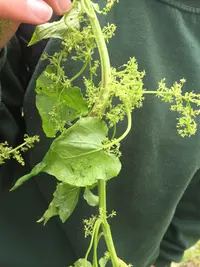
Provide a thin trellis or horizontal wires and gently wind the twining stems around them while still soft so the caudex remains exposed and the vining growth stays compact and easy to manage.

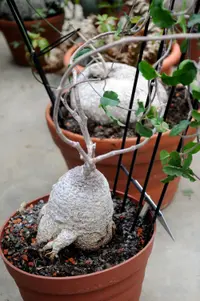
Hottentot bread (Fockea edulis) is a caudiciform succulent, grown mainly for its swollen, tuberous base and twining green stems. It is usually kept as a compact pot plant rather than for its small flowers.
In nature it occurs in arid and semi-arid regions of South Africa and Namibia, where it survives long dry periods by storing water and nutrients in its caudex. This storage habit makes it relatively forgiving of occasional missed waterings.
The plant prefers bright light, very well-drained soil, and careful watering that avoids long-term wetness around the roots. Once its basic needs are understood, it is not difficult to care for Hottentot Bread.

Care Difficulty
Moderate Care

Light Preference
Partial Sun

Water Requirements
Low Water

Temperature Preference
Tropical / Frost Sensitive

Hardiness Zone
10–11

Soil Texture
Sandy, Loamy, Rocky

Soil pH
Slightly acidic (6.5–7.0), Neutral (7.0)

Soil Drainage
Well-drained

Fertilization
Minimal (feed rarely)
Scan your plant to receive care tips personalized for your specific plant
Available on iOS and Android
This caudiciform succulent prefers bright, indirect light with some gentle direct sun each day.
This species stores water in its caudex, so watering should be infrequent and guided by soil dryness.
This plant prefers warm, dry conditions and reacts poorly to cold and frost.
This caudiciform succulent handles typical indoor air well and rarely needs special humidity control.
This species needs a very fast-draining, mineral-rich mix that keeps the caudex dry and well aerated.
This species is very suitable for container growing due to its compact caudex and controllable vines.
This caudiciform succulent grows well with light, controlled feeding rather than heavy fertilization.
Fockea edulis benefits from light, targeted pruning to manage its twining vines and maintain a compact form.
This species prefers a stable pot and infrequent disturbance, since its swollen caudex and fine roots dislike rough handling.
Fockea edulis is most reliably propagated from seed, with vegetative methods used less often by hobbyists.
This succulent is not frost hardy and needs thoughtful winter care in most temperate climates.

Plant Health Check
Not sure what's wrong with your plant? Check your plant's health inside the app.
The swollen underground stem, or caudex, has long been eaten raw or roasted by indigenous communities in southern Africa as an emergency or seasonal starch-rich food, which is why the species is commonly called hottentot bread.
This species is a deciduous climber that sheds its above-ground foliage in the dry season and stores water and nutrients in the caudex, an adaptation to the arid and semi-arid habitats of South Africa and Namibia.
In its native range, this plant serves as a larval food source for certain African swallowtail and other butterfly species, whose caterpillars feed on the leaves and stems while the plant survives thanks to its protected caudex.

The genus Fockea, including Fockea edulis, produces a white latex that is toxic in many related species, yet the large caudex of this particular species is notably edible after traditional preparation, making it an unusual example of a caudiciform succulent with a long-documented use as human food.
This species handles both conditions if kept warm and bright, but performs best outdoors in mild, frost-free climates. Indoors it stays smaller and needs very strong light, making careful Hottentot Bread indoor care especially important.
Keep your plants happy and healthy with plant identification, disease detection, and easy care guidance.