Provide sturdy support
Install a strong, upright trellis or moss pole at least 1.5–2 m tall and loosely secure vines with soft ties so aerial roots can attach and the plant can climb safely without kinking or snapping.

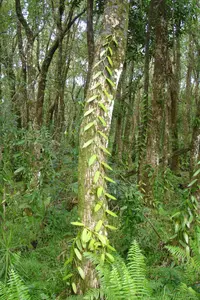
Vanilla orchids, usually referring to Vanilla planifolia, are climbing orchids grown for their scented pods, which are the source of natural vanilla flavoring. The plant has long, vine-like stems, fleshy green leaves, and aerial roots that cling to supports.
In nature, it occurs in tropical forests of Mexico and Central America, where it climbs trees in warm, humid shade. It can be challenging to grow indoors because it needs consistent warmth, high humidity, and space to climb, but is rewarding for patient growers who want to care for Vanilla orchids.
It prefers bright, filtered light, evenly moist but not waterlogged conditions, and a loose, airy orchid substrate that allows roots to breathe.

Care Difficulty
Hard Care

Light Preference
Bright Indirect Light

Water Requirements
Keep Soil Moist

Temperature Preference
Tropical / Frost Sensitive

Hardiness Zone
11–12

Soil Texture
Loamy, Peaty, Organic-rich

Soil pH
Acidic (5.5–6.5), Slightly acidic (6.5–7.0)

Soil Drainage
Moist but well-drained

Fertilization
Moderate (every 2–4 weeks)
Scan your plant to receive care tips personalized for your specific plant
Available on iOS and Android
This climbing orchid prefers bright, filtered light similar to bright tropical shade.
Watering should keep the root zone evenly moist but never saturated.
This species thrives in consistently warm, frost-free conditions.
This species needs consistently high humidity for vigorous vining and leaf health.
Vanilla planifolia prefers a loose, airy, organic-rich medium that behaves more like an epiphyte mix than traditional potting soil.
This species is suitable for container growing when the pot supports its climbing, top-heavy habit.
Vanilla planifolia benefits from light, consistent feeding during active growth to support long vines and flowering.
Pruning Vanilla planifolia manages size, improves air flow, and encourages flowering laterals along the vine.
Vanilla planifolia in containers needs occasional repotting to refresh the medium and give aerial roots more space.
Vanilla planifolia is commonly propagated from stem cuttings rather than seed, which is slow and specialized.
Vanilla planifolia is a tropical vine with poor frost tolerance and needs indoor or greenhouse conditions in cold climates.

Plant Health Check
Not sure what's wrong with your plant? Check your plant's health inside the app.
This species is native to lowland tropical forests of Mesoamerica, where it grows as a climbing vine (liana) in warm, humid, partially shaded conditions, often scrambling up tree trunks rather than living as a typical potted orchid.
In its native range, pollination in the wild is mainly carried out by specific Melipona stingless bees and sometimes hummingbirds, which is why outside this area flowers almost always require hand-pollination to develop vanilla pods.
The characteristic vanilla aroma comes largely from the compound vanillin, which is formed during careful curing and drying of the green seed pods; fresh pods from the plant have little fragrance until this enzymatic and oxidative process occurs.

The Aztec people highly valued this species long before global trade, using its cured pods to flavor xocoatl, a bitter cacao drink, which made it one of the earliest documented flavoring ingredients traded from the Americas to Europe.
Yellowing leaves usually come from chronic overwatering, cold drafts, nutrient imbalance, or natural aging of the oldest leaves. Check roots for rot, improve drainage, keep temperatures consistently warm, and feed lightly with a balanced orchid fertilizer during active growth.
Keep your plants happy and healthy with plant identification, disease detection, and easy care guidance.