Blue Passion Flower Care (Passiflora caerulea)

Also known as: bluecrown passionflower, blue passionfruit, Common Granadilla, Common Grenadella, Grenadilla, Passion Flower, Passion Fruit, Fiore della passione

About Blue Passion Flower

Blue passion flower (Passiflora caerulea) is a vigorous, woody vine grown for its striking, complex flowers and fast coverage of trellises, fences, or pergolas. It is an evergreen to semi-evergreen climber in mild climates and may drop leaves in colder areas.

The plant is native to South America, especially Argentina, Brazil, and Paraguay, but is widely grown in warm and mild-temperate regions. Showy blue and white flowers and decorative egg-shaped fruits give it strong ornamental value.

Passiflora caerulea is generally considered easier to grow than many other passionflowers, thanks to its tolerance of cooler conditions and occasional neglect. It prefers bright light, moderate moisture, and well-drained soil, so understanding how to care for Blue Passion Flower helps maintain healthy growth and flowering.

Main Plant Requirements

Care Difficulty

Moderate Care

Light Preference

Full Sun

Water Requirements

Moderate Water

Temperature Preference

Warm Climate

Hardiness Zone

7–11

Soil Texture

Sandy, Loamy, Organic-rich

Soil pH

Acidic (5.5–6.5), Slightly acidic (6.5–7.0)

Soil Drainage

Moist but well-drained

Fertilization

Light (every 4–6 weeks)

Get Personalized Care Plan

Scan your plant to receive care tips personalized for your specific plant

Personalized Care in the App

Available on iOS and Android

How to Care for the Blue Passion Flower

This vigorous climber needs strong light to flower heavily and grow dense foliage.

  • Provide 6–8 hours of direct sun daily; morning sun with light afternoon shade is ideal in hot summer regions.
  • Tolerates light partial shade (around 4–5 hours sun), but flowering of Blue Passion Flower decreases and vines become sparser in deeper shade.
  • In cooler climates, choose a south- or west-facing site; in very hot areas, protect from harsh late-afternoon sun to prevent leaf scorch.

This species prefers evenly moist, well-drained soil rather than constant wetness or complete drying.

  • Water when the top 3–5 cm of soil feels dry, soaking the root zone deeply, then let excess drain away to avoid root rot.
  • In spring and summer, check moisture more often during active growth and heat; reduce watering in fall and winter as growth slows.
  • Wilting with dry soil suggests underwatering; yellowing lower leaves, mushy stems, or a sour smell in the soil suggest overwatering in Passiflora caerulea.

This hardy passion vine grows best in mild, frost-free conditions but can tolerate short cold spells.

  • Optimal growth occurs around 65–80°F (18–27°C); flowering is strongest in warm, stable weather without sharp temperature swings.
  • Mature plants usually survive brief drops to about 15–20°F (-9 to -6°C) if roots are mulched, though top growth may die back.
  • In hot regions above 90°F (32°C), provide mulch and consistent moisture; protect from cold, drying winds and late spring frosts.

This species prefers moderate humidity and usually adapts to typical household levels.

  • Aim for 40–60% humidity; it tolerates brief dips lower but prolonged very dry air slows growth and flower production.
  • Watch for crispy leaf edges, rolling leaves, and stalled buds as signs of humidity stress in Blue Passion Flower.
  • Increase local humidity with nearby trays of water and pebbles or by grouping plants, rather than misting leaves frequently.

This vine needs free-draining, fertile soil that stays evenly moist but not waterlogged.

  • Use a loamy mix with high organic matter, such as 2 parts peat-free compost, 1 part perlite, and 1 part fine bark or coarse sand.
  • Ensure very sharp drainage; standing water around roots of Passiflora caerulea quickly leads to rot and poor vigor.
  • Aim for slightly acidic to neutral pH, roughly 6.0–7.0, to support nutrient uptake and steady growth.
  • Improve aeration by avoiding heavy clay-only substrates and breaking up compaction before planting, especially in outdoor beds.

This species is well suited to container growing when provided with support and adequate root space.

  • Choose a deep, heavy pot that stabilizes the vine and prevents tipping as the top growth becomes dense and climbing.
  • Select a container material that slows rapid drying, such as glazed ceramic or thick plastic, to buffer moisture swings in hot weather.
  • Use a container 30–40 cm wide with several unobstructed drainage holes so water exits quickly after thorough irrigation.

Passiflora caerulea responds well to moderate feeding during active growth.

  • Use a balanced liquid fertilizer (such as 10-10-10 or 20-20-20) at half strength every 2–4 weeks from spring to late summer.
  • Alternatively, apply a slow-release granular fertilizer or a thin layer of compost in early spring for steady nutrition.
  • Stop feeding in fall and winter to avoid forcing soft growth when light and temperature are low.
  • Flush the potting mix with plain water a few times per season to limit salt buildup from fertilizers.

Pruning supports flowering performance and manageable size in Passiflora caerulea.

  • Carry out main pruning in late winter or very early spring before strong new growth begins.
  • Remove dead, damaged, or crossing stems first, then thin crowded shoots to allow light and air into the vine.
  • Shorten long whips to a framework of strong, well-placed stems to control spread and improve flowering display.
  • Use sharp, clean bypass pruners and make cuts just above a healthy bud or side shoot to reduce dieback.

Container-grown plants of this vigorous climber benefit from periodic repotting or transplanting.

  • Look for roots circling the pot, pushing through drainage holes, or a plant that dries out very quickly as signs it needs more space.
  • Plan repotting or outdoor transplanting for spring, once frost risk has passed and new growth is starting.
  • Move up only 1 pot size, using a free-draining mix, and keep the root ball as intact as possible to limit shock.
  • Water thoroughly after planting, shade from intense sun for a few days, and maintain even moisture while roots re-establish.

This species is commonly propagated to maintain desirable flower and fruit traits.

  • Take 8–12 in semi-ripe stem cuttings in late spring or summer, removing lower leaves and dipping the base in rooting hormone.
  • Insert cuttings into a moist, free-draining medium, then keep at 70–75°F with high humidity and bright, indirect light until roots form.
  • Sow fresh seeds in spring in warm conditions; light scarification helps the hard seed coat absorb water and improves germination.
  • Simple layering of a flexible stem into soil can also root over a season while still attached to the parent plant.

In many mild climates, Blue Passion Flower is fairly hardy but benefits from some winter attention.

  • Mature plants in the ground often tolerate brief drops to about 15–20°F, though top growth may die back in severe cold.
  • Apply a 5–10 cm mulch layer over the root zone in late fall, keeping it slightly away from the main stem.
  • In colder regions, grow in containers and move plants indoors to a bright, cool, frost-free area before hard frost.
  • Reduce watering in winter so the soil stays lightly moist, not wet, to limit root rot in cool conditions.

Care Tips

Sturdy Trellis Support

Install a strong, weather-resistant trellis or wire framework before planting so the vines can be tied in loosely as they grow, preventing wind damage and stem breakage.

Selective Stem Training

Choose 2–4 main stems and gently spiral or fan them along the support, removing weak side shoots near the base to create a stable framework that flowers more evenly across the plant.

Root Zone Protection

Apply a 5–8 cm layer of organic mulch around the root zone, keeping it a few cm away from the stems, to moderate soil temperature and reduce stress during hot summers and light frosts.

Seasonal Hard Pruning

In late winter, cut back old, woody stems to strong buds closer to the framework to stimulate vigorous new growth and more flowering shoots in the coming season.

Strategic Pest Monitoring

Inspect the undersides of leaves and new growth weekly in warm weather and hose off early aphid or spider mite infestations before resorting to targeted treatments, which is a key step in caring for Blue Passion Flower.

Common Pests and Diseases

Passion vine hopper

This pest is a sap-sucking insect that weakens vines, causes leaf yellowing, and excretes honeydew that leads to sooty mold. Symptoms include stunted growth and a sticky residue on leaves and stems.

Solution

Prune and destroy heavily infested shoots, then spray the plant thoroughly with an insecticidal soap or a ready-to-use neem oil product, repeating every 7–10 days until activity stops. Encourage natural predators by avoiding broad-spectrum insecticides and keeping surrounding vegetation diverse and undisturbed.

Passionflower flea beetle

This pest chews characteristic shot-hole damage in leaves and can skeletonize young foliage when populations are high. Symptoms include ragged leaves and slowed growth, especially on young vines.

Solution

Handpick beetles in early morning and drop them into soapy water, and remove heavily damaged leaves. If damage continues, use a labeled spinosad or pyrethrin spray in the evening, coating both upper and lower leaf surfaces while protecting nearby beneficial insects as much as possible.

Passionflower anthracnose

This disease causes dark, sunken spots on leaves, stems, and sometimes fruit, often with a yellow halo. Symptoms include premature leaf drop and dieback of young shoots in warm, humid conditions.

Solution

Prune out and discard infected leaves and stems, disinfecting pruners between cuts, and improve air circulation by thinning dense growth and avoiding overhead watering. In regions with recurring problems, apply a copper-based or chlorothalonil fungicide at the first sign of spotting, repeating as directed during extended wet weather as part of overall Passiflora caerulea care.

Fusarium wilt

This disease is caused by a soil-borne fungus that invades the vascular system, leading to wilting, yellowing, and eventual death of vines even when soil is moist. Symptoms include one-sided wilting on a stem and brown discoloration inside stems when cut open.

Solution

Remove and destroy affected vines including as much root material as possible, and avoid replanting Passiflora in the same spot for several years. Improve soil drainage, water at the base only, and source new plants from reputable nurseries that monitor for Fusarium problems.

Scale insects

These insects appear as small, round or oval bumps on stems and leaf undersides, feeding on sap and excreting honeydew that attracts ants and promotes sooty mold. Symptoms include sticky leaves, yellowing, and general decline in vigor.

Solution

Gently scrape or wipe off visible scales with a cotton pad dipped in alcohol, then wash the plant with a strong stream of water. For persistent infestations, use horticultural oil or neem oil, applied thoroughly to all plant surfaces, repeating every 7–14 days to catch newly hatched crawlers.

Interesting Facts

Unusual cold tolerance

Unlike most passionflowers, this species can survive brief frosts and is often hardy down to about 15–20°F when well established, which allows it to grow outdoors in many temperate gardens where other Passiflora species fail.

Specialized pollination structure

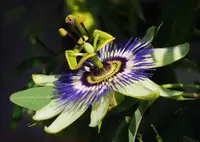
The prominent corona filaments, five anthers, and three stigmas are arranged in a complex 3‑dimensional structure that guides large insects to contact both pollen and stigma as they move through the flower, increasing pollination efficiency.

Naturalized outside native range

Native to South America, this species has escaped cultivation and naturalized in parts of Europe, the southeastern US, and other warm-temperate regions, where it can spread along hedges, fences, and disturbed sites.

Botan icon

Did you know?

The ornate floral pattern of this species was interpreted by early Christian missionaries in South America as a symbol of the Passion of Christ, which led to its common name passion flower and helped spread the plant through European botanical gardens in the 17th century.

FAQs about Blue Passion Flower

Lack of flowers often comes from insufficient maturity, heavy pruning at the wrong time, or excess nitrogen fertilizer. Poor light, root disturbance, or stress from cold snaps can also reduce bud formation and flowering performance.

Grow Healthy Plants with Botan Care

Keep your plants happy and healthy with plant identification, disease detection, and easy care guidance.

Botan plant care app — identify plants on mobile

Explore More Plants