Pot selection strategy
Use a heavy, low clay or ceramic pot with a drainage hole to counterbalance the top-heavy spines and reduce the risk of the plant tipping over as the stem thickens.

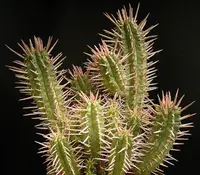
Thorn Noors (Euphorbia ferox) is a compact, spiny succulent from arid regions of South Africa. It forms a rounded, cactus-like clump covered with dense, stiff spines. New growth often shows green to blue-green stems, while older parts can take on a slightly woody look as the plant ages. Flowers are small and understated, appearing near the stem tips. This species grows slowly and stays relatively small, which suits windowsills and bright indoor spots. Its drought tolerance and minimal growth make it suitable for patient beginners who want to learn how to care for Thorn Noors without frequent watering or complex maintenance.

Care Difficulty
Easy Care

Light Preference
Full Sun

Water Requirements
Low Water

Temperature Preference
Tropical / Frost Sensitive

Hardiness Zone
10–11

Soil Texture
Sandy, Loamy, Rocky

Soil pH
Slightly acidic (6.5–7.0), Neutral (7.0)

Soil Drainage
Well-drained

Fertilization
Minimal (feed rarely)
Scan your plant to receive care tips personalized for your specific plant
Available on iOS and Android
This compact succulent prefers bright, mostly direct sun in dry climates.
This species stores water in its stem and needs thorough but infrequent watering.
This drought-adapted succulent prefers warm, dry conditions with cool but not freezing nights.
This succulent tolerates typical indoor humidity and rarely needs special adjustments.
This species needs very fast-draining, mineral-rich soil to prevent root and stem rot.
This plant is well suited to container growing due to its compact, slow habit.
This slow-growing succulent needs only light feeding to maintain compact, healthy growth when grown in containers as Thorn Noors.
Pruning Euphorbia ferox is minimal and mainly focused on safety and plant health rather than shaping.
This compact succulent stays small, so repotting is infrequent and mainly about renewing the soil and managing offsets.
Propagation of Euphorbia ferox is usually done from offsets or stem cuttings rather than seeds for predictable results.
This species prefers mild, dry winters and is not fully hardy in regions with prolonged freezes.

Plant Health Check
Not sure what's wrong with your plant? Check your plant's health inside the app.
This species is naturally restricted to the semi‑arid Karoo region of South Africa, where it grows on rocky slopes and gravelly flats with very sparse rainfall.
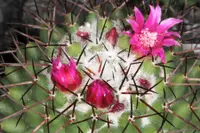
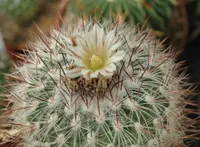
Mature plants form tight, dome‑shaped clusters of many short, cylindrical stems covered in dense, stiff spines that help shade the surface and reduce water loss in intense sun.
Like many members of Euphorbia, it produces a white latex sap that is irritating or toxic if ingested or if it contacts skin or eyes, so handling should be careful when stems are damaged or cut.

In its native habitat, this compact succulent often grows among stones and coarse gravel, where its rounded, spine‑covered stems visually blend with the surrounding rocks, likely providing some camouflage from herbivores in the open Karoo landscape.
This species grows slowly, typically adding only a few millimeters of height and girth each year. Growth accelerates slightly in warm months with steady light, but remains compact, making it suitable for long-term container display.
Keep your plants happy and healthy with plant identification, disease detection, and easy care guidance.

_4-1-200x112.webp)