Cautious repot timing
Repot only when roots visibly circle the pot or emerge from drainage holes, and schedule it for warm weather so the plant can recover quickly from root disturbance.


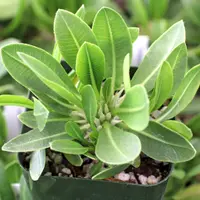
Pachypodium brevicaule is a dwarf, caudiciform succulent shrub known for its very flat, swollen base that often looks like a pale grey stone. Short, spiny stems and small, narrow leaves emerge from this base, creating a compact, sculptural plant.
It is native to rocky, highland areas of Madagascar, where it grows in full sun and very fast-draining, mineral soils. Growth is slow and the plant is sensitive to excess moisture, which makes how to care for Pachypodium brevicaule more demanding than for many common houseplants.
In cultivation it prefers bright light, warm temperatures, and a gritty substrate that dries quickly between waterings.

Care Difficulty
Hard Care

Light Preference
Full Sun

Water Requirements
Low Water

Temperature Preference
Tropical / Frost Sensitive

Hardiness Zone
11–12

Soil Texture
Sandy, Rocky, Loamy

Soil pH
Slightly acidic (6.5–7.0), Neutral (7.0)

Soil Drainage
Well-drained

Fertilization
Minimal (feed rarely)
Scan your plant to receive care tips personalized for your specific plant
Available on iOS and Android
This species needs strong, direct light to stay compact and healthy.
Watering must be infrequent and controlled to avoid root rot in this desert-adapted species.
This plant prefers warm, dry conditions and reacts poorly to cold and damp.
This species is adapted to very dry air, so humidity is rarely a concern indoors.
This desert succulent needs a very fast-draining, mineral-rich mix that dries quickly.
This species is well suited to container growing due to its compact caudex and slow growth.
This slow-growing Madagascan succulent needs light feeding to support healthy growth without stressing its compact caudex.
This species needs minimal pruning and is usually shaped by its natural growth rather than cutting.
Repotting is infrequent for this slow-growing caudiciform, but correct timing and gentle handling are important.
Propagation of this species is slow and usually done from seed rather than cuttings.
This plant is not frost hardy and needs a dry, cool but bright rest period in winter.

Plant Health Check
Not sure what's wrong with your plant? Check your plant's health inside the app.
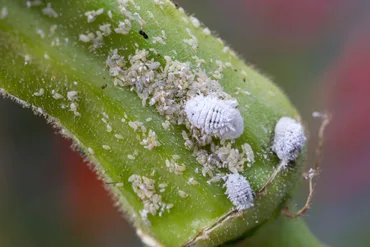
This pest commonly settles in leaf axils and along the rough caudex surface, feeding on sap and weakening the plant.
Symptoms include white cottony clusters, distorted new growth, and sticky honeydew on the plant or pot surface.
Solution
Isolate the plant, then remove visible insects with a cotton swab dipped in 70% isopropyl alcohol.
Follow with 1–2 light applications of a systemic insecticide labeled for succulents or repeated sprays of insecticidal soap, and reduce nitrogen fertilization.
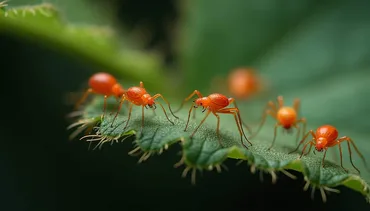
These insects thrive in warm, dry air and can colonize the rough skin of the caudex and undersides of the small leaves.
Symptoms include very fine webbing, dull or stippled leaves, and gradual leaf drop.
Solution
Increase humidity around the plant and rinse foliage and stems under a gentle stream of lukewarm water to remove mites.
After washing, apply a miticide or insecticidal soap approved for indoor use, and repeat at 5–7 day intervals until no new damage appears.
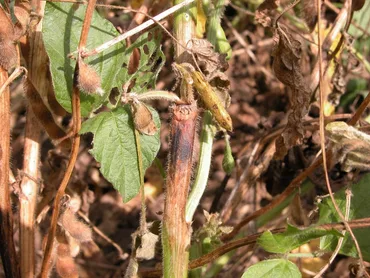
This disease can enter through wounds on the caudex or old leaf scars, leading to localized sunken, dark lesions that may expand slowly.
Symptoms include corky or discolored patches on the caudex that may exude sap and, in advanced cases, partial collapse of affected tissue.
Solution
Cut away all visibly affected tissue, then allow the wound to dry and callus in a warm, airy place with no watering on the caudex.
Disinfect tools between cuts, avoid overhead watering, and maintain a very free-draining mineral substrate to limit excess moisture that favors Fusarium spread.
This species naturally grows almost flat against quartz-rich rocky slopes in Madagascar, with its grey, warty caudex mimicking surrounding stones so closely that it can be hard to spot even at close range.
The plant forms a wide, flattened caudex that expands only slightly each year, and wild individuals are believed to take many years to reach even modest sizes, which contributes to its vulnerability in habitat.
Unlike many succulents that flower in warm seasons, this species often produces its yellow, tubular flowers during the cooler, drier period in its native high-elevation habitat, when leaves may be sparse or absent.

This species is endemic to a very restricted highland region in central Madagascar, and its narrow distribution on specialized quartzite substrates has led to it being considered at high conservation risk from habitat disturbance and over-collection.
This species grows very slowly, often adding only a few millimeters of caudex diameter per year. It stays extremely compact, forming a low, cushion-like mound rather than a tall stem or trunk.
Keep your plants happy and healthy with plant identification, disease detection, and easy care guidance.