


Stabilize Upright Spears
Group several spears together and secure them loosely with a soft tie near the base to keep tall leaves from leaning or snapping, especially as they elongate in low or indoor light.

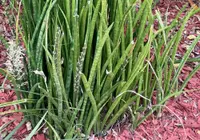
Dracaena angolensis, often called cylindrical snake plant, is a succulent houseplant with stiff, upright leaves that grow in smooth, round spears. The leaves are usually dark green with subtle striping and can be braided or left to fan out naturally.
This species is native to arid regions of Angola, which explains its strong tolerance of drought and irregular watering. It grows slowly and adapts well to containers, making it suitable for small spaces and low-maintenance interiors.
The plant copes with a wide range of indoor light and is not demanding, so many owners find it straightforward to care for Cylindrical snake plant.

Care Difficulty
Easy Care

Light Preference
Bright Indirect Light

Water Requirements
Low Water

Temperature Preference
Tropical / Frost Sensitive

Hardiness Zone
10–12

Soil Texture
Sandy, Loamy, Organic-rich

Soil pH
Acidic (5.5–6.5), Slightly acidic (6.5–7.0)

Soil Drainage
Well-drained

Fertilization
Minimal (feed rarely)
Scan your plant to receive care tips personalized for your specific plant
Available on iOS and Android
This species prefers bright, filtered light and tolerates some shade with slow growth.
Dracaena angolensis stores water in its thick leaves and needs infrequent, careful watering.
This species prefers warm, stable temperatures and does not tolerate frost.
This species tolerates a wide range of indoor humidity and rarely needs special adjustments.
This species prefers a very fast-draining, airy mix similar to a cactus or succulent substrate.
This species is well-suited to container growing, both indoors and on sheltered patios.
This drought-tolerant species needs modest feeding, so focus on light, infrequent fertilizer during active growth.
Pruning Dracaena angolensis is minimal and mainly focused on tidying and managing height.
This slow-growing succulent prefers slightly tight conditions and only occasional repotting.
Multiplying this species is straightforward by division or cuttings taken during warm months.
This succulent is frost-sensitive and requires mild, dry conditions during winter.

Plant Health Check
Not sure what's wrong with your plant? Check your plant's health inside the app.
The species forms nearly round, rod-like leaves with internal water-storing tissues that reduce surface area, a structural adaptation that limits water loss in its semi-arid native habitats of Angola.
Its stiff, upright leaves emerge from a basal rosette and naturally arrange into fan-shaped clusters or slow spirals, a growth pattern that helps the plant support its own weight and expose more leaf surface evenly to light.
Like many drought-adapted succulents, this plant uses crassulacean acid metabolism (CAM), opening stomata mostly at night to take in carbon dioxide, which conserves water compared with typical day-opening leaf physiology.

Mature clumps in habitat can produce tall, branched flower stalks with narrow, greenish-white tubular flowers that are scented at night and mainly pollinated by nocturnal insects, an adaptation to hot, dry environments where daytime pollinator activity is limited.
Brown tips or patches usually come from underwatering, very dry air, salt buildup from fertilizer, or sudden cold drafts. Check soil moisture, flush excess salts occasionally, and keep it away from heaters, air vents, and cold windows.
Keep your plants happy and healthy with plant identification, disease detection, and easy care guidance.

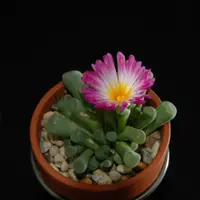
Fairy Elephant's-feet
Frithia pulchra
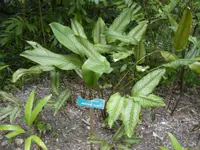
Pin-stripe calathea
Goeppertia ornata
 POPULAR
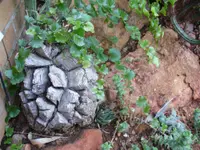
Elephant's Foot Plant
Dioscorea elephantipes
Common Tiptoothfig
Acrodon bellidiflorus
star jasmine
Jasminum multiflorum
Dragon Wing Begonia
Begonia Dragon Wing Pink
Pennywort Begonia
Begonia hydrocotylifolia
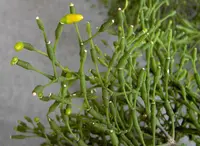
Dancing bones cactus
Hatiora salicornioides