


Provide climbing support
Install a sturdy moss pole or rough wooden plank and gently tie new vines with soft plant ties so aerial roots can attach and leaves size up instead of stretching weakly outward.

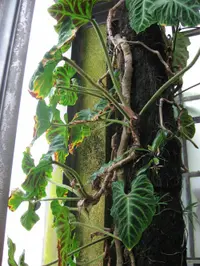
Philodendron verrucosum is a climbing aroid valued for its striking, velvety foliage. Mature leaves are heart-shaped, deeply veined, and often show contrasting green tones with reddish undersides.
This species is native to tropical rainforests of Central and South America, where it grows as an epiphyte on trees in warm, humid, shaded environments.
It can be moderately challenging for beginners because it dislikes cold, dry air, and inconsistent moisture. Providing stable warmth, high humidity, and airy, well-drained soil is important.
Understanding how to care for Philodendron verrucosum helps prevent leaf damage and slow growth, especially in typical indoor conditions with lower humidity and fluctuating temperatures.

Care Difficulty
Moderate Care

Light Preference
Bright Indirect Light

Water Requirements
Moderate Water

Temperature Preference
Tropical / Frost Sensitive

Hardiness Zone
11–12

Soil Texture
Loamy, Peaty, Organic-rich

Soil pH
Acidic (5.5–6.5), Slightly acidic (6.5–7.0)

Soil Drainage
Moist but well-drained

Fertilization
Light (every 4–6 weeks)
Scan your plant to receive care tips personalized for your specific plant
Available on iOS and Android
This plant prefers bright, filtered light that mimics a bright rainforest understory.
Watering should keep the root zone evenly moist but never saturated.
Stable, warm conditions support healthy foliage and root growth.
This species needs high humidity to maintain healthy foliage and steady growth.
This aroid prefers a loose, airy, organic-rich mix that drains fast yet holds steady moisture.
This species is well suited to container growing when the pot supports its vining, climbing habit.
This aroid benefits from modest, consistent feeding during its active season for balanced Philodendron verrucosum growth.
Thoughtful pruning keeps Philodendron verrucosum compact, healthy, and easier to manage indoors.
Container-grown plants appreciate periodic repotting to refresh soil and support healthy Philodendron verrucosum indoor care.
This climbing species is most often propagated from stem cuttings rather than seed for predictable Philodendron verrucosum plant care.
This tropical philodendron has no frost tolerance and needs warm, stable winter conditions indoors.

Plant Health Check
Not sure what's wrong with your plant? Check your plant's health inside the app.
The leaf blades have a dense layer of tiny hairs (pubescence) that creates a velvety texture and slightly matte sheen, which helps diffuse strong light in its native understory habitat.
The petioles are distinctly rough and bristly, with small wart-like projections that give the species its name verrucosum, meaning warty or roughened in Latin.
Wild populations in Ecuador and Peru show considerable variation in leaf shape, size, and vein coloration, and some cultivated plants are thought to be natural hybrids or regional forms rather than a single uniform clone.

This species is an obligate climber in nature, spending its life attached to tree trunks in humid premontane and montane forests of Ecuador and Peru, where its leaves develop their largest size and most pronounced metallic veining only once it has climbed higher into brighter canopy light.
Browning edges usually result from low humidity, underwatering, or fertilizer salts building up in the potting mix. Check soil moisture, flush the soil occasionally, and increase ambient humidity. Avoid placing the plant near hot or cold drafts.
Keep your plants happy and healthy with plant identification, disease detection, and easy care guidance.

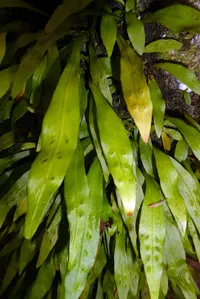
lance fern
Loxogramme dictyopteris
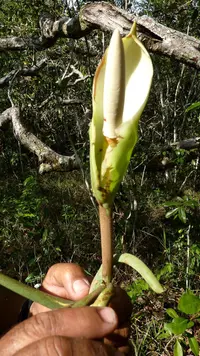
Philodendron pedatum
Philodendron pedatum

White Variegated Monstera
Monstera deliciosa 'Albovariegata'
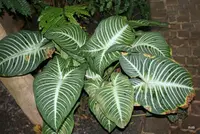 POPULAR
Caladium lindenii
Caladium lindenii
 POPULAR
Philodendron mayoi
Philodendron mayoi
Monstera 'Karstenianum'
Monstera 'Karstenianum'
silver peanut butter fruit
Bunchosia argentea
 POPULAR
Moon Valley
Pilea mollis