Floating mat control
Regularly thin and lift dense mats with long tweezers to prevent lower portions from shading out and decaying, which keeps water quality stable and growth compact.


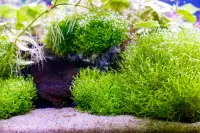
Crystalwort (Riccia fluitans) is a small floating liverwort often used in aquariums and paludariums. It forms bright green, cushion-like mats of finely branched, flat thalli. In nature it occurs in still or slow-moving fresh water across many regions worldwide, attaching loosely to rocks, wood, or remaining free-floating.
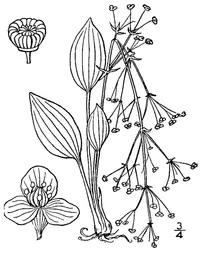
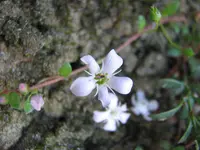
This plant grows quickly under stable conditions, which makes it attractive but sometimes a bit invasive in closed tanks. It is generally considered easy to manage once its needs for clean water, steady light, and good nutrients are understood, so learning how to care for Сrystalwort helps keep it dense and healthy. Another free-floating aquatic plant is Water spangles, which also forms surface mats but has distinct floating leaves.

Care Difficulty
Moderate Care

Light Preference
Partial Shade

Water Requirements
Aquatic

Temperature Preference
Tropical / Frost Sensitive

Hardiness Zone
Unknown

Soil Texture
Organic-rich, Peaty

Soil pH
Acidic (5.5–6.5), Slightly acidic (6.5–7.0)

Soil Drainage
Waterlogged tolerant

Fertilization
Light (every 4–6 weeks)
Scan your plant to receive care tips personalized for your specific plant
Available on iOS and Android
Riccia fluitans grows best with bright, indirect light that is stable throughout the day.
Riccia fluitans is a true aquatic plant and depends on consistently clean, well-oxygenated water rather than soil moisture.
This floating aquatic liverwort prefers stable, mild water temperatures without sudden swings.
This floating liverwort needs very high humidity to avoid desiccation.
This aquatic liverwort does not require traditional soil and instead anchors to hard surfaces or floats freely.
This species is well suited to container culture in aquariums, nano tanks, and shallow water trays.
This floating liverwort benefits from light, consistent nutrition rather than heavy feeding.
Pruning Riccia fluitans is mainly about controlling spread and keeping mats healthy and light-permeable.
This species is not truly repotted; it is repositioned or remounted as mats in the aquarium or paludarium.
Riccia fluitans is commonly multiplied by division of its small, branching thalli rather than by spores in home aquariums.
Winter care for this aquatic species focuses on temperature stability rather than traditional outdoor protection.

Plant Health Check
Not sure what's wrong with your plant? Check your plant's health inside the app.
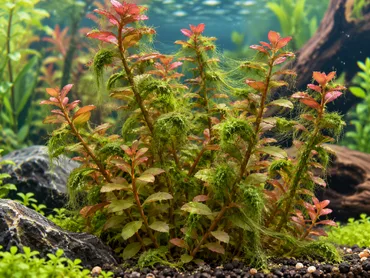
This problem appears when excess light and nutrients allow filamentous or green spot algae to smother the plant mats.
Symptoms include Riccia turning darker, trapped in hair-like strands, and losing its floating, airy structure.
Solution
Reduce light intensity or duration to 6–8 hours, lower dissolved nutrients by smaller, more frequent water changes, and manually remove algae with a soft brush or siphon.
Increase water flow around the Riccia, avoid overfeeding fish, and use fast-growing stem plants or a balanced CO2 and fertilization regime to outcompete algae .
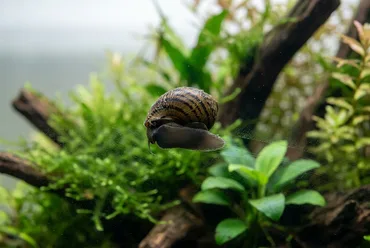
These animals may rasp the delicate thalli, leading to thinning patches, ragged edges, and slow disintegration of the mat, especially in small tanks or with high snail populations.
Solution
Manually remove excess snails, reduce excess food in the aquarium, and use snail traps at night to lower numbers.
Move Riccia to a nursery tank, introduce snail-eating fish or invertebrates that suit the system, and regularly trim and re-anchor healthy sections.
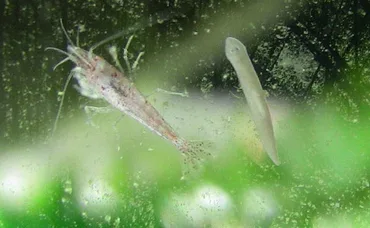
These flatworms thrive in nutrient-rich, overfed aquariums and often hide among the dense Riccia cushions, stressing shrimp fry and making maintenance difficult.
Solution
Cut back feeding, vacuum debris from and under the Riccia mat, and perform several partial water changes to reduce organic load.
Treat with a planaria-safe dewormer following aquarium dosage guidelines, then rinse and thin the Riccia to remove dead worms.
This liverwort can grow both floating at the water surface and attached to hardscape or substrate, changing its growth form depending on light and water movement.
It has a very simple thallus (flat plant body without true leaves or roots) that represents an early evolutionary stage of land plants, making it a model organism in studies of bryophyte biology.
In aquariums it forms dense, branching mats that trap tiny food particles and provide important hiding spaces for fish fry and small invertebrates.

Riccia fluitans is one of the few aquatic liverworts that can rapidly colonize newly flooded habitats, allowing it to appear and spread quickly in temporary pools, rice paddies, and drainage ditches after seasonal rains.
Growth is usually rapid under strong light, stable CO2, and adequate nutrients, often forming dense mats within a few weeks. Poor light, low nutrients, or frequent disturbance slow it significantly, so consistent conditions are key when aiming to grow Riccia fluitans.
Keep your plants happy and healthy with plant identification, disease detection, and easy care guidance.