Rhizome Mounting
Attach the rhizome to rock or driftwood with cotton thread or plant-safe glue, leaving it fully exposed so it does not rot in substrate.

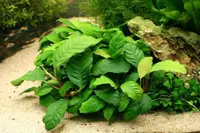
Anubias barteri is a slow-growing, semi-aquatic aroid commonly used in freshwater aquariums and paludariums. It forms sturdy, dark green leaves on short stems emerging from a creeping rhizome. Native to shaded streams and riverbanks in West Africa, it is adapted to low light and gentle water movement. The plant often attaches to rock or wood and grows in compact clumps rather than tall, fast shoots. Its tough leaves, slow metabolism, and tolerance of varied water conditions make it one of the easier aquarium plants to maintain. Those traits explain why many aquarists find it straightforward to care for Anubias barteri in both beginner and mixed-species setups.

Care Difficulty
Easy Care

Light Preference
Partial Shade

Water Requirements
Aquatic

Temperature Preference
Tropical / Frost Sensitive

Hardiness Zone
Unknown

Soil Texture
Loamy, Silty, Organic-rich

Soil pH
Acidic (5.5–6.5), Slightly acidic (6.5–7.0)

Soil Drainage
Waterlogged tolerant

Fertilization
Light (every 4–6 weeks)
Scan your plant to receive care tips personalized for your specific plant
Available on iOS and Android
This slow-growing aquatic plant prefers gentle, indirect light rather than direct, intense sun.
This rhizomatous aquatic plant prefers stable moisture around the roots and rhizome without prolonged stagnation in debris-filled water.
This tropical aquatic species prefers stable, warm conditions and reacts poorly to rapid temperature swings.
This species stays healthy across a wide humidity range but prefers moderately moist air.
In aquariums, this plant attaches to hardscape rather than rooting in conventional soil or substrate.
This species is very suitable for container culture in both aquariums and emersed setups.
This slow-growing aquatic species needs only light, occasional nutrition to maintain healthy foliage.
Pruning is mainly used to keep Anubias barteri compact and to remove declining foliage under water.
This rhizomatous aquarium plant is usually attached to hardscape rather than potted, so repotting is infrequent.
Anubias barteri is commonly propagated by division of the rhizome rather than by seed in home aquariums.
As a tropical aquarium plant kept indoors, Anubias barteri usually needs minimal winter-specific care.

Plant Health Check
Not sure what's wrong with your plant? Check your plant's health inside the app.
This species is an extremely slow grower, often producing only a few new leaves per year when fully submerged, which makes its leaf tissue dense and long-lasting in aquariums.
Anubias barteri stores resources in a thick horizontal rhizome, allowing it to recover from leaf damage or grazing as long as the rhizome remains healthy and not buried in substrate.
In nature this plant occurs along shaded rivers and streams in West Africa, where it often grows attached to rocks and wood in areas that may be periodically submerged or exposed.

In its native range, this species sometimes flowers underwater and can still complete pollination and seed development, an ability that is relatively uncommon among aquatic aroids.
Yellowing leaves usually result from nutrient deficiency, low CO2, or old age of individual leaves. Check for limited nitrogen, potassium, or iron, and ensure stable water parameters and clean, algae-free leaf surfaces.
Keep your plants happy and healthy with plant identification, disease detection, and easy care guidance.

-1-200x154.webp)