


Stem renewal
Every 2–3 years, cut and re-root a few healthy stems in fresh gritty mix to renew the clump and keep plants compact instead of letting old, woody bases dominate.

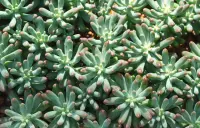
Sedum pachyphyllum, commonly called jelly beans or many-fingers, is a compact succulent from dry regions of Mexico. It forms low, branching clumps with short stems and dense, cylindrical leaves. The leaves are thick, bead-like, and often tipped with red when grown in strong light, giving the plant its jelly bean look. In good conditions, it may produce small yellow star-shaped flowers above the foliage. This species is popular for containers, rock gardens, and windowsills because it stays relatively small and tolerates some neglect. It prefers bright light, quick-draining soil, and infrequent watering, which makes it suitable for beginners learning how to care for Jelly Beans.

Care Difficulty
Easy Care

Light Preference
Full Sun

Water Requirements
Low Water

Temperature Preference
Warm Climate

Hardiness Zone
9–11

Soil Texture
Sandy, Loamy, Rocky

Soil pH
Slightly acidic (6.5–7.0), Neutral (7.0)

Soil Drainage
Well-drained

Fertilization
Minimal (feed rarely)
Scan your plant to receive care tips personalized for your specific plant
Available on iOS and Android
This succulent prefers strong light to maintain compact, colorful growth.
Watering should be infrequent and guided by soil dryness rather than a fixed schedule.
Stable, mild warmth supports dense, healthy growth in this succulent.
This succulent prefers dry air and rarely needs humidity adjustment indoors.
Sedum pachyphyllum needs very fast-draining, mineral-rich soil to avoid root rot.
This species is well suited to container growing, especially in small, sun-exposed pots.
This succulent needs only light feeding to stay healthy and compact.
Pruning Sedum pachyphyllum is optional but helpful for keeping plants dense and tidy.
Container-grown plants need infrequent repotting due to their shallow, fibrous root system.
This species is commonly multiplied from stem and leaf cuttings rather than seed.
This succulent is moderately cold tolerant but benefits from simple winter precautions in colder regions.

Plant Health Check
Not sure what's wrong with your plant? Check your plant's health inside the app.
This species stores water in short, cylindrical leaves whose outer cells contain more pigments when exposed to strong light, causing the characteristic red-tipped “jelly bean” appearance.
It is naturally distributed in arid to semi-arid regions of central Mexico, where it grows on rocky slopes and outcrops with very thin, fast-draining soils.
In its native habitat, stems that fall or lean onto the ground can root at the nodes, allowing the plant to slowly form low, sprawling clumps from genetically identical pieces.

In habitat, this plant often grows in exposed, sun-baked sites where daytime leaf temperatures can be much higher than the surrounding air, yet the succulent leaf tissue maintains internal water balance by opening its microscopic pores mainly at night, an adaptation known as CAM photosynthesis.
Leaf tips usually turn brown from underwatering, intense direct sun, or sudden temperature swings. Check soil dryness, increase watering slightly, and give bright light with some protection from harsh afternoon sun to prevent further tissue damage.
Keep your plants happy and healthy with plant identification, disease detection, and easy care guidance.

-200x133.webp)
_(49532732922)-2-200x133.webp)