


Rotate For Symmetry
Turn the pot 90° every 2–3 weeks so the rosette stays compact and balanced instead of leaning toward the strongest light source.

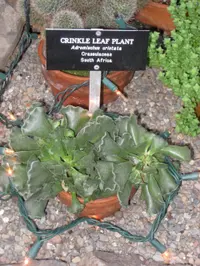
Crinkle leaf (Adromischus cristatus) is a compact, slow-growing succulent from rocky areas of South Africa. It forms low clusters of thick, tongue-shaped leaves with distinct crinkled tips. Leaves often show gray-green tones with fine powdery coating and may develop reddish edges in strong light.
This plant stays small and is suited to windowsills, desks, and mixed succulent displays. Its drought tolerance and shallow root system make it relatively easy to manage indoors.
Light, fast-draining soil, and careful watering are the main points to understand when learning how to care for Crinkle leaf.

Care Difficulty
Easy Care

Light Preference
Bright Indirect Light

Water Requirements
Low Water

Temperature Preference
Tropical / Frost Sensitive

Hardiness Zone
10–11

Soil Texture
Sandy, Loamy, Rocky

Soil pH
Slightly acidic (6.5–7.0), Neutral (7.0)

Soil Drainage
Well-drained

Fertilization
Minimal (feed rarely)
Scan your plant to receive care tips personalized for your specific plant
Available on iOS and Android
This compact succulent needs bright light but not all-day harsh sun.
This species prefers infrequent, deep watering with thorough drying in between.
This succulent favors mild, dry conditions and is sensitive to frost.
This succulent prefers dry indoor air and does not need extra humidity.
This species needs a very fast-draining, mineral-based mix that dries quickly between waterings.
This compact succulent is very suitable for container growing.
Adromischus cristatus has low nutrient needs but responds well to light feeding in active growth.
Adromischus cristatus needs only light pruning to keep a compact, healthy shape.
This compact succulent grows slowly and needs infrequent repotting in a well-drained mix.
This species is commonly propagated from leaves and short stem cuttings.
This succulent is not frost hardy and needs mild, dry winter conditions, especially in containers.

Plant Health Check
Not sure what's wrong with your plant? Check your plant's health inside the app.
The leaves form flat, paddle-shaped blades with a distinct crinkled or frilled edge, created by uneven expansion of leaf tissues along the margin during growth.
Individual leaves can root and form new plants from the base of the detached leaf, a form of vegetative reproduction that allows the species to persist even if stems are damaged.
In the wild, this species naturally occurs on rocky sandstone slopes in the Eastern and Western Cape of South Africa, often growing in shallow pockets of gritty soil with strong drainage.

In its native habitat, this succulent often grows wedged between rocks where fog and coastal mists contribute more to its water supply than direct rainfall, an adaptation that helps it survive in very localized microclimates.
This species often blooms only when mature and given a cool, bright, dry winter rest. Lack of flowers usually relates to insufficient light, excess winter watering, or warmth that prevents the natural cool-season trigger.
Keep your plants happy and healthy with plant identification, disease detection, and easy care guidance.

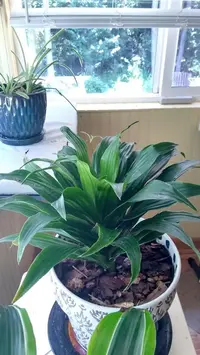
Dracaena
Dracaena fragrans 'Janet Craig Compacta'
 POPULAR
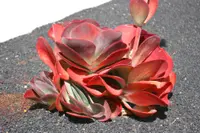
Paddle plant
Kalanchoe luciae
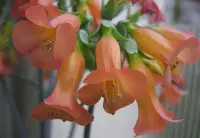
Chandelier plant
Kalanchoe delagoensis
Latin American orchid
Oncidium ensatum
elephantear pricklypear
Opuntia tuna
Bird's Nest Snake Plant
Dracaena trifasciata 'Golden Hahnii'
Black Pagoda
Aeschynanthus longicaulis
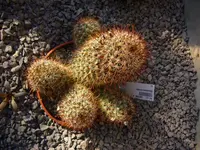
Cochemiea armillata
Cochemiea armillata