Rotate container
Turn the pot 90° every 1–2 weeks during active growth so the single leaf umbrella develops an even, balanced canopy and the petiole does not lean or twist excessively toward the light.

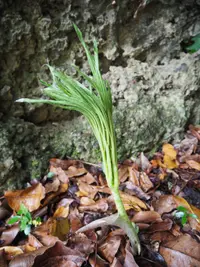
Amorphophallus henryi is a tuberous aroid grown mainly for its unusual single seasonal leaf and striking, sculptural form. It produces one tall, speckled petiole topped by an umbrella-like leaf that can look almost tree‑like in maturity. Native to parts of China, it grows in forested or woodland habitats with warm, moist summers and a dry resting period. The plant enters dormancy after the growing season, dying back to its underground tuber until conditions improve. These strong seasonal changes and its sensitivity to overwatering in dormancy are the main challenges when learning how to care for Amorphophallus henryi. It generally prefers bright, filtered light, airy humus-rich soil, and consistent moisture only while in active growth.

Care Difficulty
Hard Care

Light Preference
Partial Shade

Water Requirements
Regular Water

Temperature Preference
Tropical / Frost Sensitive

Hardiness Zone
10–11

Soil Texture
Loamy, Sandy, Organic-rich

Soil pH
Acidic (5.5–6.5), Slightly acidic (6.5–7.0)

Soil Drainage
Moist but well-drained

Fertilization
Light (every 4–6 weeks)
Scan your plant to receive care tips personalized for your specific plant
Available on iOS and Android
This tuberous aroid prefers bright, gentle light that mimics dappled forest shade.
This species needs steadily moist but sharply drained soil during active growth and much less moisture when dormant.
This plant grows best in warm, frost-free conditions with a distinct cool, dry dormant period.
This species prefers moderately moist air but usually copes with typical home humidity.
This tuberous aroid needs loose, airy, and sharply drained soil to prevent rot.
This species is well suited to container culture when given a deep, stable pot.
Feed Amorphophallus henryi modestly to support foliage and corm development without causing soft, weak growth.
Pruning needs for Amorphophallus henryi are minimal and mainly focused on hygiene rather than shaping.
Repotting or transplanting focuses on giving the corm fresh, well-drained substrate and enough space for seasonal expansion.
Propagation of Amorphophallus henryi is usually done by dividing offsets rather than from seed in home conditions.
Cold sensitivity means Amorphophallus henryi typically needs managed dormancy in cooler climates.

Plant Health Check
Not sure what's wrong with your plant? Check your plant's health inside the app.
This species is native to central China, where it grows in leaf litter on shaded limestone slopes and forest edges, showing a strong preference for alkaline, calcareous soils compared with many other Amorphophallus species that favor more acidic substrates.
During its vegetative phase it produces a single, umbrella-like leaf on a solitary stalk (petiole) that is often mottled in green and pale tones, providing camouflage among forest floor patterns rather than the strong contrasting marbling seen in some related species.
The inflorescence typically emerges close to ground level and remains relatively small and low compared with the towering blooms of some congeners, an adaptation that likely enhances access for crawling carrion-associated pollinators that respond to its odor cues.
This species usually flowers only when the tuber reaches adequate size and has stored enough energy. Immature or recently divided tubers rarely bloom. Blooming often occurs after a full growing season followed by a cool, dry rest period.
Keep your plants happy and healthy with plant identification, disease detection, and easy care guidance.