Secure Leaf Support
Provide tall, stable stakes or a moss pole and loosely tie the long leaves in several places so their weight does not crease or snap the midrib as they elongate.

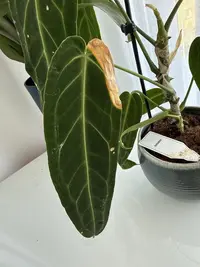
Queen anthurium, Anthurium warocqueanum, is a tropical aroid prized for its long, pendant leaves and striking, velvety texture. It is usually grown as a high-humidity foliage specimen rather than for flowers.
In nature it occurs in Colombian rainforests, where it grows as an epiphyte, anchoring to trees rather than soil. This origin explains its need for warm, stable conditions and airy, moisture-retentive substrates.
The plant is considered challenging because it reacts quickly to low humidity, poor airflow, and unstable watering. Understanding how to care for Queen Anthurium starts with providing bright filtered light, consistent moisture, and good root oxygenation.

Care Difficulty
Hard Care

Light Preference
Bright Indirect Light

Water Requirements
Keep Soil Moist

Temperature Preference
Tropical / Frost Sensitive

Hardiness Zone
11–13

Soil Texture
Loamy, Peaty, Organic-rich

Soil pH
Acidic (5.5–6.5)

Soil Drainage
Moist but well-drained

Fertilization
Light (every 4–6 weeks)
Scan your plant to receive care tips personalized for your specific plant
Available on iOS and Android
This species prefers bright, indirect light that mimics high-canopy tropical forest conditions.
Anthurium warocqueanum requires evenly moist but never waterlogged substrate around its fine roots.
This aroid thrives in consistently warm, humid conditions with minimal temperature swings.
This species needs high, stable humidity to keep leaves large and healthy.
Anthurium warocqueanum prefers a very airy, chunky, organic-rich medium that drains fast but stays lightly moist.
This species grows well in containers when the pot supports its tall, leaf-heavy growth and moisture-sensitive roots.
Anthurium warocqueanum benefits from light, consistent feeding during active growth for strong foliage.
Pruning Anthurium warocqueanum is mainly hygienic, keeping foliage healthy and manageable.
This species prefers a stable environment, so repotting Anthurium warocqueanum is done only when clearly needed.
Propagation of Anthurium warocqueanum is usually done on established plants and requires controlled conditions.
This plant is tropical and highly sensitive to cold, so winter care focuses on stable indoor conditions.

Plant Health Check
Not sure what's wrong with your plant? Check your plant's health inside the app.
The deep velvet look of its leaves comes from dense microscopic hairs that scatter light, a surface adaptation that helps protect the leaf from intense rainforest glare and excess water loss.
Mature leaves can grow extremely long and hang down in a pendant fashion, an adaptation that lets the plant capture light efficiently in shaded, vertical rainforest habitats.
In its native Colombian forests, this species grows as an epiphyte or hemi-epiphyte on tree trunks, using aerial roots to anchor to bark while taking up moisture and nutrients from organic debris rather than soil.

Wild specimens have been documented with individual leaves over 1.5 m long, which is one reason Anthurium warocqueanum is considered one of the largest-leaved species grown by aroid collectors.
Brown tips or edges usually result from low humidity, salt buildup from fertilizer, or past underwatering. Large brown patches may indicate leaf burn from direct sun or root rot. Remove damaged leaves and correct the underlying issue.
Keep your plants happy and healthy with plant identification, disease detection, and easy care guidance.