Staggered deadheading
Remove spent flowers every few days rather than all at once, which keeps the plant in active bloom and lets you monitor for early signs of rot or stem weakness at the same time.

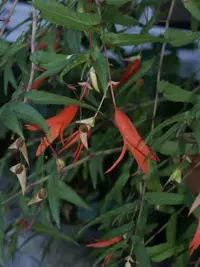
Begonia boliviensis, often called Bolivian begonia, is a tuberous flowering plant valued for its long, arching stems and abundant pendulous blooms. It forms a cascading habit, making it useful for hanging baskets and containers.
Flowers are typically tubular and bright in color, standing out against narrow, pointed green leaves. In nature, this species grows on rocky cliffs and slopes in the Andes of Bolivia and neighboring regions, where conditions are cool, bright, and well drained.
The plant is considered moderately easy, as it responds well to consistent moisture, airy soil, and bright but not harsh light. Understanding how to care for Bolivian begonia helps maintain steady flowering and a compact, healthy shape.

Care Difficulty
Moderate Care

Light Preference
Partial Shade

Water Requirements
Moderate Water

Temperature Preference
Tropical / Frost Sensitive

Hardiness Zone
10–11

Soil Texture
Loamy, Peaty, Organic-rich

Soil pH
Acidic (5.5–6.5), Slightly acidic (6.5–7.0)

Soil Drainage
Moist but well-drained

Fertilization
Moderate (every 2–4 weeks)
Scan your plant to receive care tips personalized for your specific plant
Available on iOS and Android
This species prefers bright but gentle light that mimics dappled mountain shade.
This tuberous begonia needs steady moisture in well-drained soil without staying soggy.
This plant grows best in mild, frost-free conditions with cool nights and moderate daytime warmth.
This species prefers moderate humidity and benefits from slightly moist air in homes.
This species needs airy, moisture-retentive but sharply draining soil to protect its tuber and fine roots.
This species is well suited to container growing, especially for hanging baskets and patio pots.
Nutrient support keeps Begonia boliviensis flowering well but it is sensitive to excess salts.
Targeted pruning helps Begonia boliviensis stay compact, healthy, and floriferous.
Container-grown Begonia boliviensis benefits from periodic repotting to refresh soil and manage roots.
Begonia boliviensis is commonly propagated from stem cuttings or by dividing tuberous roots.
This species is not frost hardy and needs planned winter care in most climates.

Plant Health Check
Not sure what's wrong with your plant? Check your plant's health inside the app.
This species is native to cool, rocky slopes of the Bolivian and northwestern Argentinian Andes, where it often grows in crevices and on cliffs exposed to mist and seasonal rainfall.
It forms underground tubers that store starch and water, allowing the plant to survive a pronounced dry or cool season and resprout when conditions improve.
In its native range, the long, narrow, pendulous orange-red flowers are adapted for pollination by hummingbirds, which can easily access the nectar while hovering around the blooms.

This wild Andean species was a key parent in breeding many modern hanging basket begonias, and its distinctive pendant flower form strongly influenced the look of contemporary hybrids used in ornamental horticulture.
Lack of blooms often comes from insufficient light, depleted nutrients, or the plant being too crowded. Old, exhausted tubers also flower poorly. Regular feeding, dividing congested clumps, and providing bright, indirect light usually restore flowering.
Keep your plants happy and healthy with plant identification, disease detection, and easy care guidance.