Control plant density
Thin out crowded stems a few times per year by cutting whole shoots at the base; this improves airflow inside the mat of growth and reduces the risk of rot and fungus gnats when caring for Rattail crassula.

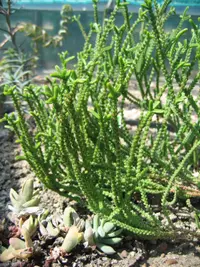
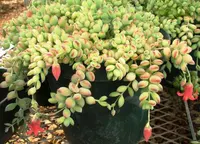
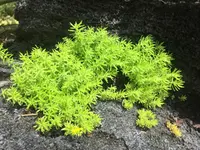
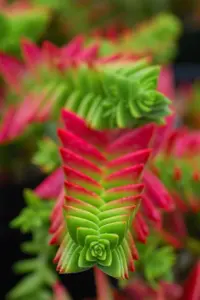
Rattail crassula (Crassula muscosa) is a compact, succulent shrublet known for its densely stacked, tiny leaves that form thin, tail-like stems. It often grows in tight mats or cascading strands, making it suitable for small pots, mixed succulent containers, and hanging planters.
In nature, it occurs in arid regions of South Africa and Namibia, where it is adapted to bright light and dry conditions. Its drought tolerance and small root system usually make it easy to keep in indoor collections, as long as overwatering is avoided.
Those learning how to care for Rattail crassula mainly need to focus on providing bright light, quick-draining soil, and infrequent but thorough watering.

Care Difficulty
Moderate Care

Light Preference
Bright Indirect Light

Water Requirements
Low Water

Temperature Preference
Tropical / Frost Sensitive

Hardiness Zone
10–11

Soil Texture
Sandy, Loamy, Rocky

Soil pH
Slightly acidic (6.5–7.0), Neutral (7.0)

Soil Drainage
Well-drained

Fertilization
Minimal (feed rarely)
Scan your plant to receive care tips personalized for your specific plant
Available on iOS and Android
Crassula muscosa prefers bright conditions with some protection from intense midday sun.
Crassula muscosa needs infrequent but thorough watering that allows the soil to dry between soakings.
This succulent grows best in warm, frost-free conditions with only moderate temperature swings.
Crassula muscosa handles typical indoor humidity well and rarely needs special adjustments.
Crassula muscosa prefers a very fast-draining, mineral-rich mix that keeps roots airy and dry between waterings.
This species is very suitable for container growing, including small desk or windowsill pots.
Crassula muscosa benefits from light feeding but is sensitive to excess nutrients.
Pruning Crassula muscosa helps maintain a compact, tidy shape and removes weak growth.
Crassula muscosa grows in shallow root systems and only needs occasional repotting.
Crassula muscosa is commonly multiplied from stem cuttings under warm, bright conditions.
Crassula muscosa is frost-tender and needs protection from freezing conditions in most climates.

Plant Health Check
Not sure what's wrong with your plant? Check your plant's health inside the app.
The plant’s stems are covered in tiny, overlapping leaves arranged in tight ranks, creating a dense, moss-like surface that inspired the species name muscosa, meaning mossy.
Under bright light it stays compact with stiff, upright stems, but in lower light the stems elongate and may flop or trail, showing strong morphological plasticity, which is the ability of a plant’s form to change with conditions.
This species is native to arid and semi-arid parts of South Africa and Namibia, where it grows in rocky crevices and shallow soils, often shaded by stones or other vegetation to avoid intense midday sun.
Leggy, stretched stems usually result from insufficient light and natural aging of older growth. Provide brighter light, rotate the pot regularly, and lightly trim stems to encourage denser branching and more compact new growth.
Keep your plants happy and healthy with plant identification, disease detection, and easy care guidance.