Rotate And Thin
Rotate the pot 90° every 2–3 weeks and occasionally remove the weakest, most crowded stems to keep the clump evenly full and reduce competition for light and nutrients.

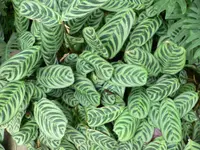
Ctenanthe burle-marxii, commonly called fishbone prayer plant, is a compact tropical foliage plant grown mainly for its patterned leaves. It belongs to the Marantaceae family, known for decorative, shade-loving houseplants.
Its oval leaves show silver-green backgrounds with dark fishbone-like stripes and often purple undersides, forming a low, spreading clump. Leaves may slightly lift and lower between day and night, giving a subtle prayer plant movement.
In nature it occurs in the understory of Brazilian rainforests, where light is filtered and air is consistently warm and humid. These origins explain its preference for soft, indirect light, evenly moist but not waterlogged soil, and stable indoor temperatures.
With steady humidity and careful watering, it is moderately easy to care for Fishbone Prayer Plant and suits patient beginners who can observe and adjust conditions.

Care Difficulty
Moderate Care

Light Preference
Bright Indirect Light

Water Requirements
Keep Soil Moist

Temperature Preference
Tropical / Frost Sensitive

Hardiness Zone
11–12

Soil Texture
Loamy, Peaty, Organic-rich

Soil pH
Acidic (5.5–6.5), Slightly acidic (6.5–7.0)

Soil Drainage
Moist but well-drained

Fertilization
Light (every 4–6 weeks)
Scan your plant to receive care tips personalized for your specific plant
Available on iOS and Android
This plant prefers bright, filtered light that mimics dappled forest shade.
This species prefers evenly moist, but not saturated, soil throughout the growing season.
This plant does best in warm, stable temperatures with no exposure to frost.
This species needs relatively high humidity to maintain healthy foliage and stable growth.
This plant prefers a loose, airy, organic-rich mix that drains quickly yet retains moderate moisture.
This species is well suited to container growing due to its compact, spreading root system.
Ctenanthe burle-marxii responds well to light, consistent feeding during its active growing season.
Pruning Ctenanthe burle-marxii is mainly cosmetic and helps maintain a neat, compact plant.
This species prefers slightly snug pots and benefits from repotting only when clearly root-bound.
Ctenanthe burle-marxii is most reliably propagated by division of mature, healthy clumps.
This tropical species is frost-sensitive and needs mild, stable indoor conditions in winter.

Plant Health Check
Not sure what's wrong with your plant? Check your plant's health inside the app.
This species has a distinctive herringbone pattern on its leaves, formed by the lateral veins that angle sharply from the midrib, which is more pronounced than in many related Ctenanthe species.
Like other members of the Marantaceae family, it performs nyctinasty, a daily movement where leaf blades lift and fold more vertically at night, likely helping reduce water loss and protect leaf surfaces.
In its native Brazilian Atlantic Forest understory, it is adapted to low, filtered light and high humidity, with relatively thin leaves optimized for capturing diffuse light rather than direct sun.

The species name burle-marxii honors the Brazilian landscape architect Roberto Burle Marx, who was also a plant collector and played a key role in bringing many Brazilian ornamental species, including this one, into wider horticultural use.
Brown, crispy edges usually come from low humidity, underwatering, or a buildup of salts from fertilizer and hard water. Increase humidity, water evenly with filtered or rested tap water, and flush the potting mix occasionally.
Keep your plants happy and healthy with plant identification, disease detection, and easy care guidance.