Venus flytrap Care (Dionaea muscipula)

About Venus flytrap

The Venus flytrap, Dionaea muscipula, is a small carnivorous plant that naturally grows in nutrient-poor, boggy areas of North and South Carolina in the United States. It forms low rosettes of hinged traps with hair-like triggers that snap shut on small insects.

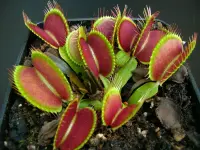
This plant relies on insects for extra nutrients but still performs photosynthesis like other green plants. Traps are typically green with red interiors, especially under strong light.

Venus flytraps can be moderately challenging for beginners because they need consistently moist, mineral-free conditions and a cool winter rest. Understanding how to care for Venus flytrap usually makes long-term success much more likely.

Main Plant Requirements

Care Difficulty

Hard Care

Light Preference

Full Sun

Water Requirements

Keep Soil Moist

Temperature Preference

Cool Climate

Hardiness Zone

8–10

Soil Texture

Sandy, Peaty, Organic-rich

Soil pH

Strongly acidic (4.5–5.5)

Soil Drainage

Waterlogged tolerant

Fertilization

Minimal (feed rarely)

Get Personalized Care Plan

Scan your plant to receive care tips personalized for your specific plant

Personalized Care in the App

Available on iOS and Android

How to Care for the Venus flytrap

Dionaea muscipula needs strong light to develop compact growth and deep red trap color.

  • Provide 4–6 hours of direct sun plus bright light the rest of the day; full sun is ideal in mild climates.
  • In hot regions, give morning sun with light afternoon shade to prevent leaf scorch and dried, bleached traps.
  • Outdoors, adjust seasonally: increase sun exposure in spring, then monitor in summer, reducing harsh afternoon sun if traps yellow or crisp.

Watering for Dionaea muscipula focuses on constantly moist, mineral-free conditions without stagnation around the rhizome.

  • Use rainwater, distilled, or reverse-osmosis water; avoid tap water with dissolved salts that damage roots over time.
  • Keep the soil evenly moist at all depths; do not let the root zone dry, but avoid foul-smelling, sour, or algae-heavy waterlogged conditions.
  • In active growth, maintain steady moisture; in cooler dormancy, keep the medium just damp, watching for limp leaves (too dry) or black, mushy bases (too wet).

This species prefers mild, temperate conditions with a cool winter dormancy period.

  • Aim for 70–85°F (21–29°C) during active growth, with short peaks to 90°F (32°C) tolerated if soil stays moist and roots shaded.
  • For winter dormancy, provide roughly 35–50°F (2–10°C); brief light frosts are tolerated, but protect from deep or extended freezes.
  • Avoid prolonged exposure above 95°F (35°C) or below 25°F (-4°C), which can damage traps, roots, and the underground bulb-like rhizome.

This species prefers moderate humidity but adapts to many home environments.

  • Aim for 40–60% humidity to support consistent trap development.
  • Plants tolerate short periods of drier air if roots stay constantly moist with pure water.
  • Low humidity stress shows as shriveling traps, browning edges, and stalled new growth.
  • Increase humidity by grouping pots in a water-filled pebble tray without raising the waterline above the pot base.

Dionaea muscipula needs nutrient-poor, acidic, open, and consistently wet substrate.

  • Use a mix of 1:1 unfertilized sphagnum peat moss and coarse silica sand or perlite for both moisture retention and air spaces.
  • Keep drainage free but never let the mix dry; the pot should sit in a shallow tray of rain, distilled, or reverse-osmosis water.
  • Target pH around 3.5–5.5, avoiding lime, tap-water mineral buildup, and any added fertilizers or compost.
  • Avoid bark chips, standard potting mix, or manures, which add nutrients that burn roots and quickly weaken the plant.

This species is very suitable for container growing when moisture and stability are controlled.

  • Choose a pot at least 10–12 cm deep so the rhizome and roots stay cool and protected below the surface.
  • Use plastic or glazed ceramic containers, which slow water loss and keep the root zone evenly wet compared with porous clay.
  • Pick a light-colored pot to reduce overheating in full sun and keep the standing tray water cooler around the root zone.

Dionaea muscipula is adapted to very poor soils and usually performs best with no conventional fertilizer at all.

Pruning for Dionaea muscipula focuses on hygiene and conserving the plant’s energy, rather than shaping.

  • Use small scissors to remove blackened or dead traps at the base, cutting as close to the rhizome as possible.
  • Trim yellow or mushy leaves anytime they appear to reduce fungal problems and improve airflow around the crown.
  • In late season, remove old flower stalks after blooming to direct energy back into root and trap development.

Periodic repotting supports healthy root and rhizome growth in Venus flytrap plants kept in containers.

  • Plan to repot every 1–2 years, or when roots circle the pot or growth becomes weak despite proper light and water.
  • Repot in late winter to early spring, just before new growth starts, to minimize active-season stress.
  • Use a nutrient-poor, airy mix such as 1:1 sphagnum peat and perlite, and avoid any compost or added fertilizer.
  • Handle the rhizome gently, keep roots moist during the process, and water well with distilled or rainwater after repotting.

Propagation of Dionaea muscipula is most reliable by division, with seed used mainly for larger-scale or breeding projects.

  • Divide mature clumps in late winter or early spring, separating offsets with several healthy traps and roots each.
  • Plant divisions into fresh carnivorous plant mix, keep evenly moist with low-mineral water, and maintain bright light.
  • Sow fresh seed on the surface of moist sphagnum or peat mix under high humidity and strong light for germination.
  • For successful growing Venus flytrap from seed, provide stable warmth around 70–80°F and avoid covering seeds with dense substrate.

Dionaea muscipula requires a cool dormancy period in winter, not warm indoor conditions year-round.

  • Hardy to around 20°F when kept evenly moist, though prolonged deep freezes can damage roots in small pots.
  • In-ground plants in mild climates benefit from a light mulch layer around the root zone, kept thin over the crown.
  • Move container plants to an unheated but frost-free spot like a cold frame or bright garage for 3–4 months of dormancy.

Care Tips

Dormancy preparation

About 4–6 weeks before winter dormancy, gradually reduce feeding and slightly shorten light exposure so the plant enters its rest period with strong but not overstimulated growth, which reduces stress and dieback.

Trap management

Remove only completely black, dry traps by cutting them at the base with clean scissors, leaving any partially green traps in place so they can continue photosynthesis and support new growth.

Mineral-safe watering

If distilled or rainwater is limited, store it in a clean, covered container and use a narrow-spout bottle or syringe to top-water directly onto the soil, avoiding splashing mineral-rich tap water onto the pot or saucer by mistake.

Outdoor insect access

When conditions are warm enough, place the pot outdoors in a protected, sunny spot for several hours or days so the plant can catch natural insects, then return it indoors if needed for ongoing Venus flytrap indoor care.

Repot timing

Plan repotting for late winter to very early spring, just before new growth starts, as this timing reduces transplant shock and allows fresh rhizome roots to establish quickly in the new medium.

Common Pests and Diseases

Grey mold

This disease often appears on old traps or injured tissue as fuzzy grey growth, especially in cool, humid, stagnant air. Symptoms include browning, collapse of traps, and a spreading grey or brown moldy patch.

Solution

Remove and discard all affected leaves and traps, cutting back to clean, firm tissue, and avoid wounding fresh growth. Improve air circulation, keep foliage drier, reduce overcrowding, and if spread continues, treat with a sulfur-based or other carnivorous-plant-safe fungicide according to label directions.

Rhizome rot

This disease affects the underground rhizome, which turns soft, brown or black, and causes traps to yellow, wilt, and die back from the center of the rosette. Symptoms include a foul smell and mushy tissue when the rhizome is inspected.

Solution

Unpot the plant, trim away all soft, discolored tissue with a sterile blade, and repot in fresh, low-mineral carnivorous plant mix kept evenly moist, not waterlogged. Improve light, avoid fertilizer and hard water, and maintain good seasonal dormancy to support long-term Dionaea muscipula care instructions.

Aphids

These insects cluster on young traps and flower stalks, sucking sap and causing distorted, twisted growth that may fail to form proper closing mechanisms. This pest can also transmit pathogens and weaken the plant over time.

Solution

Rinse the plant under a gentle stream of soft or distilled water to dislodge insects, repeating every few days as needed. For persistent infestations, use a dilute insecticidal soap or a systemic product labeled safe for carnivorous plants, applied when traps are less active to reduce stress.

Spider mites

This pest thrives in warm, dry conditions and is often hard to see, but causes stippled, pale traps that may become dry, misshapen, and less responsive. Fine webbing may be visible between leaves in advanced cases.

Solution

Increase humidity slightly, avoid hot, dry air, and hose down foliage with soft water to physically remove mites. If damage continues, apply a miticide or insecticidal soap labeled for ornamental use, treating the undersides of leaves and repeating per product instructions until new growth appears healthy.

Fungus gnat larvae

These insects lay eggs in constantly wet media, and the larvae feed on tender roots and young traps, leading to stunted growth and poor recovery of small plants or seedlings. Symptoms include visible small black adults hovering above the pot and a decline in vigor despite correct light and water quality.

Solution

Allow the surface of the medium to become just slightly less wet between waterings while keeping the root zone moist, and use distilled or rainwater in trays rather than overhead watering. Apply a biological control such as Bacillus thuringiensis israelensis (Bti) or introduce beneficial nematodes to target larvae, and use yellow sticky traps to reduce adult numbers.

Interesting Facts

Electrical trigger counting

The trap lobes only close after two distinct touches of their trigger hairs within about 20 seconds, and additional touches fine‑tune how tightly the trap seals. This simple electrical counting system helps the plant avoid wasting energy on debris or raindrops.

Specialized digestive glands

After the trap seals, hundreds of tiny glands on the inner surface release digestive enzymes that break down soft tissues of the prey. The plant then absorbs released nutrients such as nitrogen and phosphorus through these same glands.

Fire-adapted life cycle

In its native Carolina bog habitats, periodic wildfires remove competing vegetation and open up more light for seedlings and adult plants. The underground rhizomes are often protected in the soil, allowing the plant to resprout after fire.

Botan icon

Did you know?

Dionaea muscipula is endemic to a very small region of the coastal plain of North and South Carolina, where it naturally occurs only within roughly a 100 km radius of Wilmington, North Carolina, making it one of the most geographically restricted carnivorous plant species.

FAQs about Venus flytrap

Yellowing leaves usually come from older traps dying naturally, mineral buildup from tap water, or insufficient light. Remove dead traps, use rain, distilled, or reverse-osmosis water, and provide strong light to prevent further stress.

Grow Healthy Plants with Botan Care

Keep your plants happy and healthy with plant identification, disease detection, and easy care guidance.

Botan plant care app — identify plants on mobile

Explore More Plants