Chilled Root Tray
Stand the pot in a shallow tray of cool distilled water, and during hot spells drop in a few ice cubes once or twice a day to keep root temperatures low without soaking the foliage.

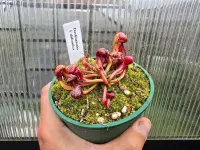
Cobra lily, Darlingtonia californica, is a North American carnivorous plant that traps insects rather than catching sunlight alone for nutrients. It forms upright, tubular leaves with hooded tops and forked, tongue-like appendages that resemble a striking snake.
This species is native to cold mountain bogs and seeps in northern California and Oregon, where roots stay cool in constantly moving water. It is considered challenging to grow because it needs pure, low-mineral water, cool roots, and bright light without overheating. Gardeners who learn how to care for Cobra Lily usually grow it in containers, cold greenhouses, or carefully managed outdoor bog gardens.

Care Difficulty
Hard Care

Light Preference
Partial Sun

Water Requirements
Aquatic

Temperature Preference
Cool Climate

Hardiness Zone
7–9

Soil Texture
Sandy, Peaty, Organic-rich

Soil pH
Strongly acidic (4.5–5.5)

Soil Drainage
Waterlogged tolerant

Fertilization
Minimal (feed rarely)
Scan your plant to receive care tips personalized for your specific plant
Available on iOS and Android
This mountain bog species needs bright, cool conditions with gentle, not harsh, sun exposure.
This plant requires constant moisture with cool, oxygen‑rich water mimicking flowing mountain seeps.
This species prefers cool roots and mild air temperatures, similar to mountain stream edges.
This species needs consistently high humidity along with cool root conditions to thrive.
Darlingtonia californica requires a cool, very airy, permanently wet but not stagnant substrate.
This species can be grown in containers if the pot supports cool, oxygenated, constantly moist roots.
Darlingtonia californica is adapted to nutrient-poor bogs and usually performs best with no fertilizer in cultivation.
Pruning Darlingtonia californica focuses on hygiene rather than shaping the plant.
Container-grown Cobra Lily resents root disturbance, so repotting should be infrequent and gentle.
Propagation of Darlingtonia californica is possible but slow and best done by patient growers.
This species is cold hardy in many temperate climates but still benefits from considered winter care.

Plant Health Check
Not sure what's wrong with your plant? Check your plant's health inside the app.
The inflated hood of this species forms a light-filled dome with many translucent spots that confuse trapped insects, while the true exit is hidden and lined with slippery surfaces and downward-pointing hairs that guide prey deeper into the trap.
In nature it grows along cold mountain seeps and constantly chilled springs, and its roots are so temperature-sensitive that sustained warm conditions can quickly kill the plant even when the foliage appears healthy.
Unlike Venus flytraps or sundews, its pitchers are passive pitfall traps that never move; instead, the plant relies on gravity, waxy walls, and internal hairs to direct insects into a fluid-filled chamber where they are broken down, a key aspect of Darlingtonia californica plant care in cultivation.

This species is the only member of its genus and has one of the most geographically restricted ranges among North American carnivorous plants, being naturally confined to scattered, often isolated populations in northern California and southwestern Oregon.
Brown tips or edges usually come from mineral-heavy or warm water, excess heat around the roots, or low humidity. Use cool, low-mineral water, keep roots shaded and cool, and avoid hot, drying air.
Keep your plants happy and healthy with plant identification, disease detection, and easy care guidance.