Rock-pocket planting
Tuck offsets into shallow crevices between rocks or in porous stone pockets so the roots anchor firmly and the tight cushion form develops without being dislodged by rain or handling.

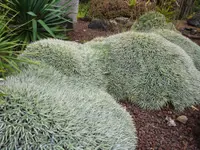
Deuterocohnia brevifolia is a small terrestrial bromeliad that forms dense, cushion-like mats of tightly packed rosettes. Each rosette carries stiff, narrow, spiny leaves that give the plant a textured, almost mossy look from a distance.
In nature it grows on rocky slopes and outcrops in arid regions of Bolivia and Argentina, where it handles intense sun, wind, and poor, gravelly soils. This background makes it quite tough in cultivation but sensitive to overwatering and poorly drained substrates.
Many growers find it slow but reliable once established. Bright light, excellent drainage, and careful watering are the main points to understand when learning how to care for Deuterocohnia brevifolia.

Care Difficulty
Moderate Care

Light Preference
Full Sun

Water Requirements
Low Water

Temperature Preference
Warm Climate

Hardiness Zone
9–11

Soil Texture
Sandy, Rocky, Loamy

Soil pH
Slightly acidic (6.5–7.0), Neutral (7.0)

Soil Drainage
Well-drained

Fertilization
Minimal (feed rarely)
Scan your plant to receive care tips personalized for your specific plant
Available on iOS and Android
This compact terrestrial bromeliad thrives in strong light that mimics exposed rocky habitats.
This species prefers infrequent, thorough watering that allows the root zone to dry quickly.
This high-light xeric bromeliad prefers warm, dry conditions with good air movement.
This species handles typical indoor humidity well and rarely needs special humidity management.
This plant needs a very fast-draining, mineral-rich mix that mimics rocky, sandy habitats.
This species is well suited to container culture due to its compact, clumping growth.
This xeric bromeliad has low nutrient needs, so use fertilizer sparingly for Deuterocohnia brevifolia grown in containers.
Pruning Deuterocohnia brevifolia is minimal and focuses on hygiene and slight shape control.
This species grows slowly and forms dense cushions, so repotting or transplanting is infrequent but should be done carefully.
Deuterocohnia brevifolia is most often propagated by division of its many small rosettes.
This plant is somewhat cold tolerant when dry but benefits from basic winter care in colder regions.

Plant Health Check
Not sure what's wrong with your plant? Check your plant's health inside the app.
This species forms dense, rounded cushions made of thousands of tiny rosettes, each with stiff, triangular leaves that help the plant tolerate intense sun and desiccating winds in its native Andes habitats.
It uses crassulacean acid metabolism (CAM), a water-saving photosynthetic pathway where stomata open mainly at night, allowing the plant to conserve moisture in its rocky, arid environments.
In the wild it often anchors itself in rock crevices and on near-vertical slopes, using its compact growth and strong root system to exploit shallow pockets of substrate that many other plants cannot use.

Genetic and morphological studies have shown that this species, traditionally placed in Deuterocohnia, is very closely allied to some terrestrial Puya species, making it an important taxon for understanding evolutionary transitions within terrestrial bromeliads adapted to high, dry Andean regions.
This species spreads slowly by forming tight clumps and mats. It is not invasive, but over many years can cover a wider area. Edging, rock borders, or containers help keep the cushion growth neatly contained.
Keep your plants happy and healthy with plant identification, disease detection, and easy care guidance.