African candelabra Care (Euphorbia ammak)

About African candelabra

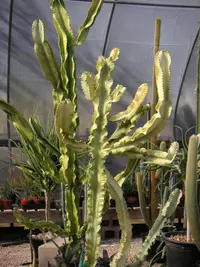
African candelabra (Euphorbia ammak) is a large, tree-form succulent from arid regions of the Arabian Peninsula, often grouped with African desert species in cultivation. It has tall, upright, many-ribbed green stems with small spines along the edges, forming a candelabra-like branching pattern as it matures.

This species stores water in its stems and drops any temporary leaves quickly, which makes it drought tolerant but sensitive to overwatering. It prefers strong light, very fast-draining soil, and minimal moisture, so indoor growers should learn how to care for African candelabra before choosing a location.

Main Plant Requirements

Care Difficulty

Moderate Care

Light Preference

Full Sun

Water Requirements

Low Water

Temperature Preference

Tropical / Frost Sensitive

Hardiness Zone

10–11

Soil Texture

Sandy, Loamy, Rocky

Soil pH

Slightly acidic (6.5–7.0), Neutral (7.0)

Soil Drainage

Well-drained

Fertilization

Minimal (feed rarely)

Get Personalized Care Plan

Scan your plant to receive care tips personalized for your specific plant

Personalized Care in the App

Available on iOS and Android

How to Care for the African candelabra

Euphorbia ammak thrives in strong light that mimics its desert origins, but it still needs protection from harsh extremes.

  • Provide 6–8 hours of sun daily, ideally with morning sun and bright light for the rest of the day; in very hot climates, give light shade after 2–3 p.m.
  • African candelabra tolerates light, open shade, but stems may stretch and lose strong color if grown with less than 4 hours of direct sun.
  • In summer, acclimate plants gradually to stronger sun over 10–14 days to avoid scorching; in winter, move container plants to the brightest, frost-free spot available.

This drought-adapted succulent prefers infrequent, deep watering and quick-drying soil.

  • Use fast-draining, gritty soil; water only when the top 3–5 cm of soil are completely dry, then soak thoroughly and let excess drain away.
  • In spring and summer, watering may be needed every 10–21 days depending on heat and wind; in cool or low-light periods, reduce to very occasional watering.
  • Euphorbia ammak shows overwatering by yellowing, soft, or mushy stems and a sour soil smell; slight wrinkling of ribs signals it is time to water again.

This species prefers warm, dry conditions and is sensitive to prolonged cold and any frost.

  • Aim for 70–90°F (21–32°C) during active growth; it tolerates short spikes to 100°F (38°C) if soil is fast-draining and roots are not kept wet.
  • Protect from temperatures below 40°F (4°C); tissue damage and rot risk increase sharply under this level, especially in damp soil or cold wind.
  • In regions with cool winters, grow in containers that can be moved to a sheltered, dry spot kept above 45°F (7°C), and avoid sudden swings of more than 15°F (8°C) in a day.

Humidity is rarely critical for this desert Euphorbia, which thrives in dry indoor air.

  • Target 30–50% relative humidity, similar to most heated or air-conditioned homes.
  • Dry air is well tolerated; avoid pairing the African candelabra with constantly misted tropical plants that raise local humidity.
  • If humidity rises above 60%, increase air movement and let the soil dry more thoroughly to prevent fungal issues or stem rot.

This species needs very sharply drained, mineral-based soil to prevent root and stem rot.

  • Use a gritty mix such as 60–70% inorganic material (pumice, coarse sand, small gravel) with 30–40% cactus potting mix or loamy soil.
  • Aim for slightly acidic to neutral pH, roughly 6.0–7.0, which supports stable nutrient availability without encouraging rot organisms.
  • Increase aeration by avoiding fine peat-heavy mixes that compact; large, irregular particles create air pockets around the roots.
  • Avoid moisture-retentive garden soil, clay, or unamended compost in containers, as these trap water around Euphorbia ammak roots.

This species is suitable for container growing, especially in cooler climates or where winter protection is needed.

  • Choose a wide, heavy container that resists tipping, as the tall, columnar stems become strongly top-heavy over time.
  • Select unglazed clay pots if extra moisture evaporation is desired, particularly in regions with cooler, slower-drying conditions.
  • Raise the pot slightly on feet or bricks so drainage holes stay clear and excess water exits quickly after heavy watering or rain.

This succulent tree has modest nutrient needs, but light feeding improves container growth and overall vigor when done carefully.

  • Use a balanced liquid fertilizer (around 10-10-10) or cactus formula at 1/4–1/2 strength for African candelabra in active growth.
  • Feed every 4–6 weeks in spring and summer only, after thoroughly watering the soil.
  • Avoid compost-heavy mixes; excess organic matter can hold too much moisture and cause root problems.
  • Stop fertilizing in fall and winter when growth slows or stops, to prevent soft, weak tissues.

Pruning Euphorbia ammak is usually limited to managing size, removing damage, and keeping a stable structure.

  • Carry out any pruning in late spring or early summer when growth is active and recovery is faster.
  • Remove dead, damaged, or rubbing branches with clean, sharp bypass pruners or a fine-tooth saw.
  • Cut back awkward or leaning stems to a side branch to improve balance and prevent toppling.
  • Wear gloves and eye protection, and avoid contact with the milky sap, which can irritate skin and eyes.

This species is slow-growing and typically needs infrequent repotting or transplanting, but timing and handling are important.

  • Check for roots circling the pot, pushing through drainage holes, or very slow growth as signs it needs a larger container.
  • Plan repotting or transplanting in late spring to early summer, about every 3–5 years for container-grown plants.
  • Choose a heavy, wide pot with gritty, fast-draining cactus mix to anchor the tall stems securely.
  • Support the plant, keep the root ball mostly intact, and water lightly afterward to limit root stress and rot risk.

Propagation of this species is usually done by stem cuttings but requires care due to its latex sap and slow rooting.

  • Take healthy, non-shriveled stem sections in late spring or early summer using a sterile, sharp knife or saw.
  • Allow cut surfaces to stop bleeding, then dry and callus for 7–14 days in a shaded, airy place.
  • Plant callused cuttings in a very well-draining cactus mix and keep slightly warm (70–80°F) with bright, indirect light.
  • Water sparingly until firm resistance indicates rooting, then gradually increase light and resume normal succulent care.

This plant is not frost hardy and needs careful winter management in most temperate climates.

  • Keep temperatures above 40–45°F; prolonged exposure near freezing can damage or kill stems.
  • Move container plants indoors or into a bright, cool greenhouse before the first frost is forecast.
  • Provide as much light as possible indoors and reduce watering, allowing soil to dry almost completely between waterings.
  • In mild climates, use a very gritty soil and a gravel mulch to keep the root zone drier during cool, wet periods.

Care Tips

Stabilize Heavy Stems

Place the pot in a wide, heavy container or use top-dressing gravel to lower the center of gravity and prevent tall stems from tipping as they gain height and weight.

Rotate For Even Columns

Turn the pot 90° every 2–3 weeks so the ribs develop evenly and the plant does not lean permanently toward the light source.

Safe Handling Routine

Always handle the plant with thick gloves and long sleeves, and keep paper towels and a trash bag ready to capture any sap immediately if a stem is accidentally nicked.

Controlled Height Management

If the plant outgrows its space, plan a single, clean heading cut in warm, dry weather, allow the cut surface to callus, and then root healthy segments as new plants rather than making repeated small cuts.

Dry Winter Rest

During short winter days, keep the root zone on the dry side and avoid repotting or heavy disturbance, as this rest period supports long-term vigor when growing African candelabra.

Common Pests and Diseases

Mealybugs

This pest feeds on stems and branch crevices, appearing as white, cottony clusters along ribs and growing points. Symptoms include stunted growth, yellowing segments, and sticky honeydew that can attract sooty mold.

Solution

Isolate the plant, then dab visible insects with cotton swabs dipped in 70% isopropyl alcohol and repeat weekly until no new clusters appear. For larger plants or outdoor specimens, use a strong water spray to dislodge insects, then apply a systemic insecticide labeled for succulents if the infestation persists, while keeping the plant in bright, dry conditions to prevent reinfestation.

Scale insects

These insects appear as small, rounded or oval bumps tightly attached to the ribs and woody trunk, often brown, gray, or tan. Symptoms include patchy yellowing, reduced vigor, and sticky honeydew on lower stems or nearby surfaces.

Solution

Gently scrape or rub off individual scales with a soft brush or cloth, taking care not to damage the epidermis. For heavier infestations, treat with repeated applications of horticultural oil or a systemic insecticide suited to cacti and succulents, always allowing the plant to dry thoroughly between treatments to avoid softening the tissue.

Corky stem canker

This disease causes sunken, brown to gray lesions on stems that later become rough, corky patches, often starting where mechanical damage or sunburn occurred. Symptoms include localized shrinking, cracking, and in severe cases, deformation of ribs around the cankered area.

Solution

Prune out severely affected segments with a sterile, sharp knife, cutting back into firm, unblemished tissue and allowing the wound to dry and callus in warm, dry air. Improve African candelabra indoor care by avoiding overhead watering, providing strong light, and preventing physical damage so that new injuries do not become entry points for secondary infections.

Bacterial soft rot

This disease leads to rapidly spreading, mushy, foul-smelling areas on stems, often starting from a wound or water-sitting point. Symptoms include translucent, water-soaked tissue that collapses and may ooze liquid when pressed.

Solution

Immediately cut away all affected tissue, extending well into firm, healthy stem and disinfecting tools between cuts, then dispose of infected material in the trash. Move the plant to a dry, airy, warm location, keep water off the stems, and if the main stem is severely compromised, salvage healthy tips as cuttings, allowing them to callus fully before replanting in very well-draining soil.

Spider mites

These insects are tiny sap-feeding arachnids that thrive in hot, dry indoor air, often settling along rib edges and between spines. Symptoms include fine stippling, a dull or dusty appearance to stems, and very fine webbing in crevices when populations build up.

Solution

Rinse the plant thoroughly with a firm but controlled stream of water, focusing on rib junctions and branching points, and repeat every few days to disrupt their life cycle. In persistent cases, use insecticidal soap or a labeled miticide, applied in the early morning or late afternoon, and slightly increase ambient humidity and airflow without leaving the plant wet for long periods.

Interesting Facts

Arabian Peninsula native

This species occurs naturally in arid regions of the Arabian Peninsula, especially Yemen and Saudi Arabia, where it grows on rocky, well-drained slopes exposed to intense sun.

Juicy but toxic latex

Its stems contain a milky latex that stores water yet is also highly irritating and toxic, a typical feature of Euphorbia species that deters herbivores and protects wounded tissue.

Subtle, reduced flowers

Instead of showy petals, it produces small cyathia, a specialized Euphorbia flower structure where tiny true flowers are grouped in a cup-like cluster with minimal ornamentation.

Botan icon

Did you know?

In its native range, large, old plants form tall, tree-like stands that can dominate exposed rocky hillsides, creating a distinctive, nearly pure Euphorbia shrubland in some very dry habitats.

FAQs about African candelabra

This species flowers rarely in cultivation. Lack of bloom is normal, especially in containers or cooler climates. Mature age, strong light, warm temperatures, and minimal stress increase chances, but many plants never produce noticeable flowers indoors.

Grow Healthy Plants with Botan Care

Keep your plants happy and healthy with plant identification, disease detection, and easy care guidance.

Botan plant care app — identify plants on mobile

Explore More Plants