Graft Union Check
Inspect the junction between the colorful top and green rootstock every 1–2 months and discard plants where the top is soft, collapsing, or clearly separating, as failed grafts rarely recover and can spread rot to nearby plants.

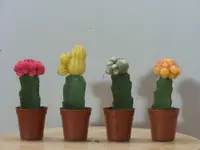
Moon cactus is a grafted cactus that combines a colorful Gymnocalycium mihanovichii top with a green rootstock, usually Hylocereus. It is grown mainly as a compact ornamental plant for windowsills and desks.
The top cactus lacks chlorophyll, so it depends entirely on the rootstock for energy and long-term survival. It typically stays small, forming a rounded, ribbed globe with short, sparse spines.
In nature, G. mihanovichii occurs in parts of Paraguay, Bolivia, and Argentina, where it grows in bright but not harshly exposed sites. This background explains its preference for bright, indirect light, a very well-drained mineral soil mix, and careful watering. These traits make it moderately easy to care for Moon Cactus if overwatering and strong midday sun are avoided.

Care Difficulty
Moderate Care

Light Preference
Bright Indirect Light

Water Requirements
Low Water

Temperature Preference
Tropical / Frost Sensitive

Hardiness Zone
11–12

Soil Texture
Sandy, Loamy, Rocky

Soil pH
Acidic (5.5–6.5), Slightly acidic (6.5–7.0)

Soil Drainage
Well-drained

Fertilization
Minimal (feed rarely)
Scan your plant to receive care tips personalized for your specific plant
Available on iOS and Android
This cactus needs bright, indirect light with limited direct sun to keep its colorful top healthy.
Watering for this cactus focuses on thorough soaking followed by a clear dry period.
Stable warmth is important for this grafted cactus, which dislikes both frost and intense heat extremes.
This cactus prefers relatively dry air and usually does best at typical indoor humidity.
This grafted cactus requires a very fast-draining, mineral-rich substrate to prevent root and graft rot.
This species is very suitable for container growing because of its compact root system and slow growth.
This grafted cactus benefits from light feeding during its active season but is sensitive to excess nutrients and salts.
Gymnocalycium mihanovichii needs minimal pruning, mainly to maintain health and remove problem tissue.
This small grafted cactus prefers a stable pot but benefits from occasional repotting to refresh the soil and inspect roots.
Propagation of this grafted form is more advanced, since colored tops lack chlorophyll and depend on a rootstock.
This cactus is frost-sensitive and needs controlled indoor conditions during cold weather in most climates.

Plant Health Check
Not sure what's wrong with your plant? Check your plant's health inside the app.
Many cultivated forms of this species lack chlorophyll due to spontaneous mutations found in wild populations in Paraguay and neighboring regions, which is why the vivid red, orange, or yellow scions cannot survive on their own roots and require a green rootstock for photosynthesis.
The familiar commercial moon cactus is usually a single individual of this species grafted onto an unrelated cactus, often Hylocereus or Myrtillocactus, creating a long‑term physiological union where the rootstock supplies water and sugars while the scion contributes most of the visible color.
In its native habitat in Paraguay, Bolivia, and Argentina, the species typically appears as a small green to gray‑green globular cactus with low, broad ribs and modest spines, quite different in appearance from the brightly colored chlorophyll‑deficient cultivars sold in garden centers.

The species name mihanovichii honors the Croatian botanist Karel (Karl) Mihanovich, reflecting a long botanical tradition of naming newly described cacti after scientists who first documented or studied them in detail.
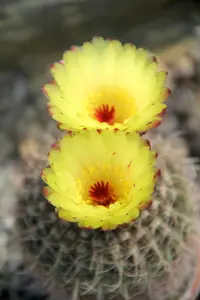
This grafted cactus may not bloom if the rootstock is weak, underfed, or stressed. Provide a stable environment, avoid frequent repotting, and keep it slightly cool and dry in winter to encourage flower bud formation.
Keep your plants happy and healthy with plant identification, disease detection, and easy care guidance.