Stable placement
Place the pot where light, temperature, and humidity stay very stable day to day, since frequent moves or drafts stress this species and often cause leaf edge collapse.

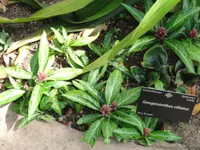
Geogenanthus ciliatus, often nicknamed the Geo plant, is a compact tropical understory plant valued for its striking foliage. It forms low clumps with thick, glossy leaves that show deep purple to nearly black tones on the upper surface and lighter undersides.
This species comes from the shaded rainforest floor of South America, where light is filtered and humidity is consistently high. Its slow growth and sensitivity to low humidity or strong sun make it a bit more demanding than common houseplants.
Those who care for Geo plant successfully usually provide soft, indirect light, evenly moist but not waterlogged soil, and stable indoor conditions without temperature swings.

Care Difficulty
Hard Care

Light Preference
Bright Indirect Light

Water Requirements
Keep Soil Moist

Temperature Preference
Tropical / Frost Sensitive

Hardiness Zone
11–12

Soil Texture
Loamy, Peaty, Organic-rich

Soil pH
Acidic (5.5–6.5), Slightly acidic (6.5–7.0)

Soil Drainage
Moist but well-drained

Fertilization
Light (every 4–6 weeks)
Scan your plant to receive care tips personalized for your specific plant
Available on iOS and Android
This species prefers soft, filtered light that mimics a shaded forest floor.
This plant prefers evenly moist soil with brief, shallow drying between waterings.
This species thrives in consistently warm, stable temperatures without sudden drafts.
This species needs consistently high humidity to maintain healthy foliage indoors.
This plant prefers a loose, airy, organic-rich mix that drains quickly but does not dry out abruptly.
Geogenanthus ciliatus is very suitable for container growing because its compact root system adapts well to pots.
Geogenanthus ciliatus benefits from light, steady feeding to support foliage color and compact growth.
Pruning Geogenanthus ciliatus is minimal and mainly keeps the plant neat and healthy.
Repotting helps this slow-growing understory plant maintain healthy roots and stable moisture.
Propagation of Geogenanthus ciliatus is possible but somewhat slow, so patience is important.
This species is frost tender and needs warm, stable indoor conditions in winter.

Plant Health Check
Not sure what's wrong with your plant? Check your plant's health inside the app.
The leaves have a strongly textured, velvety upper surface created by dense microscopic hairs, which scatter light and make the purple-black color appear especially deep and matte.
Mature leaves show a strong contrast between the very dark upper surface and a lighter, often reddish to greenish underside, an adaptation thought to help manage low light in the dim Amazon forest floor understory.
This species is native to low, shady, humid rainforest habitats in western Amazonia, where it typically grows close to the ground among leaf litter and other understory plants rather than as a climbing or canopy species.
Brown leaf edges usually result from low humidity, underwatering, or a buildup of fertilizer salts. Check soil moisture, flush the pot occasionally, increase room humidity, and keep this plant away from heater vents or cold drafts.
Keep your plants happy and healthy with plant identification, disease detection, and easy care guidance.