Regular Tip Trimming
Pinch or trim stem tips weekly and replant the healthy tops to keep the stand dense, prevent shading of slower plants, and renew older, leggy growth.


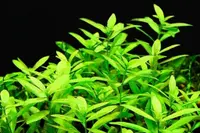
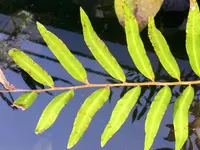
Indian swampweed (Hygrophila polysperma) is a fast-growing aquatic stem plant commonly used in freshwater aquariums. It forms dense, leafy stems that can quickly create a lush, underwater thicket. Leaves are usually narrow and green, sometimes with a slight bronze or reddish tint under stronger light. In the wild, it occurs in slow-moving or still waters in parts of South Asia. This species is considered very adaptable and forgiving, which makes it popular with beginner aquarists learning how to care for Indian swampweed. It generally prefers stable water conditions, moderate to bright light, and a nutrient-rich substrate or water column.

Care Difficulty
Easy Care

Light Preference
Partial Sun

Water Requirements
Aquatic

Temperature Preference
Tropical / Frost Sensitive

Hardiness Zone
10–11

Soil Texture
Loamy, Silty, Organic-rich

Soil pH
Acidic (5.5–6.5), Slightly acidic (6.5–7.0)

Soil Drainage
Waterlogged tolerant

Fertilization
Moderate (every 2–4 weeks)
Scan your plant to receive care tips personalized for your specific plant
Available on iOS and Android
Hygrophila polysperma grows best with bright, stable light levels that avoid harsh extremes.
This species is adapted to saturated conditions but still benefits from stable, well-oxygenated water or very moist substrate.
Stable warm temperatures support vigorous growth and reduce stress for this aquatic plant.
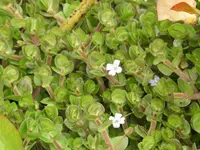
This aquatic species, like Lemon Bacopa, is flexible about air humidity, but very dry air can slow growth and cause leaf issues above water.
For rooted growth, this plant prefers a fine, stable substrate that holds nutrients yet still allows water movement and some oxygen around the roots.
This species is suitable for container culture in aquariums or water-filled tubs where roots can anchor in a stable substrate layer.
This fast-growing aquatic species benefits from consistent but moderate nutrition in planted aquariums.
Hygrophila polysperma responds well to pruning, which keeps stems dense and healthy in aquariums.
In aquariums, this stem plant is managed by replanting cuttings rather than traditional repotting.
Propagation of this aquatic stem plant is straightforward and commonly done in home aquariums.
As a tropical aquatic plant, this species needs stable warm conditions and does not tolerate frost or very cold water.

Plant Health Check
Not sure what's wrong with your plant? Check your plant's health inside the app.
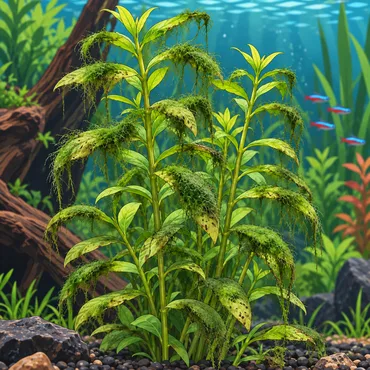
This problem appears when excess light and nutrients trigger fast algae growth that crowds and shades the stems and leaves.
Symptoms include slimy films or hair-like strands on foliage and hardscape, and slowed growth of the plant.
Solution
Reduce light intensity or duration to about 8 hours, lower nutrient dosing and fish feeding, and increase partial water changes to dilute excess nutrients.
Manually remove algae from leaves and hard surfaces, improve flow and CO2 levels, and use fast-growing stems.
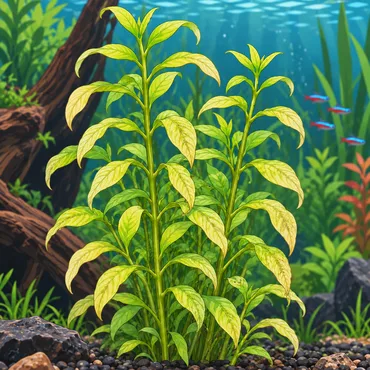
This condition develops in high-light or fast-growing setups when key nutrients such as iron, nitrogen, or potassium are insufficient.
Symptoms include yellowing leaves, pale new growth, and in some cases translucent patches or pinholes in older leaves.
Solution
Test water parameters if possible and review fertilization, then provide a balanced aquarium plant fertilizer that covers macro- and micronutrients.
Maintain consistent dosing, avoid sudden large changes, and trim heavily damaged stems so new, healthy shoots can develop under stable conditions.
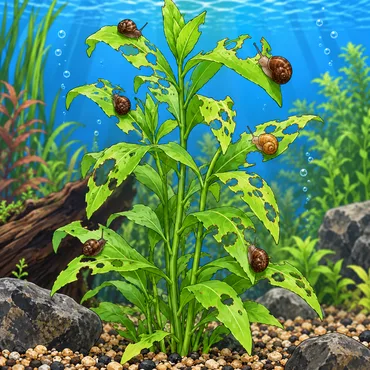
These animals may graze on soft or decaying tissue, and heavy populations can start rasping at tender new shoots.
Symptoms include irregular holes, shredded leaf edges, and visible snails resting on or under the foliage, especially at night.
Solution
Reduce excess food and decaying plant matter to limit snail reproduction, and manually remove snails with traps or by hand during maintenance.
If compatible with the aquarium community, introduce natural snail predators such as certain loach species, and maintain strong plant health.
This species can shift from a compact nursery form to long, fast-growing shoots once submerged, allowing it to quickly dominate open water and aquarium spaces in suitable conditions.
In parts of the southern United States it is listed as a noxious or invasive aquatic weed, as it forms dense stands that shade out native submerged plants and alter freshwater habitats.
Leaves on the same plant can look quite different depending on whether they grow emersed (above water) or submerged, a plastic response that helps it exploit changing water levels.

The species name polysperma refers to its many-seeded fruits; each capsule produces numerous tiny seeds that, combined with stem fragments able to root easily, make this plant especially effective at spreading in the wild.
This is a very fast-growing aquatic stem plant. In favorable conditions it may add several cm per week, quickly reaching the water surface and requiring frequent trimming to prevent overcrowding and shading in aquariums or ponds.
Keep your plants happy and healthy with plant identification, disease detection, and easy care guidance.