Polka Dot Plant Care (Hypoestes phyllostachya)

Also known as: Polka Dot Plant, Baby's Tears, Flamingo Plant, Measles Plant

About Polka Dot Plant

Polka dot plant, Hypoestes phyllostachya, is a small tropical perennial often grown as a colorful houseplant or seasonal bedding plant. It is valued for its spotted leaves, which can be pink, red, or white on a green background.

In its native habitat of Madagascar, it grows as a low understory plant, forming compact clumps with a bushy habit. Indoors it tends to stay small and can become leggy if light is too low.

The plant is relatively easy but not maintenance free, as it can stretch, lose color, or drop leaves if conditions are unsuitable. Understanding how to care for Polka Dot Plant includes providing bright, indirect light, evenly moist soil, and moderate indoor temperatures.

Main Plant Requirements

Care Difficulty

Moderate Care

Light Preference

Bright Indirect Light

Water Requirements

Keep Soil Moist

Temperature Preference

Tropical / Frost Sensitive

Hardiness Zone

10–11

Soil Texture

Loamy, Peaty, Organic-rich

Soil pH

Acidic (5.5–6.5), Slightly acidic (6.5–7.0)

Soil Drainage

Moist but well-drained

Fertilization

Light (every 4–6 weeks)

Get Personalized Care Plan

Scan your plant to receive care tips personalized for your specific plant

Personalized Care in the App

Available on iOS and Android

How to Care for the Polka Dot Plant

Hypoestes phyllostachya develops best color in bright, indirect light with limited direct sun.

  • Provide 4–6 hours of bright, filtered light daily; gentle morning sun is fine, but avoid harsh afternoon sun that can scorch leaves and fade pink spots on Polka Dot Plant.
  • Outdoors, place in dappled shade under taller plants or trees; indoors, set near an east- or north-facing window, or slightly back from a bright south window.
  • If foliage turns dull green and stretches, light is too low; if leaves curl, crisp, or show bleached patches, reduce direct sun exposure.

This species prefers evenly moist but not waterlogged soil and reacts quickly to inconsistent watering.

  • Before watering Hypoestes phyllostachya, let the top 2–3 cm of soil dry; then water thoroughly until excess drains away, discarding any standing water.
  • In warm, active growth, expect to water more often as the top layer dries; in cooler months, allow slightly deeper drying to reduce root rot risk.
  • Wilting, limp leaves and dry soil indicate underwatering; yellowing, mushy stems, fungus gnats, or a sour smell suggest poor drainage or excess moisture.

This plant thrives in stable, warm conditions without sudden temperature swings.

  • Aim for 65–80°F (18–27°C) for steady growth; short exposures up to 85°F (29°C) are tolerated if humidity and soil moisture are adequate.
  • Avoid temperatures below 55°F (13°C); chilling injury appears as drooping, darkened, or dropping leaves, and growth slows noticeably near this limit.
  • Hypoestes phyllostachya is frost-sensitive; protect from any frost, cold drafts, or air conditioning blasts, and move outdoor plants indoors when nights approach 55°F (13°C).

This plant prefers moderate to high humidity for stable leaf color and vigor.

  • Aim for 50–60% humidity; it tolerates brief dips lower but prolonged very dry air leads to leaf edge browning.
  • Watch for curled leaves, crispy tips, and dull color as signs of humidity stress in Polka Dot Plant.
  • Increase humidity with a nearby humidifier, grouping plants, or a pebble tray, but keep leaves dry to limit fungal issues.

This species grows best in a loose, moist but fast-draining, organic-rich substrate.

  • Use a mix of roughly 50% peat or coco coir, 30–40% fine bark or compost, and 10–20% perlite for Hypoestes phyllostachya.
  • Aim for slightly acidic to neutral pH around 6.0–7.0, which supports balanced nutrient availability and root function.
  • Ensure water drains through within seconds; heavy, compact, or clay-based media promote root rot and should be avoided.
  • Improve aeration by adding extra perlite or fine bark if the mix feels dense or stays wet longer than 3–4 days.

This species is well suited to container growing for both indoor displays and outdoor seasonal use.

  • Choose a pot only 2–3 cm wider than the root ball to keep the mix drying evenly and reduce waterlogging risk.
  • Prefer lightweight plastic or resin containers outdoors so the plant can be moved easily to adjust light and temperature.
  • Ensure the container is shallow to moderately deep, matching its fibrous, relatively shallow roots rather than using tall, soil-heavy pots.

Balanced feeding helps Hypoestes phyllostachya maintain strong color and compact growth.

  • Use a balanced liquid fertilizer (for example 10-10-10 or 20-20-20) diluted to 1/4–1/2 strength for Polka Dot Plant in active growth.
  • Feed every 2–4 weeks in spring and summer when light and watering are consistent.
  • Reduce feeding to monthly or stop entirely in fall and winter when growth slows.
  • Compost or a slow-release granular fertilizer in spring can support steady growth in container plants.

Thoughtful pruning keeps Hypoestes phyllostachya dense, colorful, and well-shaped.

  • Pinch soft shoot tips in spring and summer to encourage branching and a fuller, lower habit.
  • Remove yellowing, dead, or damaged leaves and stems with clean scissors or small pruning snips.
  • Cut back leggy or stretched stems by 1/3 to a node to improve shape and stimulate new growth.
  • Disinfect tools before and after use, especially if any stems look diseased or weak.

Container-grown Hypoestes phyllostachya benefits from timely repotting to keep roots healthy.

  • Check for roots circling the pot, growing through drainage holes, or slow growth as signs repotting is needed.
  • Plan to repot every 1–2 years in spring, moving only 1 pot size up with a light, peat-free houseplant mix.
  • Water well the day before, then gently loosen the root ball and trim only dead or mushy roots.
  • After repotting, water thoroughly once, keep in bright indirect light, and avoid heavy feeding for 2–3 weeks to limit stress.

New plants of Hypoestes phyllostachya are commonly produced from stem cuttings and seeds.

  • Take 7–10 cm non-flowering stem cuttings in spring or summer, removing lower leaves.
  • Place cuttings in moist, sterile mix or water, keeping nodes slightly buried and humidity high until roots form.
  • Provide bright, indirect light and warmth of 70–75°F to support quick rooting.
  • Sow fresh seeds on the surface of a fine seed mix, press lightly, keep evenly moist, and maintain similar warm temperatures.

Hypoestes phyllostachya is frost-sensitive and needs warm, stable conditions in winter.

  • Move outdoor containers indoors before temperatures drop near 50°F and place in bright, indirect light.
  • Maintain indoor temperatures around 60–75°F and avoid cold drafts from windows or doors.
  • Water less often in winter, allowing the top 2–3 cm of mix to dry to reduce root rot risk.
  • In mild climates, mulch lightly around outdoor plants and treat them as tender annuals if hard frost is expected.

Care Tips

Staggered Pinch Routine

Pinch 1–2 stem tips every 2–3 weeks in rotation rather than all at once so the plant keeps some foliage for photosynthesis while steadily becoming denser and less leggy.

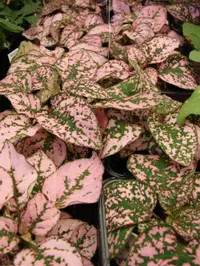
Color Maintenance Check

If leaf spots begin fading, move the plant slightly closer to a bright window and reduce nitrogen-heavy fertilizer for a month, since excessive shade and nitrogen both push the plant toward greener, less patterned foliage.

Short-Lived Cycle Planning

Plan to restart plants from fresh nursery stock or stem cuttings every 12–18 months, since many specimens naturally lose vigor and become woody and sparse over time under indoor conditions.

Tray Propagation Method

When stems become too long, cut 8–10 cm tip cuttings and insert many of them together in a shallow tray of moist, sterile mix to root, then transplant several rooted cuttings back into the original pot for a full, compact mound.

Targeted Pest Monitoring

Inspect the undersides of leaves and tender tips weekly with a hand lens for spider mites and aphids, and at the first sign of pests isolate the plant and treat with a gentle insecticidal soap spray, repeating every 5–7 days until no new pests appear, which greatly simplifies caring for Polka Dot Plant in busy homes.

Common Pests and Diseases

Spider mites

This pest causes fine yellow stippling on leaves, dulling of the colored spots, and delicate webbing between stems and leaf undersides, especially in dry indoor air.

Solution

Rinse foliage thoroughly under a gentle shower, then wipe leaf undersides to remove mites; repeat weekly until clear. Increase humidity, avoid letting the soil go bone dry, and use an insecticidal soap or horticultural oil labeled for indoor plants if populations persist.

Aphids

These insects cluster on soft new growth, causing curling leaves, sticky honeydew, and sometimes distorted or stunted shoots on polka dot plants grown indoors or outdoors.

Solution

Pinch or prune heavily infested shoot tips and discard them, then wash remaining foliage with lukewarm water and mild insecticidal soap. Check nearby plants, repeat treatments every 5–7 days until no new aphids appear, and avoid overfertilizing, which promotes lush, aphid-prone growth.

Mealybugs

This pest appears as white, cottony clumps in leaf axils and on stems, leading to weakened growth and sticky residue that can attract sooty mold.

Solution

Dab visible clusters with a cotton swab dipped in isopropyl alcohol, then rinse the plant with lukewarm water to dislodge hidden insects. Quarantine the plant from others, inspect weekly, and repeat alcohol spot-treatments or use a labeled insecticidal soap at 7–10 day intervals until mealybugs are gone.

Leaf spot

This disease produces small, water-soaked to brown spots on leaves that may merge, causing patches of dead tissue and premature leaf drop, especially in plants kept too wet or overcrowded.

Solution

Remove and discard affected leaves, then improve air circulation and avoid wetting foliage when watering. Allow the top of the soil to dry slightly between waterings, and if spotting continues, apply a copper-based or other houseplant-safe fungicide according to label directions.

Powdery mildew

This disease shows up as white, powdery patches on leaves and stems, leading to dull foliage color and reduced vigor, particularly in low light with poor air movement.

Solution

Increase light to a bright, indirect level, space plants so leaves do not touch, and remove heavily infected leaves. For ongoing issues, use a houseplant-safe fungicide for powdery mildew and avoid frequent light misting that keeps foliage damp without improving humidity.

Interesting Facts

Natural forest understory

In its native range of Madagascar, Hypoestes phyllostachya naturally grows in the shaded forest understory, which explains its adaptation to dappled light and its relatively thin, soft leaves.

Leaf speckles as sunscreen

The pink, red, or white speckles on the leaves result from pigmented cells that reduce the area of green chlorophyll tissue exposed to direct light, functioning as a form of photoprotection for the leaf.

Short-lived perennial habit

In the wild, this species behaves as a short-lived perennial that often declines after flowering and seed set, which is why cultivated plants are frequently renewed from cuttings rather than kept for many years.

Botan icon

Did you know?

The wild form of Hypoestes phyllostachya has far less dramatic spotting than modern houseplant varieties; the intense pink and contrasting patterns seen today are the result of extensive selective breeding for ornamental foliage rather than how the species typically appears in its native habitat.

FAQs about Polka Dot Plant

Brown, crispy leaf edges usually come from low humidity, underwatering, or fertilizer salt buildup. Increase ambient humidity, water more evenly, and occasionally flush the potting mix with plain water to remove excess salts.

Grow Healthy Plants with Botan Care

Keep your plants happy and healthy with plant identification, disease detection, and easy care guidance.

Botan plant care app — identify plants on mobile

Explore More Plants