Strategic leaf propagation
When pruning, keep healthy mature leaves and place their margins on barely moist, gritty mix in a shallow tray to root multiple plantlets at once for dense future plantings.

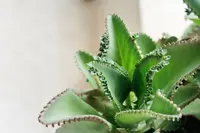
Miracle leaf, Kalanchoe pinnata, is a succulent perennial known for its thick, fleshy leaves that can sprout plantlets along the edges. It usually grows upright with branching stems and a compact, shrubby form.
In nature it occurs in Madagascar but is now naturalized in many tropical and subtropical regions, often in rocky or disturbed sites. Its drought tolerance and ability to root easily from leaves make it a resilient houseplant.
It generally prefers bright light, well-drained soil, and infrequent watering, which simplifies how to care for Miracle Leaf for most indoor growers.

Care Difficulty
Easy Care

Light Preference
Full Sun

Water Requirements
Low Water

Temperature Preference
Tropical / Frost Sensitive

Hardiness Zone
10–12

Soil Texture
Sandy, Loamy, Rocky

Soil pH
Acidic (5.5–6.5), Slightly acidic (6.5–7.0)

Soil Drainage
Well-drained

Fertilization
Minimal (feed rarely)
Scan your plant to receive care tips personalized for your specific plant
Available on iOS and Android
Kalanchoe pinnata prefers bright, indirect light with some direct morning sun for compact, healthy growth.
This succulent stores water in its leaves and needs infrequent but thorough watering for best health.
This species prefers warm, frost-free conditions and reacts poorly to extended cold or sudden temperature swings.
This succulent is adapted to dry air, so humidity rarely needs special control for Miracle Leaf.
This species prefers a very free-draining, sandy to gritty substrate that mimics arid, rocky soils.
This species grows very well in containers when the pot supports fast drainage and a shallow, spreading root system.
This succulent needs modest feeding to support leafy growth without causing weak, stretched stems when caring for Miracle Leaf.
Thoughtful pruning keeps Kalanchoe pinnata compact, safe, and productive.
This species prefers slightly tight containers and infrequent repotting or transplanting.
Kalanchoe pinnata is commonly multiplied from vegetative material rather than seed for consistent traits.
This plant is frost-sensitive and needs protection in regions with cold winters.

Plant Health Check
Not sure what's wrong with your plant? Check your plant's health inside the app.
This species shows a type of vegetative reproduction called epiphyllous budding, where tiny complete plantlets with roots form along the leaf margins and drop off to root in the soil.
As a succulent, it uses crassulacean acid metabolism (CAM) photosynthesis, taking in CO₂ mainly at night to reduce water loss in hot or dry conditions.
In many tropical and subtropical regions it is listed as an invasive plant, because its abundant plantlets and high seed viability allow it to spread quickly and outcompete native vegetation.

The species was carried by humans across tropical trade routes for centuries and is now naturalized on multiple continents, to the point that in some Pacific islands it forms dense stands on cliffs and lava flows that were originally almost bare rock.
Lack of flowering usually comes from insufficient light, too much nitrogen fertilizer, or no dry rest period. Shorter days, bright conditions, and slightly cooler, drier treatment for several weeks often trigger buds. Avoid frequent repotting during bud formation.
Keep your plants happy and healthy with plant identification, disease detection, and easy care guidance.