Kleinia stapeliiformis Care

About Kleinia stapeliiformis

Kleinia stapeliiformis is a stem succulent from arid regions of South Africa. It forms long, pencil-like, leafless stems with dark bands that resemble reptile skin. Over time it creates a low, spreading clump and may trail over the edge of containers, making it suitable for pots and hanging baskets. In good light it produces small, brush-like orange flowers at the stem tips. This species is adapted to strong sun, high drainage, and infrequent rain, which makes it relatively easy to grow indoors if overwatering is avoided. Understanding how to care for Kleinia stapeliiformis mainly involves controlling moisture and providing bright light.

Main Plant Requirements

Care Difficulty

Easy Care

Light Preference

Partial Sun

Water Requirements

Low Water

Temperature Preference

Tropical / Frost Sensitive

Hardiness Zone

10–11

Soil Texture

Sandy, Loamy, Rocky

Soil pH

Slightly acidic (6.5–7.0), Neutral (7.0)

Soil Drainage

Well-drained

Fertilization

Minimal (feed rarely)

Get Personalized Care Plan

Scan your plant to receive care tips personalized for your specific plant

Personalized Care in the App

Available on iOS and Android

How to Care for the Kleinia stapeliiformis

This succulent prefers bright, indirect light with some direct sun for compact, healthy growth.

  • Provide 4–6 hours of morning sun or late-afternoon sun, plus bright, filtered light the rest of the day; avoid harsh midday sun in hot regions to prevent stem scorch.
  • Outdoors, place Kleinia stapeliiformis where it gets dappled shade during the hottest hours; indoors, use a south- or east-facing window with sheer curtain if light is intense.
  • If stems stretch, lose pattern, or lean strongly toward a window, light is too low; move the plant closer to a bright exposure or supplement with a grow light.

This drought-tolerant succulent needs thorough but infrequent watering and very fast-draining soil.

  • Water only when the top 3–5 cm of soil are completely dry; then soak the root zone once, allowing all excess to drain away fully.
  • In spring–summer, drying may take 7–21 days depending on heat and pot size; in fall–winter, water much less often, sometimes only once every 4–6 weeks.
  • Wrinkling, soft, or yellowing stems suggest overwatering and possible root rot, while very thin, shriveling stems indicate prolonged dryness; adjust watering and ensure gritty, free-draining mix.

This species prefers warm, dry conditions and does not tolerate frost.

  • Aim for 65–80°F (18–27°C) for active growth, with good air movement; short spikes up to 90°F (32°C) are tolerated if soil is dry and light is filtered.
  • Protect from cold below 50°F (10°C); growth slows under this level and tissue damage can occur near 40°F (4°C), especially in wet soil.
  • Kleinia stapeliiformis must be kept frost-free; in regions with freezing winters, grow it in a container that can be moved to a sheltered, bright, cool (55–65°F / 13–18°C) spot over winter.

This succulent handles typical indoor humidity well and rarely needs adjustment.

  • Ideal humidity is 30–50%, matching most heated or air-conditioned homes.
  • It tolerates very dry air; issues usually come from excess moisture, not low humidity.
  • If stems soften or show rot near the base, reduce ambient humidity and increase air movement rather than adding humidity.

This species needs a very fast-draining, mineral-rich substrate to prevent root and stem rot.

  • Use a gritty, sandy mix such as 50–60% cactus soil blended with coarse perlite, pumice, or horticultural grit.
  • Aim for pH 6.0–7.0; avoid strongly acidic or alkaline mixes that can limit nutrient availability.
  • Keep organic matter low to moderate; too much peat or compost holds water and suffocates roots.
  • Improve aeration by using larger, irregular particles (3–6 mm) and avoiding fine, compacting materials.

This species is well suited to container growing due to its compact, spreading root system.

  • Choose a shallow, wide pot that matches the horizontal spread of the stems so the plant does not become unstable as it trails.
  • Use a heavy or low-center-of-gravity container if stems lengthen, to prevent tipping when the soil is very dry and light.
  • Select a pot material with slightly porous walls, such as unglazed terracotta, to help excess moisture evaporate quickly after watering.

This drought-adapted succulent grows well with light feeding during its active season.

  • Use a balanced liquid fertilizer (around 10-10-10 or 20-20-20) diluted to 25–50% strength for Kleinia stapeliiformis.
  • Apply every 4–6 weeks in spring and summer when growth is visible.
  • Skip compost-heavy mixes; choose a low-organic, cactus or succulent fertilizer instead.
  • Stop feeding in fall and winter to avoid soft, weak growth during dormancy.

This species needs only modest pruning to stay tidy and healthy.

  • Prune in late spring or early summer, once active growth has started.
  • Use clean, sharp scissors or pruning snips to remove dead, shriveled, or damaged stems.
  • Thin crowded or tangled stems at the base to maintain spacing and reduce rot risk.
  • Trim back excessively long stems to control spread while keeping the plant’s upright, jointed form.

This succulent prefers a slightly snug pot and infrequent disturbance.

  • Repot every 2–3 years in spring when roots circle the pot, emerge from drainage holes, or growth slows.
  • Choose a shallow container with large drainage holes and a gritty cactus mix to keep roots aerated.
  • Slide the root ball out gently, loosen circling roots lightly, and remove old, soggy soil without tearing roots.
  • After repotting, keep soil just barely moist for 1–2 weeks to limit stress and allow roots to reestablish.

Stem cuttings provide the most reliable method for increasing plants.

  • Take 7–10 cm healthy stem sections in late spring or early summer from non-shriveled growth.
  • Allow cuttings to dry and callus for 3–5 days in bright, indirect light before planting.
  • Insert callused ends into a dry, gritty cactus mix and keep slightly warm, around 70–75°F.
  • Water sparingly after planting, misting the soil surface lightly until firm resistance indicates rooting.

This plant is frost-sensitive and benefits from careful winter management in most climates.

  • Keep temperatures above 45–50°F; prolonged exposure below this range can damage stems and roots.
  • Move container plants indoors to a bright, cool, and very dry spot before the first frost.
  • Reduce watering drastically in winter, allowing soil to stay almost completely dry between light sips.
  • Ensure pots are not sitting on cold, uninsulated surfaces to limit root chill and potential rot.

Care Tips

Segment support

Use shallow, wide pots and loosely arrange the stems in a circular pattern on the soil surface so the plant can root at multiple points and stay stable as segments lengthen and become top-heavy.

Controlled propagation

When a stem breaks or becomes too long, cut it into 8–10 cm sections, let them callus for 3–5 days, then lay them horizontally on dry, gritty mix so new roots and shoots can form along the nodes.

Dormancy adjustment

In cooler months when growth slows, allow longer dry intervals and avoid repotting or heavy disturbance so the plant can rest and store energy for the next active season.

Targeted pest checks

Inspect the grooves and joints between segments every few weeks with a hand lens, since mealybugs and scale insects often hide there, and treat early with an alcohol-dipped cotton swab or a labeled systemic insecticide if needed.

Light acclimation

When moving the plant outdoors for summer, increase light exposure over 7–10 days using shade cloth or dappled shade screens to prevent segment bleaching and scarring while growing Kleinia stapeliiformis in stronger sun.

Common Pests and Diseases

Mealybugs

This pest feeds on stem tissue and hides in grooves and joints along the pencil-like stems, often leaving cottony white clusters and sticky honeydew. Symptoms include distorted new growth and gradual decline in vigor.

Solution

Isolate the plant, then dab visible insects with cotton swabs dipped in 70% isopropyl alcohol and gently wipe along the ribbed stems. Follow with 1–2 thorough sprays of insecticidal soap or a neem oil solution at 7–10 day intervals, and reduce nitrogen-rich fertilizing until the plant recovers as part of overall Kleinia stapeliiformis care instructions.

Soft scale

These insects appear as small tan to brown bumps tightly attached to the stems, often near nodes and along ridges. Symptoms include sticky honeydew, sooty mold growth, and weak, slow growth over time.

Solution

Manually remove scale with a soft toothbrush or cloth lightly moistened with dilute soapy water or 70% isopropyl alcohol, taking care not to crush the stems. After mechanical removal, spray with horticultural oil, ensuring full stem coverage, and repeat once after 7–10 days while improving light and airflow to support recovery.

Spider mites

This pest thrives in hot, very dry indoor air and can be hard to see, but symptoms include fine webbing between stems and a dusty, stippled appearance on the green surface. Over time, stems may lose color and look dull or grayish.

Solution

Rinse stems under a gentle stream of lukewarm water or shower the plant to wash off mites, then apply insecticidal soap to all surfaces, including less visible crevices. Increase ambient humidity slightly, avoid placing the plant directly over heating vents, and inspect weekly to treat early if mites reappear.

Fungal stem rot

This disease often develops when the plant is kept in cold, wet soil or poorly drained pots, leading to soft, mushy segments starting near the base. Symptoms include brown or black water-soaked areas on stems that collapse easily when pressed.

Solution

Immediately cut away all affected stem sections back to firm, healthy tissue using a sterile knife, then allow cut surfaces to dry and callus for several days before replanting. Repot into a fast-draining cactus/succulent mix in a pot with large drainage holes, keep at 70–80°F with bright light, and water deeply but only when the medium is fully dry.

Corking and sunscald

Symptoms include brown, corky patches or bleached, scarred areas on the stem surface, usually after sudden exposure to intense direct sun following a low-light period. While corking is a form of natural aging, rapid or patchy corking combined with pale, rough scars indicates stress damage.

Solution

Move the plant to a position with bright light that increases gradually, such as filtered sun or morning sun only, and avoid sudden placement into strong afternoon sun. Damaged areas will not reverse, but stable, non-spreading scarring combined with careful light acclimation, good drainage, and measured watering will support healthy new growth above the injured sections.

Interesting Facts

Snake-like stem geometry

The segmented stems grow in a creeping, almost zigzag pattern with four to six angles, an unusual stem geometry among succulents that inspired its common name, pickle plant.

Stapelia mimicry link

Although it belongs to the daisy family (Asteraceae), this species closely mimics the jointed, angular stems of stapeliads in the Apocynaceae, a striking example of convergent evolution in arid environments.

Contrasting orange blooms

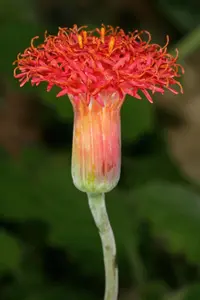
Its slender, cylindrical stems produce bright orange, brush-like flower heads on tall stalks, creating a strong visual contrast between the cryptic, camouflaged stems and conspicuous reproductive structures.

Botan icon

Did you know?

In habitat in South Africa, this species often grows partially shaded among rocks and low shrubs, where its green, mottled stems blend into the surroundings so well that they can be difficult to spot even at close range.

FAQs about Kleinia stapeliiformis

This species adapts to both, but performs best outdoors in warm, arid or Mediterranean climates with excellent drainage. In cooler regions it is often treated as a container plant and moved indoors to avoid cold damage.

Grow Healthy Plants with Botan Care

Keep your plants happy and healthy with plant identification, disease detection, and easy care guidance.

Botan plant care app — identify plants on mobile

Explore More Plants