Remove Offsets Early
If many baby plants crowd the base, remove some once they have their own small roots.
This gives the parent plant better airflow and keeps the pot from becoming too congested.

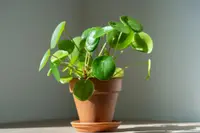
Meet this compact tropical perennial species, whose leaves look like coins on their slender stems. It grows in a neat, upright habit and often produces small offsets around the base. In nature, it can be found in rocky areas of southwestern China, where it grows in well-drained soil with filtered light.
It is easy to grow indoors because it adapts well to home conditions. To care for Chinese money plant properly, follow this guide.

Care Difficulty
Easy Care

Light Preference
Bright Indirect Light

Water Requirements
Moderate Water

Temperature Preference
Tropical / Frost Sensitive

Hardiness Zone
9-11

Soil Texture
Loamy, Organic-rich, Rocky

Soil pH
Slightly acidic (6.5–7.0), Neutral (7.0)

Soil Drainage
Well-drained

Fertilization
Light (every 4–6 weeks)
Scan your plant to receive care tips personalized for your specific plant
Available on iOS and Android
This species grows best in bright light without harsh direct sun. Try to keep it in filtered light to mimic its natural growing conditions.
Chinese money plant prefers moderate watering, with soil allowed to partially dry between drinks. Water about once a week in active growth if the top 1-2 inches (2-5 cm) of soil are dry. Yellowing leaves or constantly wet soil suggest overwatering. At the same time, drooping leaves can indicate dryness.
This species prefers stable warmth, so protect it from cold drafts and strong winds. Keep temperatures around 65-75°F (18-24°C) for leaf growth and compact form. Also, avoid exposing it to temperatures below 50°F (10°C), as cold air can damage foliage and slow growth.
This plant adapts well to typical indoor temperatures and normal household humidity. The main thing to watch for is excessively dry air, especially during the heating season. To prevent stress, place Pilea peperomioides away from hot, drying airflow from vents, radiators, or baseboard heaters.
Choose a loose, airy mix that drains quickly but holds slight moisture.
You can confidently grow this species in a pot. For this, use a container with drainage holes and empty saucers quickly so roots never sit in runoff. Also, choose a shallow to medium-depth pot because the root system remains compact.
Tip: Avoid lightweight containers even if they’re beautiful. Choose heavier ceramic pots because they help balance mature plants with long leaf stems.
Light feeding helps the Chinese money plant maintain steady leaf growth during active growth.
This houseplant needs only light pruning, mainly to remove old growth and keep its shape.
As a rule, Chinese money plant grows fast with proper conditions, so repot it when you see that the pot becomes too small.
In most cases, you'll not face any problems with propagation. This species makes baby plants that can be separated from their parent.
Winter growth slows, and this frost-sensitive plant needs stable indoor conditions. Keep your Chinese money plant away from cold windows, drafts, and temperatures below 50°F (10°C) and water less often, letting the upper soil dry before watering again.

Plant Health Check
Not sure what's wrong with your plant? Check your plant's health inside the app.
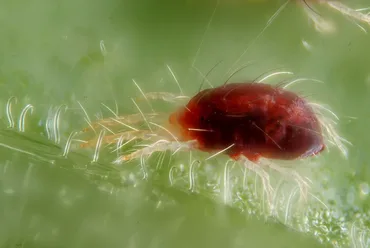
These tiny red or reddish-brown mites usually appear on the undersides of leaves, especially in warm, dry conditions.
Symptoms include pale speckling, fine webbing, dull leaves, and gradual leaf yellowing.
Solution
Isolate your Pilea peperomioides and rinse the foliage, focusing on leaf undersides and stem joints.
Repeat cleaning several times over 1-2 weeks, and use insecticidal soap or horticultural oil if the mites continue to spread.
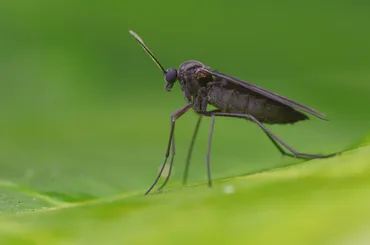
These small flies often appear when the soil stays wet for too long.
Adults are mostly just annoying, but larvae can feed on fine roots in damp potting mix.
Solution
Let the upper soil dry more fully between watering and remove decaying plant debris from the surface.
Yellow sticky traps help reduce adults.
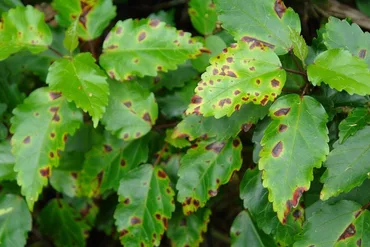
It is a disease that appears as small brown or dark marks on leaves, especially when foliage stays wet or airflow is poor.
Affected leaves can yellow or decline if the problem spreads.
Solution
Remove spotted leaves and avoid splashing water onto the foliage.
Improve spacing around the plant and keep leaves dry during routine care.
Pilea peperomioides spread among home gardeners through shared cuttings long before botanists in the West knew about it. That’s why it became known as the “friendship plant”.
Its place in the nettle family wasn’t recognized until the 1980s.
Although rare in the wild, this plant has become a favorite indoors.
Its popularity comes from its compact shape, low-maintenance care, and ability to handle drier household conditions.
The plant may occasionally produce small white to pale pink flowers on tall, spike-like stems, but it rarely blooms indoors.
Small pale dots on the leaf surface are often natural mineral deposits from pores called hydathodes. They are usually harmless unless accompanied by pests, spreading spots, or tissue damage.
Keep your plants happy and healthy with plant identification, disease detection, and easy care guidance.