Elkhorn Fern Care (Platycerium bifurcatum)

Also known as: Staghorn fern

About Elkhorn Fern

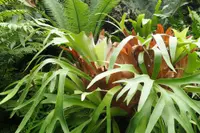
Elkhorn fern, Platycerium bifurcatum, is an epiphytic fern that often grows on tree trunks or mounted boards rather than in regular potting soil. It forms two kinds of fronds: flat shield fronds that hug the mounting surface and forked, antler-like fronds that arch outward.

In nature, it occurs in Australia and surrounding regions, where it grows in warm, humid forests. Its growth habit makes it well suited to being mounted on wood or grown in hanging situations indoors.

This fern prefers bright, indirect light, good air circulation, and evenly moist conditions. Once its basic needs are understood, it is moderately easy to care for Elkhorn Fern in home environments.


Main Plant Requirements

Care Difficulty

Moderate Care

Light Preference

Bright Indirect Light

Water Requirements

Moderate Water

Temperature Preference

Tropical / Frost Sensitive

Hardiness Zone

9–11

Soil Texture

Peaty, Organic-rich

Soil pH

Acidic (5.5–6.5), Slightly acidic (6.5–7.0)

Soil Drainage

Well-drained

Fertilization

Light (every 4–6 weeks)

Get Personalized Care Plan

Scan your plant to receive care tips personalized for your specific plant

Personalized Care in the App

Available on iOS and Android

How to Care for the Elkhorn Fern

This fern prefers bright, indirect light that mimics dappled forest shade.

  • Provide 4–6 hours of bright, filtered light each day, such as near an east window or under shade cloth outdoors, to support steady growth in Elkhorn Fern.
  • Allow light morning sun but protect from strong midday and afternoon sun, which can scorch fronds and cause bleaching or dry, crispy tips.
  • In deeper shade, move the plant gradually to a brighter spot over 1–2 weeks; increase light slightly in winter when natural light levels drop.

Watering should balance consistent moisture with very good drainage to protect the roots and fronds.

  • Water when the mounting medium or mix feels dry about 2–3 cm deep; fronds should feel firm, not limp or brittle.
  • Soak thoroughly, then let excess water drain completely; avoid letting the basal shield sit in waterlogged material, which leads to rot or black, mushy spots.
  • In warm, bright seasons, watering may be needed more often; in cooler or low-light periods, extend intervals and watch for limp fronds (underwatering) or yellowing and soft bases (overwatering) in Platycerium bifurcatum.

This species prefers mild, stable temperatures similar to warm, frost-free woodland conditions.

  • Aim for an active growth range of 65–80°F (18–27°C), where fronds develop steadily and stress is minimal.
  • Protect from cold below about 40°F (4°C); brief dips to 35–40°F (2–4°C) may be survived, but frost can permanently damage fronds and rhizomes.
  • In heat above 85°F (29°C), increase air movement and humidity while keeping the mounting medium just slightly moist; avoid hot, stagnant air or sudden cold drafts, especially at night.

This fern prefers consistently humid air and reacts quickly to very dry conditions.

  • Aim for 50–70% humidity; short dips lower are tolerated but prolonged air below 40% leads to frond tip browning.
  • Watch for crispy, curling fronds and stalled growth as signs of humidity stress in Elkhorn Fern.
  • Increase humidity with a nearby humidifier, grouped plants, or placing mounts above a pebble tray, not by misting heavily.

This epiphytic fern needs a loose, fast-draining, organic substrate rather than compact potting soil.

  • Use a mix similar to orchid or bromeliad media, for example 40% fine orchid bark, 30% sphagnum moss, 20% perlite, 10% composted leaf mold.
  • Ensure the medium drains quickly yet holds light, even moisture, avoiding any mix that stays wet and heavy for more than 1–2 days.
  • Keep pH slightly acidic to neutral, around 5.5–7.0, which supports nutrient uptake and healthy root and shield frond development.
  • For Platycerium bifurcatum, prioritize chunky particles and air gaps; avoid peat-heavy, dense potting mixes that compress and suffocate roots.

This species grows very well in containers or on mounts when stability and drainage are managed carefully.

  • Choose a shallow, wide container or basket that anchors the plant’s weight so the fronds cannot tip it over as they elongate.
  • Use a slatted or wire basket lined with breathable material to let air reach the root area while still holding the coarse medium.
  • Select a heavier container material, such as clay or ceramic, when grown large outdoors to prevent wind from shifting or toppling the plant.

This fern benefits from light, consistent feeding during active growth but is sensitive to excess salts.

  • Use a balanced, water‑soluble fertilizer (around 10‑10‑10 or 20‑20‑20) diluted to 1/4–1/2 strength.
  • Feed every 4–6 weeks in spring and summer, applying to the mounting medium, not directly on fronds.
  • Skip or reduce feeding to 1 light application the entire season in fall and winter.
  • Organic options like very thin compost tea are suitable for caring for Elkhorn Fern if applied sparingly.

Platycerium bifurcatum needs minimal pruning, focused mainly on hygiene rather than shaping.

  • Perform any pruning in late winter or early spring before strong new growth starts.
  • Remove only dead, dried, or diseased fronds with clean, sharp scissors or pruners.
  • Leave healthy shield fronds intact, as they protect the root mass and store nutrients.
  • Trim brown tips only if completely dry, cutting just into the dead tissue to maintain appearance.

This species is usually mounted rather than potted, and disturbance should be infrequent.

  • Consider remounting or repotting every 3–5 years, or when the plant outgrows its board or pot and growth slows.
  • Check for roots circling tightly, crowded pups, or a plant pulling away from its mount as signs it needs attention.
  • Best time is spring, when Platycerium bifurcatum resumes active growth and recovers faster from handling.
  • During transfer, keep the root mass intact, handle shield fronds gently, and water lightly afterward to limit stress.

Platycerium bifurcatum is most commonly propagated by separating pups rather than from spores.

  • Take divisions in spring or early summer, when the plant is actively growing.
  • Select well‑formed pups with their own roots and a portion of the rhizome attached.
  • Gently separate pups from the parent, minimizing damage to shield and fertile fronds.
  • Mount or pot pups in a loose, airy medium, keep humidity high, and provide bright, indirect light until established.

This fern is frost sensitive and needs protection in colder climates, especially when grown outdoors or in containers.

  • Maintain indoor temperatures around 55–75°F and avoid cold drafts near windows or doors.
  • Move outdoor containers indoors before temperatures drop near 40°F, giving bright, indirect light.
  • Reduce watering in winter so the root area stays just lightly moist, not saturated.
  • In mild climates, mount-grown plants outdoors may overwinter under shelter with good air movement and no direct frost exposure.

Care Tips

Secure Mounting

Use plastic-coated wire, fishing line, or soft plant ties to firmly attach the fern base to a wooden board or cork slab, making sure the ties sit over the brown shield fronds, not through the living tissue, to avoid damage as the plant expands.

Support New Pups

When new offsets develop, gently support them with additional ties or a small mesh cradle so their weight is spread across the mounting surface, preventing the whole plant from slowly tearing away from its backing.

Layered Substrate Refresh

Every 1–2 years, tuck a thin layer of fresh sphagnum moss or fine orchid bark behind the shield fronds at the base, adding organic material without disturbing the root system or breaking older fronds.

Shield Frond Management

Do not remove brown, papery shield fronds, but if they collect debris or pests, clean the crevices with a soft brush or a gentle stream of water to keep airflow good and reduce fungal or insect issues when caring for Elkhorn Fern.

Seasonal Light Rotation

Rotate the mount a quarter-turn every 2–4 weeks during active growth so the antler fronds develop evenly, and shift the entire mount slightly farther from windows in summer to prevent one-sided or scorched growth.

Common Pests and Diseases

Scale insects

This pest feeds on sap along the shield fronds and mounting surface, often appearing as small brown or tan bumps that blend into the plant. Symptoms include sticky honeydew, sooty mold growth, and gradual yellowing or weakening of fronds.

Solution

Remove infested fronds only if severely damaged, since green fronds are important for photosynthesis. Gently scrub affected areas with a soft brush or cloth dipped in diluted insecticidal soap or isopropyl alcohol, repeat weekly until clear, and improve air movement and light levels to reduce reinfestation while maintaining the plant’s tolerance for shade.

Mealybugs

These insects hide in the fuzzy bases of fronds and around mounting material, appearing as white cottony clusters. Symptoms include distorted new fronds, sticky residue, and slow decline of the plant.

Solution

Isolate the plant, then use a cotton swab dipped in 70% isopropyl alcohol to dab visible mealybugs, taking care not to soak the shield fronds. Follow with a gentle spray of insecticidal soap on accessible surfaces every 7–10 days and check crevices in the shield and mounting board regularly until no new insects appear, which is key for Platycerium bifurcatum plant care.

Spider mites

These pests thrive on Elkhorn fern fronds in dry indoor air, causing fine speckling and a dull, dusty appearance, especially on fertile fronds. Symptoms include very fine webbing and bronzing or premature browning of fronds.

Solution

Increase humidity around the plant and rinse fronds thoroughly with lukewarm water, including the undersides, to remove mites and dust. If populations persist, use a miticide or insecticidal soap labeled for mites, applied in repeated light treatments while avoiding waterlogging of the shield fronds and mounting material.

Bacterial blight

This disease causes water-soaked, translucent spots on fronds that may expand into irregular brown lesions with a yellowish halo. Symptoms include rapid spread in warm, humid, stagnant conditions and possible collapse of affected fronds.

Solution

Remove and discard badly affected fronds with sterilized tools, and avoid overhead watering so fronds dry quickly. Improve air circulation, reduce crowding, and keep water off the shield and fertile fronds; in severe cases apply a copper-based bactericide according to label directions, taking care not to overuse it on sensitive fern tissue.

Fungal leaf spot

This disease produces scattered small brown, black, or tan spots on fronds, sometimes with a darker margin, that may merge under very damp conditions. Symptoms include slow but progressive spotting, especially on plants kept constantly wet or in poorly ventilated locations.

Solution

Trim out the most affected fronds, sterilizing tools between cuts, and allow the fern to dry slightly between waterings while keeping humidity moderate rather than dripping wet. Increase airflow around the plant and, if needed, apply a broad-spectrum fungicide labeled for ornamental ferns in light, repeated doses, focusing on preventing future spread rather than trying to cure existing lesions.

Interesting Facts

Two-type frond strategy

This species produces two distinct frond types: flat, sterile shield fronds that hug the substrate and upright, forked fertile fronds that resemble deer antlers, an adaptation that helps both anchoring and spore production.

Nutrient-catching nest

As an epiphyte in Australian and some Southeast Asian forests, it traps falling leaf litter and dust between its overlapping shield fronds, creating its own small compost layer to access nutrients without growing in soil.

Naturally clumping colonies

Mature plants form clumps as new growing points develop at the base, which in the wild can create large, multi-plant colonies that share accumulated organic matter and moisture on tree trunks or rock faces.

Botan icon

Did you know?

In its native habitat, this fern often positions itself on tree trunks where rainwater naturally converges, allowing the shield fronds to funnel and hold moisture so effectively that sizable plants can persist for long dry spells without direct access to soil.

FAQs about Elkhorn Fern

Brown tips or patches usually come from low humidity, underwatering, or direct sun scorch. Brown, papery basal fronds are normal and should stay in place, as they protect roots and help anchor the plant.

Grow Healthy Plants with Botan Care

Keep your plants happy and healthy with plant identification, disease detection, and easy care guidance.

Botan plant care app — identify plants on mobile

Explore More Plants