Shaving Brush Tree Care (Pseudobombax ellipticum)

About Shaving Brush Tree

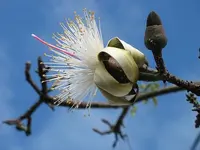
The shaving brush tree, Pseudobombax ellipticum, is a small deciduous tree known for its swollen, bottle-shaped trunk and dramatic round clusters of long, bristly flowers. The blooms resemble a shaving brush, often in white or pink, and appear on bare branches before new leaves.

This species is native to dry tropical regions of Mexico and Central America, where it is adapted to seasonal drought. In cultivation it grows slowly and stays manageable in a large container, which makes it suitable for patios or bright indoor spaces.

It is generally low-maintenance if given strong light, a warm, dryish rest period, and well-drained soil, so learning how to care for Shaving Brush Tree is straightforward for most plant owners.

Main Plant Requirements

Care Difficulty

Moderate Care

Light Preference

Full Sun

Water Requirements

Low Water

Temperature Preference

Tropical / Frost Sensitive

Hardiness Zone

10–12

Soil Texture

Sandy, Loamy, Organic-rich

Soil pH

Slightly acidic (6.5–7.0), Neutral (7.0)

Soil Drainage

Well-drained

Fertilization

Minimal (feed rarely)

Get Personalized Care Plan

Scan your plant to receive care tips personalized for your specific plant

Personalized Care in the App

Available on iOS and Android

How to Care for the Shaving Brush Tree

This species prefers bright, warm conditions that mimic its native tropical habitat.

  • Provide 6–8 hours of bright light daily, ideally with morning sun and light afternoon shade, especially in hot, inland climates.
  • Shaving Brush Tree tolerates light partial shade, but flowering and compact growth improve when it receives several hours of direct sun outside the harshest midday period.
  • In summer, protect from intense, reflected afternoon sun to prevent leaf scorch; in winter, ensure it is not shaded by buildings or trees so it still receives strong light.

Watering should follow the plant’s growth cycle and the dryness of the soil, not a fixed calendar.

  • During active growth in spring and summer, water when the top 3–5 cm of soil feel dry, then soak thoroughly, allowing excess to drain away.
  • Use sharply draining soil so the swollen trunk and roots do not sit in water; yellowing, soft leaves or stem base indicate overwatering and possible rot.
  • In autumn and winter dormancy, especially if leafless, reduce watering drastically and allow the soil to dry much deeper, only watering if stems start to slightly wrinkle.

This tropical tree prefers consistently warm conditions and is sensitive to cold and frost.

  • Optimal growth occurs around 70–85°F (21–29°C), with warm days and slightly cooler nights supporting strong stem and leaf development.
  • Pseudobombax ellipticum should be protected from temperatures below 40°F (4°C); brief exposure near freezing can damage tissues, and hard frost can kill young plants.
  • Mature plants tolerate short hot spells up to about 100°F (38°C) if soil moisture is adequate, but prolonged extreme heat combined with drought can cause leaf drop and stress.

This species handles a wide humidity range but prefers moderately moist air.

  • Aim for 40–60% humidity; typical indoor levels are usually adequate for Shaving Brush Tree.
  • It tolerates short dry spells, but very dry air can cause marginal leaf browning and quicker bud drop.
  • Increase humidity with a nearby water tray or grouped plants rather than misting, which adds only brief surface moisture.

This species needs fast-draining, airy soil that does not stay wet around its caudex-like base.

  • Use a gritty mix such as 50% coarse sand or pumice with 30% loam and 20% composted organic matter for Pseudobombax ellipticum.
  • Ensure very sharp drainage so water runs through quickly, preventing root and stem base rot.
  • Keep pH slightly acidic to neutral, around 6.0–7.0, which supports balanced nutrient uptake.
  • Avoid dense, peat-heavy or clay soils; lighten them with extra perlite or bark chips to improve aeration.

This species is suitable for container growing, especially in cooler climates or where space is limited.

  • Choose a wide, heavy container to stabilize the tall, top-heavy canopy and swollen trunk base in wind or on balconies.
  • Select a pot just slightly wider than the root zone so the mix dries evenly instead of staying wet at the bottom.
  • Use mineral-based mixes in non-glazed clay pots when extra moisture loss is needed, especially in humid or rainy regions.

This species grows acceptably in lean soil, but moderate feeding supports stronger growth and flowering in Shaving Brush Tree.

  • Use a balanced, slow-release fertilizer or liquid feed around 10-10-10 NPK, applied to the root zone, not the trunk.
  • Feed every 4–6 weeks during spring and summer while the tree is actively growing.
  • Dilute liquid fertilizers to 1/2–1/4 strength to avoid root burn, especially in containers.
  • Stop or greatly reduce feeding in fall and winter, when the plant is leafless or semi-dormant.

Pruning Pseudobombax ellipticum is mainly used to manage size, structure, and safety rather than to stimulate heavy flowering.

  • Carry out structural pruning in late winter or early spring, before vigorous new growth begins.
  • Remove dead, diseased, crossing, or storm-damaged branches using clean, sharp bypass pruners or a small pruning saw.
  • Shorten or thin crowded interior shoots to improve light penetration and airflow without over-thinning the canopy.
  • Avoid severe heading cuts; maintain the natural form by cutting back to a branch collar or side branch.

Pseudobombax ellipticum develops a substantial root system, so container plants eventually need more space or in-ground planting.

  • Check for roots circling the pot, emerging from drainage holes, or slowed growth as signals it needs a larger container.
  • Plan repotting or transplanting for late winter to early spring, just before active growth starts.
  • Expect repotting every 2–3 years in containers, stepping up only 1 pot size with a very well-draining mix.
  • Reduce root stress by watering well before and after, handling the root ball gently, and shading from strong sun for 3–7 days.

Pseudobombax ellipticum is commonly propagated from seeds and semi-woody cuttings under warm, bright conditions.

  • Sow fresh seeds in spring in a fast-draining, sandy mix; keep at 70–80°F with lightly moist, not wet, substrate.
  • Provide bright, indirect light and good air movement to limit damping-off, a fungal disease of seedlings.
  • Take semi-hardwood stem cuttings in late spring or summer, using 10–15 cm pieces with several nodes.
  • Dip cut bases in rooting hormone, place in a sterile, coarse mix, and maintain high humidity until firm rooting develops.

This species is frost-sensitive and needs targeted winter care in climates with freezing temperatures.

  • Avoid exposure below about 30°F; young or potted trees are more vulnerable to freeze damage.
  • Move container plants indoors or into a bright, frost-free greenhouse before the first hard frost.
  • Mulch in-ground roots with 5–8 cm of coarse organic material, keeping mulch a few cm away from the trunk.
  • In marginal climates, wrap young trunks with breathable frost cloth during cold snaps to limit cambium injury.

Care Tips

Caudex protection

Use a gritty top dressing such as coarse sand or small gravel around the swollen base to keep it dry and visible while discouraging rot and fungus growth at the soil line.

Controlled branching

After flowering, selectively tip-prune only a few actively growing shoots each year to encourage a well-spaced framework of branches without removing too much flowering wood.

Seasonal root checks

At the start of the warm, active season, slide the root ball out of the pot to check for circling, woody roots and lightly tease or trim them before repotting into a slightly larger container.

Dry-season storage

If the plant is fully dormant and leafless, keep it in a bright, frost-free place and water just enough to prevent the caudex from noticeably shriveling, rather than following a fixed schedule.

Wind and weight support

In outdoor containers, anchor a discreet stake on the windward side and secure the trunk loosely with soft ties so the top-heavy canopy does not rock and damage the roots during storms when growing Shaving Brush Tree.

Common Pests and Diseases

Scale insects

This pest feeds on stems and the swollen trunk (caudex), causing yellowing, weak growth, and sticky honeydew on nearby surfaces.

Solution

Remove visible insects by gently scraping or wiping with cotton pads dipped in 70% isopropyl alcohol, then wash stems with a mild soapy water solution; for larger infestations, use a horticultural oil spray, making sure to fully coat the bark and branch joints while the plant is in shade and temperatures are below 85°F.

Mealybugs

These insects hide in branch crotches and along the caudex, sucking sap and leaving white, cottony clusters and distorted new growth.

Solution

Isolate the plant, dab visible clusters with cotton swabs soaked in 70% isopropyl alcohol, then rinse the plant with lukewarm water; follow up with 2–3 applications of insecticidal soap or neem oil at 7–10 day intervals, paying special attention to crevices around old leaf scars.

Spider mites

This pest is favored by hot, dry conditions and causes fine webbing, stippled leaves, and general decline, especially on container plants kept in full sun and low humidity.

Solution

Increase humidity around the plant and hose down the canopy thoroughly, including the undersides of leaves; repeat strong water sprays every few days and, if needed, apply insecticidal soap or a miticide labeled for spider mites, ensuring good coverage of all green tissue.

Aphids

These insects cluster on young shoots and flower buds, sucking sap and excreting honeydew that can attract sooty mold growth on smooth bark and nearby surfaces.

Solution

Prune off heavily infested shoot tips and wash remaining aphids away with a firm stream of water; if populations persist, use insecticidal soap or a light horticultural oil on the new growth, repeating at 5–7 day intervals until no new aphids appear.

Sooty mold

This disease is a superficial black fungal growth that develops on honeydew left by sap-sucking insects, giving the bark and any leaves a dirty, dark coating and reducing photosynthesis.

Solution

Control the underlying insect pests first, then gently wash affected areas with lukewarm water and a small amount of mild liquid soap; improve air circulation and avoid overhead watering that keeps surfaces wet, allowing the remaining mold to weather off gradually as new tissue grows, which supports overall Pseudobombax ellipticum care.

Interesting Facts

Brush-like nocturnal flowers

This species produces large, shaving-brush–shaped flowers with hundreds of stamens that usually open at night and are mainly pollinated by bats and moths in its native range.

Swollen water-storing trunk

Mature trees often develop a conspicuously thickened, bottle-like trunk that acts as a water reservoir, an adaptation to withstand pronounced dry seasons in tropical dry forests.

Leafless flowering display

The tree commonly sheds most or all of its leaves before blooming, so the bright pink or white pompom flowers appear on bare branches, making them highly visible to pollinators over long distances.

Botan icon

Did you know?

In parts of Mesoamerica, this tree has been used as a living fence and boundary marker, since cut branches can root and establish as new trees when stuck directly into suitable ground.

FAQs about Shaving Brush Tree

Flowering often needs a pronounced dry, cool rest period and strong light. If it is watered heavily year-round or kept too warm and shaded, buds may not form. Avoid high-nitrogen fertilizer, which favors foliage over flowers.

Grow Healthy Plants with Botan Care

Keep your plants happy and healthy with plant identification, disease detection, and easy care guidance.

Botan plant care app — identify plants on mobile

Explore More Plants