Sky plant Care (Tillandsia ionantha)

Also known as: Blushing Bride Airplant, Sky Plant, Ionantha Lilac, Enhanced Lilac

About Sky plant

The sky plant, Tillandsia ionantha, is a small epiphytic air plant from Central and South America. It naturally grows on trees and rocks rather than in soil. Plants form tight rosettes of stiff, narrow leaves that often blush red or pink before producing a small violet flower spike. This compact habit makes it popular for terrariums, mounted displays, and small indoor arrangements. Tillandsia ionantha is generally easy to grow, as it absorbs water and nutrients through its leaves and has no true roots for feeding. Bright, filtered light, good air circulation, and regular misting are usually enough to care for Sky plant in most homes.

Main Plant Requirements

Care Difficulty

Moderate Care

Light Preference

Bright Indirect Light

Water Requirements

Moderate Water

Temperature Preference

Tropical / Frost Sensitive

Hardiness Zone

10–12

Soil Texture

Sandy, Rocky, Organic-rich

Soil pH

Acidic (5.5–6.5), Slightly acidic (6.5–7.0)

Soil Drainage

Well-drained

Fertilization

Light (every 4–6 weeks)

Get Personalized Care Plan

Scan your plant to receive care tips personalized for your specific plant

Personalized Care in the App

Available on iOS and Android

How to Care for the Sky plant

Tillandsia ionantha needs bright, indirect light to color up and stay compact.

  • Provide 6–8 hours of bright, filtered light daily; morning sun with afternoon shade suits Sky plant well, especially in warm climates.
  • Outdoors, place where it receives dappled light under a tree or 1–3 hours of gentle early sun; avoid harsh midday summer sun that can scorch leaves.
  • If leaf color fades to dull green or rosettes stretch, light is too low; if tips bleach or turn crispy, reduce direct sun exposure.

This air plant absorbs water through its leaves, so moisture timing and drying are crucial.

  • Soak or thoroughly mist until leaves are evenly wet, then allow to dry fully within 3–4 hours; silver, thick-leaved forms usually need less frequent soaking than greener forms.
  • In warm, dry periods, soak 1–2 times per week; in cool or very humid conditions, reduce to every 7–10 days and rely more on light misting.
  • Leaves curling inward, feeling very light, or turning brittle signal underwatering; limp bases, browning centers, or a sour smell indicate overwatering and poor drying.

This bromeliad prefers warm, frost-free conditions with moderate temperature swings.

  • Aim for 65–80°F (18–27°C) for steady growth; brief drops to 55°F (13°C) are usually tolerated if leaves are dry.
  • Protect from cold below 45°F (7°C); freezing temperatures cause permanent tissue damage, especially if the plant is wet overnight.
  • In hot spells above 90°F (32°C), increase shade and airflow and water a bit more often so the plant does not desiccate in the heat.

This air plant prefers moderate humidity but tolerates typical indoor air if misted consistently.

  • Aim for 50–70% humidity, using regular misting or a nearby humidifier in very dry homes.
  • Brown, curling leaf tips or leaves staying tightly rolled indicate low humidity stress.
  • Increase humidity by grouping air plants together, placing them near (not in) an open-water tray, and misting 2–4 times weekly, then allowing full drying.
  • Sky plant handles short dry spells but needs more frequent misting in heated or air-conditioned rooms.

Tillandsia ionantha does not grow in soil and should never be planted in a conventional potting mix.

  • Leave roots exposed and anchor the plant to wood, cork, stone, or wire; the roots serve mainly for grip, not for nutrient uptake.
  • Avoid all peat, compost, or regular potting soil, which trap moisture around the base and quickly cause rot.
  • Use open, airy mounts such as driftwood, bark, or mesh that let air flow freely around the entire plant, including the base.
  • If placing in a decorative container, keep the plant sitting above a layer of stones, shells, or glass so water cannot pool around it.

This species suits containers only when used as an airy display, not as a potted plant in mix.

  • Choose shallow, wide containers like bowls or dishes that allow air to circulate freely around the plant on all sides.
  • Keep the plant elevated on inert materials such as stones or shells so any water drains away from the base immediately.
  • Favor breathable materials like unglazed ceramic over sealed glass when possible, or provide extra airflow if using terrariums or cloches.

This small epiphytic air plant needs light but consistent feeding rather than heavy fertilizer applications.

  • Use a balanced, water‑soluble orchid or bromeliad fertilizer at 1⁄4 strength; avoid slow‑release pellets that can burn leaves.
  • Feed once every 3–4 weeks during spring–summer by adding diluted fertilizer to the misting water.
  • Reduce feeding to once every 6–8 weeks in fall–winter as growth slows.
  • Ensure leaves dry within a few hours after feeding to prevent leaf spots or rot on the Sky plant.

Pruning needs for Tillandsia ionantha are minimal and focus on hygiene rather than shaping.

  • Best time is after flowering when pups have formed and the mother plant starts declining.
  • Gently remove dead or brown leaves by pulling them downward from the base, avoiding green tissue.
  • Snip off completely spent flower spikes and dried leaf tips with clean, sharp scissors.
  • Clearing dead material improves air circulation, reduces rot risk, and keeps the plant’s rosette compact.

This air plant has no true roots for soil, so care focuses on remounting or repositioning rather than traditional repotting.

  • Shift plants when they outgrow a mount, clump becomes crowded, or air circulation is poor.
  • Best time to remount is in spring, before peak growth, to reduce stress and encourage quick recovery.
  • Typical frequency is every 2–3 years, or when older mounts decay or no longer dry quickly after watering.
  • Handle gently, attach with soft wire or non‑toxic glue to a new mount, and avoid burying the base in moss.

Propagation of Tillandsia ionantha is most reliable through offsets, also called pups, produced after flowering.

  • Wait until pups reach about 1⁄3–1⁄2 the size of the mother plant, usually in spring–summer.
  • Gently twist or pull pups sideways from the base, keeping their small attachment intact when possible.
  • Place separated pups in bright, indirect light with good air movement and maintain regular misting for 2–3 months.
  • Seed propagation is possible but slow and requires warm temperatures, high humidity, and very bright light.

This species is not frost hardy and needs indoor conditions in cold climates during winter.

  • Move outdoor plants indoors before temperatures drop near 40°F, using bright, indirect light.
  • Keep air temperatures around 60–75°F and avoid cold drafts from windows or doors.
  • Reduce watering slightly but maintain moderate humidity and strong air circulation to prevent rot.
  • Ensure plants dry within 2–4 hours after misting since cool conditions slow evaporation.

Care Tips

Optimized mounting

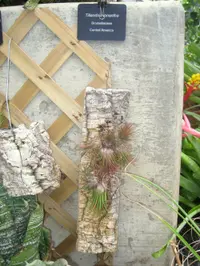
Attach plants to mounts using plastic-coated wire, fishing line, or nylon stockings instead of glue so air can circulate freely around the base and the plant can be removed easily for soaking or division.

Rotate for even form

Rotate the plant 90° every 1–2 weeks so all sides receive similar light and air flow, which encourages a compact, symmetrical rosette rather than lopsided growth.

Post-bloom offsets care

After flowering, leave the mother plant in place until pups reach at least one-third to one-half of its size, then gently twist and separate them to establish new plants with minimal stress.

Travel and vacation setup

Before travel longer than 5–7 days, give a thorough 30–60 minute soak, shake off excess water, then place the plant in bright shade with strong air movement to reduce desiccation risk while still preventing rot.

Display hygiene routine

Every 1–2 months, remove the plant from its display, rinse it thoroughly under lukewarm running water to clear dust and residue, then dry it upside down to keep leaf bases clean and reduce rot and pest issues when caring for Sky plant.

Common Pests and Diseases

Mealybugs

This pest hides in leaf bases and sheltered crevices, sucking sap and leaving white, cotton-like clusters on the plant. Symptoms include stunted growth, leaf yellowing, and sticky honeydew that can attract sooty mold.

Solution

Isolate the affected air plant, then rinse under a strong but gentle stream of lukewarm water, focusing on the leaf bases. After shaking off excess water, dab remaining insects with a cotton swab dipped in 70% isopropyl alcohol, repeat weekly until clear, and increase air movement to reduce future infestations.

Scale insects

These insects appear as small, hard, brown or tan bumps on leaves and leaf bases, where they remain fixed while feeding. Symptoms include dull, discolored foliage and weak growth over time.

Solution

Manually remove visible scale with a soft toothbrush or cotton swab moistened with 70% isopropyl alcohol, taking care not to damage the trichomes (leaf surface hairs). Rinse the plant thoroughly, let it dry quickly in bright, airy conditions, and inspect neighboring air plants, treating and separating any that show signs of infestation.

Fungal leaf spot

This disease causes small, water-soaked or dark spots on the leaf blades, often where water sits for too long between leaves. Symptoms include patches that may expand and cause leaf tip dieback, especially under low airflow and high humidity.

Solution

Improve air circulation, shorten soaking times, and ensure the plant dries fully within 3–4 hours after watering to support healthy Tillandsia ionantha plant care. Trim and discard heavily spotted leaves with clean scissors, avoid misting late in the day, and if needed apply a light, air-plant-safe copper or sulfur-based fungicide according to label directions, followed by careful drying.

Bacterial soft rot

This disease leads to rapidly soft, mushy, and foul-smelling tissue starting in the crown or dense leaf bases. Symptoms include sudden collapse of central leaves, often after water sits trapped in the rosette for extended periods.

Solution

Immediately remove and discard severely affected plants, as this rot spreads quickly and is rarely reversible. For very early cases, cut away all soft tissue with a sterile blade, keep only firm, healthy parts, position plants upside down after watering to let trapped water drain, and maintain strong airflow and moderate humidity to prevent recurrence.

Interesting Facts

Natural cliff specialist

This species often grows on exposed cliffs and tree branches in parts of Mexico, Central America, and northern South America, anchoring itself to bark or rock without drawing nutrients from the host surface.

Color change at blooming

As it approaches flowering, the normally green to silvery leaves flush red or pink at the center, a pigment change that helps attract hummingbirds and insects to its tubular violet flowers.

Efficient trichome armor

Its leaves are densely covered with specialized scale-like hairs called trichomes, which both absorb water and dissolved nutrients from rain and dust and also reflect excess sunlight to reduce overheating.

Botan icon

Did you know?

In some of its native habitats, ionantha can form dense, ball-like colonies on branches that persist for many years, creating miniature epiphytic communities where small invertebrates shelter among the rosettes.

FAQs about Sky plant

Lack of blooms often comes from insufficient light, low humidity, or inadequate air circulation. Mild stress from slightly cooler nights or a small dose of diluted bromeliad fertilizer can also help trigger flowering in mature plants.

Grow Healthy Plants with Botan Care

Keep your plants happy and healthy with plant identification, disease detection, and easy care guidance.

Botan plant care app — identify plants on mobile

Explore More Plants