Xerographica Air Plant Care (Tillandsia xerographica)

About Xerographica Air Plant

Tillandsia xerographica, often called the xerographica air plant, is a large epiphytic bromeliad that grows without soil, anchoring to bark, wood, or other surfaces. Its thick, silvery leaves curl gracefully into a rosette, forming a sculptural shape that stays compact but can become quite wide with age.

This species is native to dry forests and rocky areas of Central America, where it receives bright light, strong air movement, and periodic rainfall rather than constant moisture. Its drought-tolerant nature and slow growth make it relatively low maintenance once conditions are right. Understanding how to care for Xerographica Air Plant mainly involves providing bright light, good air circulation, and careful watering rather than regular potting soil.

Main Plant Requirements

Care Difficulty

Moderate Care

Light Preference

Bright Indirect Light

Water Requirements

Low Water

Temperature Preference

Tropical / Frost Sensitive

Hardiness Zone

10–12

Soil Texture

Rocky, Sandy, Organic-rich

Soil pH

Acidic (5.5–6.5), Slightly acidic (6.5–7.0)

Soil Drainage

Well-drained

Fertilization

Light (every 4–6 weeks)

Get Personalized Care Plan

Scan your plant to receive care tips personalized for your specific plant

Personalized Care in the App

Available on iOS and Android

How to Care for the Xerographica Air Plant

This species prefers bright, indirect light similar to bright shade in dry tropical habitats.

  • Provide 4–6 hours of bright, filtered light daily, such as near an east or bright north window or under 30–50% shade cloth outdoors.
  • Morning sun is usually tolerated, but protect the Xerographica Air Plant from harsh midday or afternoon sun that can scorch leaves and cause bleaching.
  • If light is too low, leaves lengthen and lose firmness; move gradually to a brighter spot, especially in winter when days are shorter.

This air plant absorbs water through its leaves and dries best with strong air movement.

  • Soak or thoroughly drench leaves for 10–20 minutes, then shake off excess and allow to dry within 3–4 hours in bright, airy conditions.
  • Water when leaf edges feel less firm or begin to curl slightly; in warm, dry seasons this may be 1–2 times per week, less often in cool, humid weather.
  • Signs of overwatering include limp, brown bases or rot smell; crisp, brittle leaf tips and deep curling indicate underwatering.

This species prefers warm, frost-free conditions with good air circulation.

  • Aim for 65–85°F (18–29°C) for steady growth, with nights slightly cooler than days.
  • Protect from cold below 45°F (7°C); extended exposure near or below 32°F (0°C) can cause tissue damage and death.
  • Short heat waves up to 95°F (35°C) are tolerated if humidity and airflow are high, but increase watering frequency and shade during very hot, dry periods.

This species prefers dry, airy conditions but still benefits from moderate ambient humidity.

  • Aim for 40–60% humidity, which suits most homes and keeps the Xerographica Air Plant functioning well.
  • Tolerates drier air if air circulation is strong and watering by soaking or rinsing is consistent.
  • Watch for tightly curling, brittle leaves as a sign of low humidity stress or chronic under-watering.
  • Increase humidity locally by placing the plant near other plants or above, not on, a pebble tray with water.

Tillandsia xerographica does not use soil; it absorbs water and nutrients through specialized leaf scales called trichomes.

  • Do not plant it in potting soil, moss-packed pots, or dense organic substrates, which trap moisture and cause rot.
  • Mount on inert, non-soaking materials such as cork bark, driftwood, or wire frames that allow air to flow freely around all sides.
  • If displaying in a container, use loose decorative gravel or large bark pieces only as a dry support, keeping the plant resting above them, not buried.
  • Avoid any setup that keeps the base of the plant wet for more than a few hours after soaking or misting.

This epiphytic species can sit in containers only as a display support, not as a rooted potted plant.

  • Choose wide, shallow, and heavy containers to prevent the rosette from tipping, especially as it enlarges and becomes top-heavy.
  • Use open-sided or slatted vessels, such as wire or mesh cups, to keep strong airflow around the leaves and base.
  • Position the plant so water can drain freely out of the container after soaking, without pooling under the crown.

This epiphytic Xerographica Air Plant benefits from light, diluted feeding during active growth rather than heavy fertilization.

  • Use a balanced liquid epiphyte or orchid fertilizer at 1/4–1/8 strength, never full strength.
  • Feed every 3–4 weeks in spring and summer, applying after soaking and allowing excess to drain.
  • Avoid slow-release pellets or compost, which can burn leaves or encourage rot on the leaf bases.
  • Stop or greatly reduce feeding in fall and winter when growth slows.

Pruning needs for Tillandsia xerographica are minimal and focus on hygiene rather than shaping.

  • Perform light grooming at any time of year, ideally after watering when leaves are more flexible.
  • Gently remove completely dry, brown outer leaves by hand, pulling downward along the leaf’s natural line.
  • Trim dead leaf tips with clean, sharp scissors, copying the natural curve of the leaf for a tidy look.
  • Do not cut the central rosette, since this growth point is essential for plant survival and flowering.

This air plant is usually mounted rather than potted, so transplanting focuses on adjusting its support rather than its roots.

  • Remount or reposition when the clump outgrows its display, becomes unstable, or airflow is poor.
  • Best timing is spring to early summer, when light and warmth help the plant recover from handling.
  • Typical frequency is every 2–4 years, or whenever the plant or pups crowd the mounting surface.
  • During transplanting, handle the base gently, avoid burying it in soil or moss, and resume watering gradually.

Propagation of Tillandsia xerographica is commonly done by separating offsets, known as pups, from the mother plant.

  • Wait until pups reach about 1/3–1/2 the size of the mother before removing them.
  • Best season for division is spring or early summer, when warmth and light support new growth.
  • Gently twist or cut pups away at the base with a sterile blade, keeping their small leaf bases intact.
  • Provide bright, indirect light, good airflow, and consistent misting or soaking to support establishment.

This tropical air plant is not frost hardy and needs indoor conditions in cold-climate winters.

  • Move outdoor plants indoors before temperatures drop below 45°F, keeping them away from freezing drafts.
  • Place in bright, indirect light, such as near an east or south window with sheer curtains.
  • Reduce soaking frequency in winter but maintain moderate humidity and good airflow to prevent rot.

Care Tips

Secure Display Mounting

Attach plants to driftwood, cork, or wire frames using soft-coated wire or plant-safe glue so the base is stable but air can still move freely around all leaves to prevent rot at the crown.

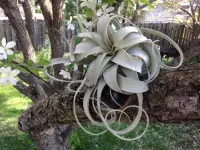
Inverted Drying Technique

After soaking, place the plant upside down on a towel or mesh rack for 1–2 hours so excess water drains from the inner leaf rosette, which significantly reduces the risk of trapped moisture and rot.

Calcium-Aware Placement

Keep plants away from constantly dripping hard tap water from shelves or overhead pipes, since repeated mineral deposits on leaves can clog trichomes and dull the plant’s natural silvery sheen.

Targeted Pest Monitoring

Inspect the tight leaf bases and inner rosette monthly with a flashlight for mealybugs or scale, and if found, remove with a cotton swab dipped in diluted isopropyl alcohol, keeping the plant dry afterward.

Seasonal Airflow Adjustment

Increase gentle air movement from a fan during humid or rainy seasons and reduce strong drafts in winter, which helps balance moisture loss and supports healthier growth when caring for Xerographica Air Plant.

Common Pests and Diseases

Mealybugs

This pest appears as small white cottony clusters tucked into leaf curls and at the base of the rosette. Symptoms include slowed growth, sticky honeydew, and sooty mold developing on affected areas.

Solution

Remove visible insects with a cotton swab dipped in 70% isopropyl alcohol, then rinse the plant thoroughly under lukewarm running water, keeping the plant inverted so water drains from the crown. Improve air movement and light, isolate the plant, and repeat alcohol spot-treatments weekly until no new clusters appear; this is a key step in Tillandsia xerographica care instructions.

Scale insects

These insects look like small tan or brown bumps attached firmly to the leaves, often along the midrib or in protected crevices. Symptoms include yellowing patches, weakened leaves, and sticky residue.

Solution

Gently scrape or lift off individual scale insects with a fingernail or soft brush, then wash the plant under a strong but gentle stream of water. Keep the plant in bright, airy conditions, avoid overfertilizing, and repeat mechanical removal every 7–10 days until new crawlers stop appearing.

Fungal crown rot

This disease starts in the central whorl where water collects, leading to soft, brown, or black tissue and a foul smell. Symptoms include leaves detaching easily at the base and rapid collapse of the rosette.

Solution

Immediately remove and discard all soft, dark, or foul-smelling tissue and any fully affected plants to prevent spread. To prevent recurrence, always dry the plant thoroughly after soaking or misting by placing it upside down, increase airflow and light, and avoid letting water sit in the crown for more than 2–3 hours.

Leaf spot fungi

This disease causes small, dark, water-soaked spots that may enlarge and turn tan or gray with a darker edge on the stiff leaves. Symptoms include scattered spotting on older leaves, especially in areas that stay wet or cramped.

Solution

Trim off heavily spotted leaves with clean scissors and dispose of them, then allow the plant to dry quickly after watering by providing strong air circulation. Reduce prolonged misting, avoid watering late in the day, and keep neighboring plants from touching to limit spread of spores.

Spider mites

These insects are tiny and often hard to see, but symptoms include fine webbing between leaf curls, dull or stippled leaf surfaces, and a general grayish cast to the plant. This pest thrives in warm, very dry indoor air with poor circulation.

Solution

Rinse the plant thoroughly under a firm stream of lukewarm water, paying attention to the inner curls and base, then let it dry quickly in bright, indirect light with good airflow. Increase ambient humidity slightly, avoid very dusty conditions, and repeat thorough rinsing every few days until no webbing or new damage appears.

Interesting Facts

Native dry-forest specialist

This species is native to seasonally dry tropical forests of southern Mexico, Guatemala, and El Salvador, where it grows as an epiphyte on tree branches exposed to strong light and long dry spells.

Structural leaf curling

Its characteristic rosette shape with tightly curling, silvery leaves results from thick, rigid leaf tissue and dense trichomes that reduce water loss and reflect intense sunlight.

Slow but long-lived

In habitat and in cultivation this air plant grows very slowly, often taking many years to reach its large, sculptural form, but individual specimens can live for a long time under stable conditions.

Botan icon

Did you know?

In the wild, very large, mature plants can produce a tall, long-lasting flower spike with many branched inflorescences that stay colorful for months and support successive waves of nectar-rich flowers visited by hummingbirds and other pollinators.

FAQs about Xerographica Air Plant

Brown tips usually result from low humidity, underwatering, or minerals and salts from hard tap water. Improve air humidity, use rainwater or filtered water, and ensure the plant dries fully within a few hours after soaking or misting.

Grow Healthy Plants with Botan Care

Keep your plants happy and healthy with plant identification, disease detection, and easy care guidance.

Botan plant care app — identify plants on mobile

Explore More Plants