Staking Heavy Umbels
Install sturdy stakes or a discreet wire ring early in the season so tall, flowering stems are supported before they become top‑heavy and prone to wind damage.

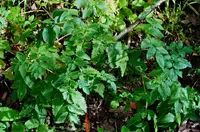
California angelica (Angelica californica) is a perennial herb in the carrot family, native to coastal hills and woodlands of California. It forms tall, upright clumps with hollow stems and divided, lance-shaped leaves.
Large, umbrella-like clusters of small white to creamy flowers appear above the foliage and attract many pollinators. The plant has a somewhat wild, meadow-like character and can spread gradually in suitable conditions.
It suits naturalistic or habitat-style plantings better than formal gardens, as it prefers sun to light shade, seasonally moist soils, and good drainage. Gardeners who care for California angelica should be comfortable with a plant that can look rangy and go summer-dormant in hotter, drier areas.

Care Difficulty
Moderate Care

Light Preference
Partial Shade

Water Requirements
Moderate Water

Temperature Preference
Cool Climate

Hardiness Zone
7–10

Soil Texture
Sandy, Loamy, Organic-rich

Soil pH
Acidic (5.5–6.5), Slightly acidic (6.5–7.0)

Soil Drainage
Moist but well-drained

Fertilization
Minimal (feed rarely)
Scan your plant to receive care tips personalized for your specific plant
Available on iOS and Android
This perennial prefers bright, cool conditions similar to open coastal or woodland edges.
This species prefers consistently moist but not saturated soil, especially during active growth.
This plant is adapted to mild, Mediterranean-type climates with cool, wet winters and dry, warm summers.
This species tolerates a wide humidity range and rarely needs special humidity management outdoors.
Angelica californica prefers deep, moist, well-drained, slightly acidic to neutral soil.
This species can be grown in containers, but large, deep pots are needed to accommodate its taproot and tall growth.
This coastal native generally needs little feeding in garden soils but benefits from light support in poor or sandy sites.
Pruning for Angelica californica is minimal and mainly focused on tidiness and seed control.
This species is usually grown in the ground; transplanting young plants is preferred over long-term container culture.
Propagation of Angelica californica is usually done from seed, with some care needed to get good germination.
This coastal perennial is moderately cold hardy in much of its native range and needs limited winter care in the ground.

Plant Health Check
Not sure what's wrong with your plant? Check your plant's health inside the app.
This species is native to California and is strongly associated with coastal scrub and chaparral habitats, particularly on north-facing slopes and canyon edges where soils stay a bit cooler and moister than surrounding areas.
The large umbrella-like flower clusters provide nectar and pollen for many native pollinators, especially small solitary bees, flies, and beneficial wasps, supporting coastal insect diversity during late spring and early summer.
Like other angelicas, it has aromatic, hollow stems, but in this species the combination of hollow stems and tall, branching flowering stalks makes an effective perch and landing platform for visiting insects in its natural range.
Lack of flowering often comes from insufficient light, young plant age, or nutrient imbalance. Overfertilizing with high nitrogen encourages foliage instead of umbels. Ensure stable moisture, avoid heavy pruning of new shoots, and allow 2–3 seasons to mature.
Keep your plants happy and healthy with plant identification, disease detection, and easy care guidance.