Rhizome division timing
Divide clumps every 3–4 years in late summer after flowering to maintain vigor, and replant only firm, healthy rhizomes at the same depth they were growing before.

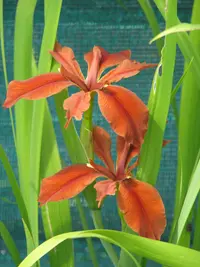
Copper iris, Iris fulva, is a rhizomatous perennial native to wetlands and stream margins in the central and southern United States. It forms fans of narrow, sword-like leaves and sends up sturdy stems topped with drooping, copper-red flowers. The flowers have a distinct tubular base and flaring falls, giving a graceful, slightly wild look in garden plantings. This species prefers consistently moist to wet soil and full sun to light shade, which makes it well suited to rain gardens and pond edges. Once established in suitable conditions, it is relatively durable, so learning how to care for copper iris mainly means matching its natural love of moisture and sun.

Care Difficulty
Moderate Care

Light Preference
Full Sun

Water Requirements
Aquatic

Temperature Preference
Cold Hardy

Hardiness Zone
5–9

Soil Texture
Loamy, Clay, Organic-rich

Soil pH
Acidic (5.5–6.5), Slightly acidic (6.5–7.0)

Soil Drainage
Waterlogged tolerant

Fertilization
Minimal (feed rarely)
Scan your plant to receive care tips personalized for your specific plant
Available on iOS and Android
Iris fulva thrives in full sun but tolerates light shade, especially in hotter climates.
This wetland iris prefers consistently moist to saturated conditions rather than cyclical drying.
This species is a hardy wetland plant that tolerates a wide temperature range when roots stay moist.
This wetland iris prefers consistently high humidity similar to its native swamp habitats.
This species thrives in heavy, moisture-retentive soils that stay saturated without becoming anaerobic for long periods.
This iris can be grown successfully in containers, especially for water gardens or patio ponds.
This native iris needs modest feeding when grown in garden soil but benefits from light nutrition in lean or container conditions.
Pruning Iris fulva is mainly about hygiene and keeping clumps tidy rather than shaping.
This species is usually grown in the ground, so transplanting and dividing clumps is more common than repotting.
Propagation of this iris is commonly done by division, with seed used mainly for breeding or larger-scale projects.
Established plants are fairly cold hardy in much of the US and usually need only modest winter care in the ground.

Plant Health Check
Not sure what's wrong with your plant? Check your plant's health inside the app.
This species has unusually coppery to brick-red flowers for a beardless iris, a color produced by a mix of anthocyanin pigments that helps distinguish it from the more common blue and yellow relatives in its native range.
Its long, narrow floral tubes and horizontal flower orientation are adapted for pollination mainly by hummingbirds, which access nectar while dusting their heads with pollen on the style arms.
In the lower Mississippi Valley it naturally hybridizes with other Louisiana irises such as Iris brevicaulis and Iris hexagona, contributing genetic material that has been widely used in modern Louisiana iris breeding.

Iris fulva is native to swampy floodplains and bayous of the lower Mississippi River basin and has been used as an indicator species for intact wetland habitats because it tends to disappear when drainage, levee construction, or heavy disturbance alters its natural flooding regime.
Lack of flowering often comes from insufficient sun, overcrowded rhizomes, or nutrient-poor soil. Divide clumps every 3–4 years and maintain consistent moisture. Good site selection is the foundation of successful Iris fulva care.
Keep your plants happy and healthy with plant identification, disease detection, and easy care guidance.