Mushroom Identification by Picture

Identify Mushrooms With a Single Tap

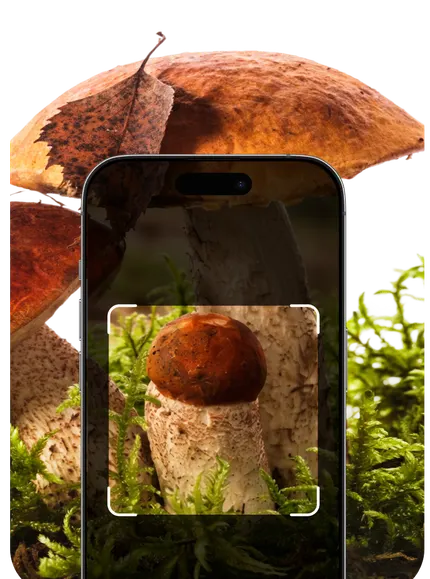
Mushroom identification is made simple with Botan. With our app, you can learn a mushroom's name, toxicity level, and cultivation tips in 1-3 seconds.


Mushroom Identification by Picture – Hero Mobile
Scan result image
Leccinum aurantiacumMATCH: 99%

Identify Mushrooms Online

Plant Identifier Online for Free

Use easy-to-see images for the best plant ID results. Try not to take photos from very far away.
Disclaimer: Botan is a fungi-identifying assistant. Despite its efficiency, it can’t fully substitute for expert mycological advice. Never eat mushrooms based solely on app identification.

How to Identify Mushrooms Using App

With Botan, mushroom identification by photo is simple and nearly instant. Though the process takes only 1-3 seconds, it includes a few underlying stages: 

  1. You take a photo in the Botan app or upload from your device. 
  2. The system processes the picture. 
  3. The image is compared to 30,000+ species in our database. 
  4. Specialized AI analyzes the features to ensure accurate ID results. 
  5. You learn its name, habitat, toxicity status, and cultivation tips.
  6. If the results are unclear, you can retry with a new photo. 

So, if you’re asking yourself, “What kind of mushroom is this?” just take a single snap — it’s enough to identify it.

Let’s say you already know the species and are cultivating edible fungi. In this case, you can still use our mushroom scanner to get care, environmental, and disease-treatment tips. 

Some Features That Help Identify Mushrooms

It’s considered that there are around 14,000 mushroom species, and only about 300 are edible. A lot of them (both edible and toxic) look very similar. Still, there are specific features that can be used to identify mushrooms and distinguish most look-alikes. 

These include cap shapes, underside features, stems, habitat, and growth patterns. Let’s see how those features and characteristics can help narrow the search and identify the correct group or exact species. 

Cap Shapes and Forms

In mycology, there are 15 mushroom shapes. We’ll focus on the six most common types, so you can easily ID mushroom species around you. 

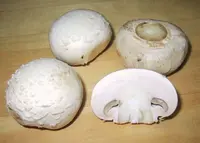
  • Convex — looks like a smooth dome. This shape is frequently seen in young fungi. It’s also clearly visible in some mature species, e.g., porcini, button mushrooms, fly agaric, and slippery jacks. 
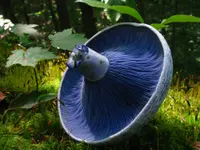
  • Funnel (bowl-shaped/depressed) — a cap with higher edges and a depressed center. It’s the signature feature for Clitocybe mushrooms (also known as “funnels”, e.g., snowmelt clitocybe, frosty funnel), chanterelles, and some mature milk cap species. 
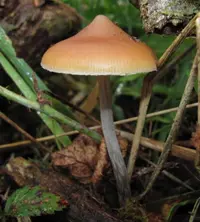
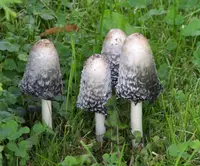
  • Conical (cone-shaped) — triangular and sharply pointed. This shape is common in morels, ink caps, and bonnet mushrooms. 
  • Flat (plane) — fully expanded, nearly level cap. This shape is often transitional — many species pass through this stage as they develop from a young, convex cap to a mature, funnel-shaped cap. Still, it’s seen in mature groups and species, e.g., cavaliers, knight mushrooms, and oyster mushrooms. 
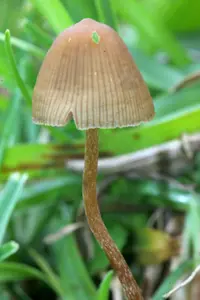
  • Bell-shaped (campanulate) — rounded top that doesn’t expand at the edges. Bell-like caps are often found in funeral bells, mottlegills, and some mature bonnet species. 
  • Umbonate (knobbed) — caps with a distinct knob in the center. It’s seen in many cavalier species, dapperlings, and humpback mushrooms. 

Note that cap shape can help narrow down species ID, but it is never a reliable indicator of toxicity or edibility.

Underside Types & Features 

It’s not only about the shape. Underside features are also very helpful for identification. Here are the main types of surfaces you are most likely to come across: 

  • Gills — thin, blade-like plates. First, pay attention to gill attachment. For example, free gills (that don’t connect to the stem) are common in button mushrooms and Amanita species, while adnate (gills meet the stem squarely) are frequently seen in webcaps. Also, consider gill spacing, width, and edge texture. 
  • Pores — a spongy surface with tiny openings. This is the strongest feature to distinguish boletes from all gilled mushrooms. Consider the color first, especially the change in color when bruising. Many edible boletes bruise blue within a few minutes, but never rely on this fact alone. 
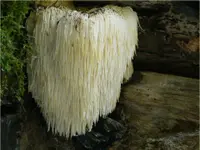
  • Teeth — soft, hanging pointed “icicles”. This distinctive pattern is clearly visible in many hedgehog mushrooms, lion’s mane, bear’s head fungi, and some leathery earthfans. 
  • Ridges — blunt, vein-like structures. They may look like gills, but unlike gills, they can’t be separated from the cap without causing serious damage. Ridges are the most common in chanterelles. 
  • Smooth — pore-less, flat or slightly wrinkled underside. Such a surface is found in crust and parchment fungi, as well as in species like the smooth chanterelle. 

Look at the structure and color first, but keep in mind that the underside's overall appearance will largely depend on the mushroom’s age. 

Stipe Structure

Stipe (stem) features are less variable than cap shapes, so they can significantly help narrow down the search. Key characteristics to consider are: 

  • Presence of a ring. This is a visible ring that looks like a small skirt on the stem. It’s common in many Agaricus species (e.g., button, field mushrooms), multiple Amanita species (e.g., fly agaric), and parasol mushrooms. 
  • Presence of volva. Volva is a cup-like structure at the very base of the stem. Present in many Amanita species (they often have both ring and volva), straw mushrooms, and species like stubble rosegill. 
  • Overall shape. It can be straight and equal, like in white button mushrooms, bulbous (stem swelling at the bottom) like in the destroying angel, or tapered (gradually narrowing at the bottom) like in funnel caps. Also, fungi can be club-shaped, as seen in porcini.
  • Thickness. Thickness should be evaluated relative to the cap size. A thin stem often indicates gilled and forest fungi, such as bonnets. Thick, strongly supporting one is common in long-lived fungi with heavy caps, like porcini.  

Also, consider the stipe texture — smooth, fibrous, scaly, velvety, or net-like. It’s not the primary identification factor, but it can help reduce uncertainty and narrow the search. 

Habitat and Growth Pattern

Even the location of the fungus can tell you a lot. Just pay special attention to the following: 

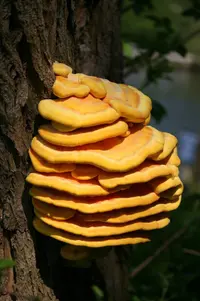
  • Substrate. Growing on soil can be either Mycorrhizal fungi (root mushrooms growing near trees) or Saprotrophs (decomposers breaking down dead material, including dead wood and leaf litter). Fungi growing on living trees are parasites or weak parasites (often bracket fungi, honey fungi). Some grow on dung (e.g., magic mushrooms, mottlegills, ink caps). 
  • Specific tree associations. Some trees are associated with multiple groups — for example, you can see many boletes, amanitas, and brittlegills near oaks. If it’s birch, the fungus is most likely to be a bolete (birch, orange) or sometimes a milk cap. If it’s one of the pine trees, there’ll be slimy boletes. If it’s aspen or poplar, it can be poplar or oyster mushrooms. 
  • Season. In early spring, you can see morels and some early wood decomposers. In late spring, the first boletes and field mushrooms can appear. In summer, most chanterelles, pine bolettes, and ink caps appear. Autumn is the peak season for most species. Winter is for cold-tolerant species, such as velvet shank or oyster mushroom. 
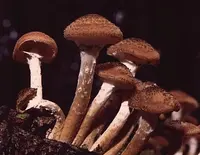
  • Growth patterns. See if the fungus grows separately. This often includes soil-based species such as boletes. If it’s clustered (multiple mushrooms growing from one point), these are likely wood-based fungi like oysters and honey fungus. If multiple fungi form an arc, these can be fairy rings or field mushrooms. 

Don’t look only at the mushroom — consider what surrounds it. 

Typical Mistakes in Mushroom Identification

It’s easy to identify mushrooms by photo with the Botan detector. If you do it yourself, it will be a more complex journey, so mistakes are possible. Consider these common pitfalls to avoid them with ease: 

  • Mistake #1: Not considering the age. Try to identify if the mushroom is young or mature. This is crucial. For example, brittlegills often go from a convex cap shape to a flat shape and finally to a slightly depressed shape at different growth stages. 
  • Mistake #2: Looking at the cap only. It’s distinctive, but can be misleading if you don’t consider other features: stem, location, season, texture, etc.
  • Mistake #3: Relying on random photos on the web. There are a lot of look-alikes. If you see a photo of a similar fungus, it’s not enough to conclude you’ve found the right species. 
  • Mistake #4: Relying on size as a valid ID criterion. It changes a lot depending on the weather and other conditions. Often, the more moisture, the bigger the fungi. 
  • Mistake #5: Not considering the missing features. Sometimes, people overlook things because they ignore the absence of certain features, such as a volva, a ring, or a change in underside/spore color. This can narrow the search a lot. 

In general, the biggest mistake is thinking that the ID can be quick and a one-step process. It’s important to consider all the features step by step to reach the right conclusion. 

Mushroom Identification Made Easier with Botan

Fungal identification can seem complex. After all, among tens of thousands of species, there are many fungi that look similar. Often, these are edible and poisonous look-alikes. 

Many factors must be considered for more accurate results. The Botan mushroom identification app offers exactly that: 

Feature

Manual Identification

Botan Identification

Effort level 

Requires deep research at every stage

Takes only two taps 

Speed 

Requires hours or even days

Very high, takes 1-3 seconds

Accuracy 

Not guaranteed, without deep research

High, up to 98% 

Safety

High chance of misidentification of toxicity level

High, helps reduce risks due to advanced technology

Conclusion-making

One relies on their perception & analysis only

Additional expert consultation via live chat is available

FAQ

Yes, it’s possible. Though Botan shows 98% accuracy in plant recognition, mistakes can still occur. Use the app as an informational and educational tool — don’t fully rely on it if you consider eating wild species.