Use host trees
Establish beds near compatible deciduous trees such as ash, elm, or apple, using a ring of woody compost and leaf litter around the dripline to encourage the fungus to form long-term mycorrhizal associations with the roots.

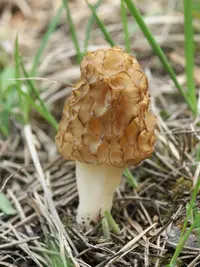
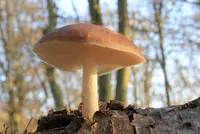
Yellow morel, Morchella esculenta, is a spring-fruiting fungus valued for its distinctive honeycomb cap and rich flavor. It is not a leafy plant but a mushroom-producing organism that lives in soil and decaying organic matter.
In nature it occurs across temperate regions, often in mixed woodlands, old orchards, and recently disturbed or burned sites. It can be challenging to cultivate because it relies on complex relationships with tree roots and specific soil conditions.
Those who care for Yellow Morel usually focus on recreating cool, moist, well-drained woodland conditions with rich organic material and light shade. Its difficulty lies in the need for the right habitat rather than daily maintenance.

Care Difficulty
Hard Care

Light Preference
Partial Shade

Water Requirements
Keep Soil Moist

Temperature Preference
Cool Climate

Hardiness Zone
4–8

Soil Texture
Loamy, Silty, Organic-rich

Soil pH
Slightly acidic (6.5–7.0)

Soil Drainage
Moist but well-drained

Fertilization
Minimal (feed rarely)
Scan your plant to receive care tips personalized for your specific plant
Available on iOS and Android
Morchella esculenta needs cool, filtered light that mimics an open woodland edge.
This fungus requires evenly moist, not waterlogged, soil to form reliable morel flushes.
This species fruits best in cool spring temperatures after a period of winter chill.
Morchella esculenta requires consistently moist, humid conditions during fruiting, as it is highly sensitive to drying out.
Morchella esculenta depends on loose, humus-rich ground that drains freely yet holds consistent moisture.
This species is generally unsuitable for long-term container growing, as it relies on complex soil and root associations in the ground.
Morchella esculenta is usually foraged from nutrient-rich woodland soils and needs minimal added fertilizer in cultivation.
Morchella esculenta does not require structural pruning because it is a fungus, but harvest hygiene matters.
Morel cultivation focuses on managing outdoor beds rather than traditional repotting.
Propagation of Morchella esculenta is specialized and usually done using spawn rather than simple garden techniques.
Established Morchella esculenta beds in temperate climates are generally cold hardy and need only basic winter attention.

Plant Health Check
Not sure what's wrong with your plant? Check your plant's health inside the app.
Yellow morels often fruit abundantly in the first spring after low- to moderate-intensity forest fires or controlled burns, taking advantage of altered soil chemistry and reduced competition.
The cap shows a distinctive honeycomb pattern of deep pits and ridges whose geometry greatly increases surface area, improving spore dispersal efficiency in moving air.
Unlike many other cup fungi with multi-layered fruiting bodies, the morel’s hollow, single-chambered structure runs from cap tip through the stem, an easy field trait that helps distinguish it from some toxic false morels.

Genetic studies show that what mushroom hunters long treated as a single widespread “yellow morel” actually represents a complex of several closely related lineages, meaning populations that look nearly identical in different regions can belong to distinct evolutionary groups.
This species is considered a choice edible mushroom when fully cooked. Raw or undercooked fruiting bodies can cause digestive upset. Always confirm identification with an expert, avoid polluted sites, and cook thoroughly before eating.
Keep your plants happy and healthy with plant identification, disease detection, and easy care guidance.